

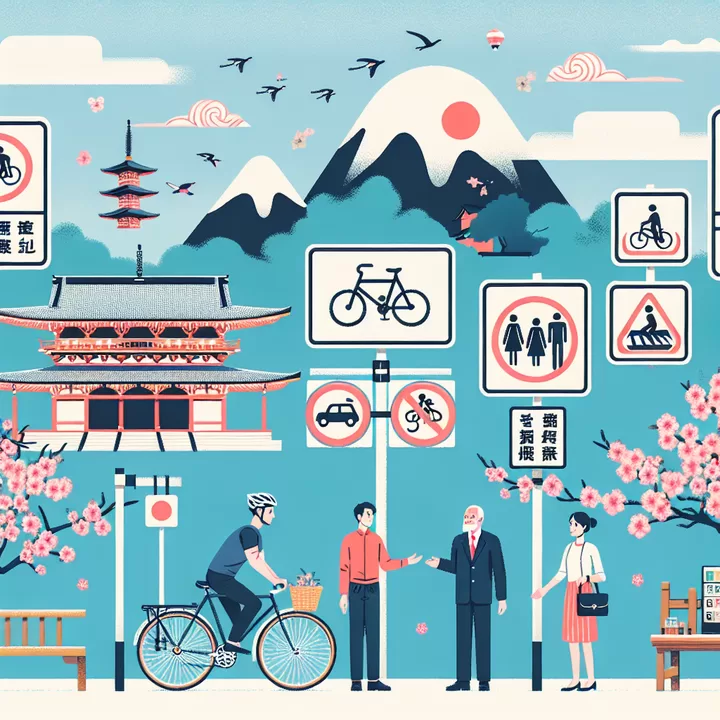
Master Japan’s Road Rules: Your Guide to Safe Cycling & Walking 🇯🇵🚶♀️🚴♂️
Hello future residents of Japan! Konnichiwa! 👋 As your language teacher, I know how excited you are to experience life in Japan. From exploring bustling city streets to cycling through serene neighborhoods, understanding the local way of life is key to a smooth and enjoyable transition. And guess what? This includes mastering Japan’s road rules, especially when you’re walking or cycling! It might seem like a small detail, but these rules are super important for your safety and for seamlessly fitting into Japanese society.
Living in Japan, you’ll find that many people rely on walking and cycling for their daily commute and errands. It’s a fantastic way to stay healthy, save money, and truly immerse yourself in your surroundings. However, road rules in Japan might be a bit different from what you’re used to in the Philippines. But don’t worry, we’re here to guide you every step of the way! Let’s dive in and make sure you’re confident and safe on Japanese roads.
💡 Teacher’s Tip:
Remember, safety is always the priority. Japanese people value order and consideration for others, and this is clearly reflected in their traffic rules. Embracing these rules isn’t just about avoiding trouble; it’s about showing respect for the community!
Walking in Japan: Your Feet Are Your Best Friends! 🚶♂️
Walking is a big part of daily life in Japan, whether it’s to the nearest train station, a convenience store, or simply enjoying a stroll. While walking might seem straightforward, there are a few key rules and cultural norms to keep in mind.
1. Stick to the Left (When Walking on the Road)
Unlike the Philippines where traffic drives on the right, Japan drives on the left. This means when you are walking on sidewalks, you generally walk on the left side, especially if it’s a busy area. If there’s no sidewalk, you should walk on the right side of the road, facing oncoming traffic. This allows you to see vehicles coming towards you and react quickly if needed.
-
右側通行 (Migigawa Tsūkō):
This means “right-hand traffic for pedestrians” when there’s no sidewalk. Keep this phrase in mind!
-
歩道 (Hodō):
This is the “sidewalk.” When on a sidewalk, generally keep to the left or simply flow with the crowd.
2. Mastering Pedestrian Crossings and Traffic Lights 🚦
This is crucial! Japanese drivers are generally very observant of pedestrian signals. You must also be just as observant. Crossing the road when the light is red, known as 「信号無視」(shingō mushi – ignoring traffic lights), is not only dangerous but also a violation that can result in a fine. Always wait for the green light, even if there are no cars coming. This is a matter of safety and respect for the rules.
-
横断歩道 (Ōdanhodō):
This is a “pedestrian crossing.” Always use these designated areas.
-
信号 (Shingō):
The “traffic light.” Red means 赤 (aka) – STOP, Green means 青 (ao) – GO.
⚠️ Common Mistake Alert for Filipinos:
In the Philippines, “jaywalking” or crossing roads where there’s no designated crossing or when the light is red, is unfortunately common. In Japan, this is a strict no-no! Japanese police enforce this, and more importantly, it’s unsafe. Always be patient and wait for your turn at traffic lights.
3. Be Mindful of Others and Your Surroundings
Japanese culture emphasizes consideration for others. When walking:
-
Avoid blocking the path:
Don’t stop in the middle of a busy sidewalk. If you need to check your map or wait for someone, step to the side.
-
Keep noise down:
While this applies more to public transport, be mindful of loud conversations when walking in residential areas.
-
Look out for cyclists:
Many sidewalks are shared with bicycles (more on that next!). Be aware of bikes approaching from behind or front.
Cycling in Japan: Your Ticket to Exploration! 🚴♀️
Cycling is incredibly popular in Japan. It’s affordable, environmentally friendly, and offers a wonderful sense of freedom. However, bicycles are considered light vehicles and must follow specific road rules. This is where many Filipino learners need to pay close attention, as the rules are often different from home.
1. Left-Hand Traffic for Bicycles! 👈
This is perhaps the most important rule to remember and a common point of confusion. Just like cars, bicycles in Japan must always ride on the left side of the road. If there’s a dedicated bicycle lane, use it. If not, ride close to the left edge of the road. Riding on the right side of the road (against traffic) is extremely dangerous and illegal.
💡 Teacher’s Tip:
Many Filipino learners are used to cycling on sidewalks or the right side of the road in the Philippines. In Japan, always remind yourself: “Left is right!” (Meaning, the left side is the correct side to ride on!) This mental trick can help you adapt.
2. Bicycle Lights and Brakes are a Must! 💡
Your bicycle must be equipped with a functional front light and a rear reflector (or rear light) for nighttime riding. Using your light at night is mandatory, not optional! Also, ensure both your front and rear brakes are working perfectly. Japanese police regularly conduct checks, and a malfunctioning bike or not using lights can lead to a fine.
-
ライト (Raito):
“Light.” Make sure it’s on at night!
-
ブレーキ (Bureeki):
“Brake.” Check them before every ride.
3. No “Dangerous” Riding Behaviors 🚫
Japan has strict rules against behaviors that could lead to accidents:
-
No riding with an umbrella:
It impairs your balance and control. Invest in a rain poncho or a rain cover for your bike.
-
No riding while holding a phone:
Similar to driving a car, using your phone while cycling is strictly prohibited and dangerous.
-
No riding with headphones/earphones:
You need to be able to hear your surroundings (traffic, horns, warnings). It’s incredibly unsafe to block out ambient sounds.
-
No tandem riding (二人乗り – futari nori):
Unless it’s a specific bicycle designed for two (like a tandem bike), you cannot carry another person on your bicycle, except for children under 6 years old in a child seat.
-
No cycling under the influence of alcohol:
This is treated as seriously as drunk driving and carries heavy penalties.
4. Sidewalk Cycling: When is it Allowed?
While bicycles are generally meant for the road, there are specific situations where cycling on the sidewalk is allowed:
-
Designated sidewalks:
Some sidewalks have specific markings or signs indicating that bicycles are allowed to share them. Even then, you must prioritize pedestrians and slow down significantly.
-
Road conditions:
If the road is extremely dangerous for cycling (e.g., heavy traffic, construction), you may ride on the sidewalk cautiously.
However, when cycling on sidewalks, you must yield to pedestrians and ride at a very slow speed (徐行 – jokō – slow speed). If you encounter pedestrians, you are generally expected to stop or dismount and walk your bike.
Quick Comparison: PH vs. JP Road Rules (Walking & Cycling)
| Aspect | Philippines (General) | Japan (Strict Rule) |
|---|---|---|
| Traffic Side | Right-hand drive | Left-hand drive |
| Pedestrian Crossing | Often flexible; jaywalking common | Strictly adhere to signals and crossings |
| Bicycle Riding Side | Often right-hand or sidewalk | Always left-hand side of the road |
| Cycling on Sidewalk | Common | Restricted; yield to pedestrians |
| Accessories while Cycling | Varies; often lax | No phone, umbrella, headphones allowed |
| Drunk Cycling | Less enforced | Highly illegal; severe penalties |
Other Important Tips and Phrases for Road Safety 🗣️
💡 Teacher’s Insight:
Beyond rules, politeness is key! A quick 「すみません」 (Sumimasen – excuse me/sorry) if you accidentally inconvenience someone, or a simple nod of thanks, goes a long way in navigating Japanese public spaces gracefully.
1. Parking Your Bicycle 🅿️
Never park your bicycle just anywhere. Japan has designated bicycle parking areas, often called 駐輪場 (chūrinjō), especially near train stations, shopping centers, and apartment buildings. Illegally parked bicycles are often impounded, and retrieving them can be costly and time-consuming. Always look for signs or designated spaces.
2. Common Road Signs to Recognize
While you don’t need to memorize every sign, knowing a few basic ones will help you understand the road environment.
| Sign Description | Meaning | Japanese Term |
|---|---|---|
| Red circle with a white bar | No Entry | 進入禁止 (Shin’nyū Kinshi) |
| Blue circle with white bicycle icon | Bicycles Only / Bicycle Lane | 自転車専用 (Jitensha Sen’yō) |
| Blue circle with walking person icon | Pedestrian Only | 歩行者専用 (Hokōsha Sen’yō) |
| Red diagonal line over an object | Prohibition (e.g., No Parking, No Standing) | 禁止 (Kinshi) |
3. What to Do in Case of a Minor Incident
Even if you’re careful, minor incidents can happen. If you’re involved in a small accident (e.g., a slight collision while cycling):
-
Stay calm and say 「すみません」 (Sumimasen):
This means “excuse me” or “I’m sorry.” It’s a standard polite response in Japan, not necessarily an admission of guilt.
-
Check for injuries:
Ensure everyone involved is okay. If there are injuries, call for an ambulance immediately: 119 (kyūkyū).
-
Exchange contact information:
Politely ask for the other person’s name and phone number. If you have a Japanese phone, exchange numbers. If not, perhaps your school or a Japanese friend can help facilitate. Do not move the vehicles or people involved until the police arrive if it’s a significant incident. For minor bumps, a polite exchange is often sufficient.
⚠️ Remember:
Always err on the side of caution. If you are unsure about a rule or situation, observe what others do, or ask for clarification from a Japanese speaker or your school staff. It’s always better to be safe and polite!
Your Journey to a Safe and Fulfilling Life in Japan! 🎉
Learning Japan’s road rules for walking and cycling is an essential step towards truly feeling at home in Japan. It’s not just about avoiding fines or accidents; it’s about respecting the orderly flow of society and ensuring everyone’s safety.
I know it might seem like a lot to remember at first, especially adapting to the left-hand traffic rule. But with a little practice and mindful observation, these rules will quickly become second nature to you. Think of it as another exciting part of your Japanese language and cultural learning journey! Every time you safely navigate a busy intersection or smoothly ride your bike to the store, you’ll feel a sense of accomplishment and independence.
Embrace these rules with confidence and a positive attitude. Your dedication to learning and adapting will not only keep you safe but also earn you the respect of the local community. You’ve got this, future Japan explorers! Keep learning, keep practicing, and keep moving forward towards your dreams in Japan. We are here to support you every step of the way!
Contact & Follow Us
お問い合わせ
📞 電話: +63 997 093 4550
📧 メール: samuraijapan.bc@gmail.com
🏠 住所: Room D3, Freb Bldg, Villa Donata Subd, Muntinlupa
🏢 会社名: SAMURAI Japan Business Center Inc.
SNSでフォロー
🎵 Tiktok: @samuraijapan0221
📸 Instagram: @samuraijapan.bc
▶️ Youtube: @SamuraiJapan-bc
📘 Facebook: Visit our Page

Leave a Reply