

Teacher’s Secret: Connecting in Japan’s Work & Daily Life ✨
Konnichiwa, future residents of Japan! 🇯🇵 Are you dreaming of a fulfilling life in the Land of the Rising Sun? Whether it’s the bustling city life or the serene countryside that calls to you, one of the most rewarding aspects of living in Japan is building genuine connections. As your language teacher, I know that mastering grammar and vocabulary is important, but truly connecting with Japanese people in their daily lives and workplaces requires understanding their unique communication style. It’s like unlocking a secret level in your Japan journey! This article will be your comprehensive guide to fostering meaningful relationships, making your transition smoother and your life richer. Let’s dive in!
The Heart of Connection: Understanding Japanese Communication Styles 🤝
When you first arrive in Japan, you might notice that communication isn’t always direct. Unlike in some Western cultures, where being very direct is common, Japanese communication often prioritizes harmony and context. This concept is often linked to `Kuuki o yomu` (空気を読む), which literally means “reading the air” – understanding the unspoken mood or intentions.
💡 Teacher’s Tip:
For Filipinos, who are generally very expressive, adapting to indirect communication can be a learning curve. Don’t worry! Start by observing. Pay attention to body language, tone, and the situation. Sometimes, silence or a vague answer can convey more than words.
Another crucial concept is `Honne` (本音) and `Tatemae` (建前).
* Honne (本音): A person’s true feelings and desires.
* Tatemae (建前): The behavior and opinions one displays in public, often to maintain harmony and social expectations.
Understanding this duality is key to navigating social interactions. While people might express `Tatemae` in public, building trust can gradually reveal `Honne`.
⚠️ Common Mistake Alert:
One common pitfall is expecting direct “yes” or “no” answers all the time. A Japanese person might say “それはちょっと難しいですね” (Sore wa chotto muzukashii desu ne – That might be a bit difficult) when they actually mean “no.” Learn to interpret these softer rejections!
Daily Life Connections: Building Bonds Beyond the Workplace 🏡
Connecting with people in your daily life, like neighbors, shopkeepers, or community members, is incredibly fulfilling. These interactions form the fabric of your life in Japan. Start with simple greetings and politeness.
Essential Daily Greetings & Phrases for Connection
| Japanese Phrase | Romaji | English Meaning | Usage Context |
|---|---|---|---|
| おはようございます | Oha-yō gozai-masu | Good morning | To neighbors, colleagues, shop staff in the morning. |
| こんにちは | Kon-nichi-wa | Good afternoon/Hello | General daytime greeting. |
| こんばんは | Kon-ban-wa | Good evening | General evening greeting. |
| ありがとうございます | Ari-gatō gozai-masu | Thank you very much | Show gratitude for any help or service. |
| すみません | Sumi-masen | Excuse me / Sorry | Catch attention, apologize, or say thank you (for a favor). |
| お願いします | Onegai shi-masu | Please / I humbly ask | When requesting something or introducing yourself. |
Beyond these basics, actively participating in your local community can deepen connections. Even simple gestures like:
* **Saying hello to your neighbors:** A simple 「こんにちは!」 (Kon’nichiwa!) and a slight nod can go a long way.
* **Participating in local events:** Look for local festivals (`omatsuri`), cleaning days (`ōsoji`), or community meetings. Even if your Japanese isn’t perfect, showing up and trying to engage is appreciated.
* **Bringing `omiyage`:** If you visit your home country or another region of Japan, bringing small souvenirs (`omiyage`) for neighbors or colleagues is a thoughtful gesture that shows you’re thinking of them.
These small efforts demonstrate your respect for Japanese culture and your willingness to integrate, which are highly valued.
Connecting at Work: Navigating Professional Relationships 🧑💼
The Japanese workplace has its own set of unwritten rules and communication norms. Building strong professional relationships is crucial for a smooth and productive experience.
One of the most important concepts is `Hōrensō` (報連相). This stands for:
* Hōkoku (報告 – Report): Regularly report on your progress and results.
* Renraku (連絡 – Communicate/Inform): Immediately inform others of any issues, changes, or new information.
* Sōdan (相談 – Consult/Discuss): Consult with your superiors or colleagues if you encounter problems or need advice.
This constant flow of communication ensures everyone is on the same page and potential issues are addressed early.
Key Business Phrases for the Workplace
| Japanese Phrase | Romaji | English Meaning | Usage Context |
|---|---|---|---|
| お疲れ様です | Otsukare-sama desu | You must be tired / Good work / Thank you for your hard work | Versatile greeting, used when leaving, arriving, or acknowledging someone’s effort. |
| 失礼します | Shitsurei shi-masu | Excuse me / Sorry to disturb you / I’m leaving | When entering/leaving an office/room, or ending a call. |
| お先に失礼します | Osaki ni shitsurei shi-masu | Excuse me for leaving ahead of you | When leaving the office before others. |
| 恐れ入ります | Osore-iri-masu | I’m sorry to trouble you / Thank you (humbly) | When asking for a favor, receiving something, or acknowledging kindness. |
| かしこまりました | Kashikomarimashita | Certainly / Understood (polite) | To acknowledge an order or instruction from a superior. |
💡 Teacher’s Tip:
Don’t be afraid to use these phrases even if your Japanese is still developing. Japanese people appreciate the effort to communicate respectfully. It shows you are serious about fitting in and learning!
Beyond Words: Non-Verbal Cues and Cultural Nuances ✨
Communication isn’t just about the words we speak. In Japan, non-verbal cues carry significant weight.
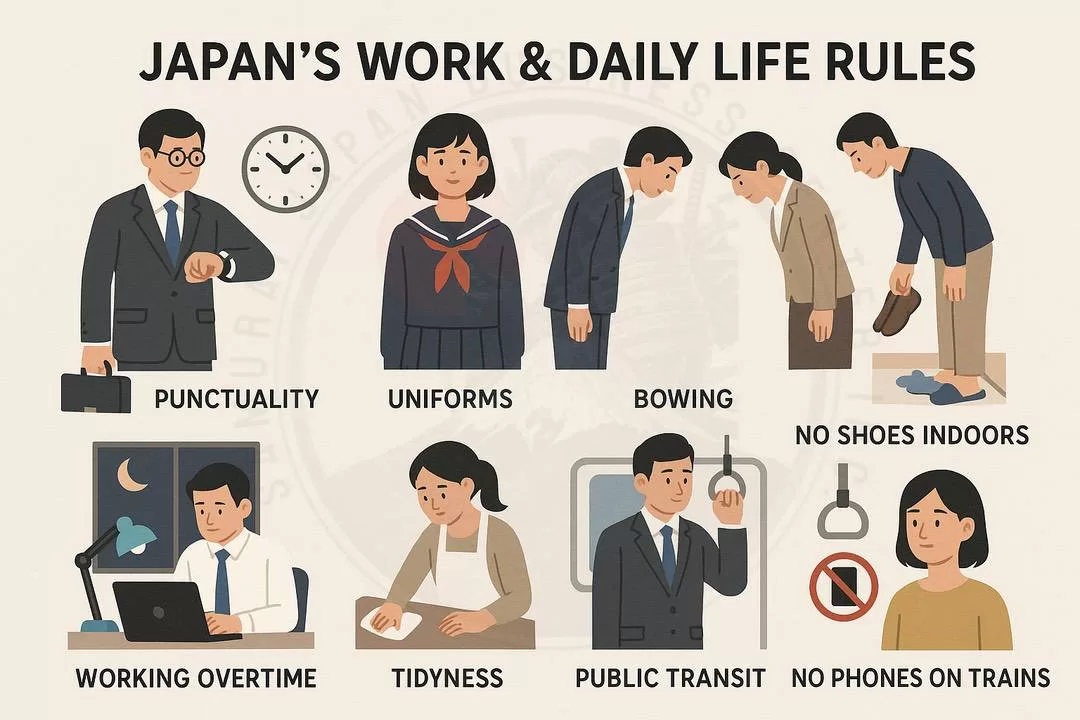
* **Bowing (お辞儀 – Ojigi):** This is a fundamental part of Japanese etiquette. The depth and duration of a bow convey different meanings – from a casual nod to a deep expression of apology or respect. Observe and mirror those around you, starting with a polite 15-30 degree bow for general greetings.
* **Eye Contact:** Unlike some cultures where direct eye contact signifies honesty, prolonged direct eye contact in Japan can sometimes be perceived as aggressive or disrespectful, especially with superiors. Aim for more indirect or softer eye contact.
* **Silence:** Silence is often comfortable in Japanese conversations and can convey thoughtfulness, agreement, or even disapproval. Don’t feel pressured to fill every silence.
* **`Tsukiai` (付き合い – Socializing):** After-work gatherings, like going for drinks (`nomikai`), are an important part of building team cohesion and personal relationships. While not mandatory, participating occasionally can help you connect with colleagues on a more personal level.
🌸 Cultural Insight:
Gift-giving, particularly omiyage (souvenirs from a trip) or temiyage (gifts when visiting someone’s home), is deeply ingrained in Japanese culture. It’s not just about the gift itself but the gesture of appreciation and thoughtfulness. It’s a powerful way to strengthen bonds!
Overcoming Challenges & Sustaining Connections 💪
It’s natural to face challenges when adjusting to a new culture and language. You might encounter misunderstandings or feel shy about speaking up. Remember, every Japanese person you meet knows you’re a foreigner, and most are incredibly understanding and patient.
* **Don’t Fear Mistakes:** Mistakes are part of learning! Japanese people often appreciate the effort of non-native speakers. If you make a mistake, apologize with 「ごめんなさい」(Gomen’nasai) or 「すみません」(Sumimasen) and try again.
* **Ask for Clarification:** If you don’t understand something, it’s perfectly fine to ask. You can say 「もう一度お願いします」(Mō ichido onegaishimasu – One more time, please) or 「ゆっくり話してください」(Yukkuri hanashite kudasai – Please speak slowly).
* **Be a Good Listener:** Active listening shows respect. Nodding (`un` or `hai`), making eye contact (as appropriate), and offering brief affirmations will show you’re engaged.
* **Show Genuine Interest:** Ask questions about their culture, hobbies, or daily life. People love to talk about themselves and their country. This curiosity is a great bridge to connection.
* **Consistency is Key:** Building relationships takes time and consistent effort. Keep practicing your Japanese, keep participating, and keep an open mind. Each interaction, no matter how small, adds to your network of connections.
⚠️ Remember:
Language is a tool, but empathy and effort are the keys to connection. You might not always have the perfect grammar, but showing you care about understanding and respecting their ways will open many doors.
Building connections in Japan, both in your daily life and at work, is a journey of continuous learning and growth. It’s about adapting, observing, and putting yourself out there, even when it feels a little challenging. Each person you connect with becomes a part of your unique story in Japan, enriching your experience in ways you can’t imagine. Keep learning, keep trying, and keep embracing the incredible adventure that awaits you! You’ve got this, future Japan residents! Ganbatte! 🎉
Contact & Follow Us
お問い合わせ
📞 電話: +63 997 093 4550
📧 メール: samuraijapan.bc@gmail.com
🏠 住所: Room D3, Freb Bldg, Villa Donata Subd, Muntinlupa
🏢 会社名: SAMURAI Japan Business Center Inc.
SNSでフォロー
🎵 Tiktok: @samuraijapan0221
📸 Instagram: @samuraijapan.bc
▶️ Youtube: @SamuraiJapan-bc
📘 Facebook: Visit our Page

Leave a Reply