

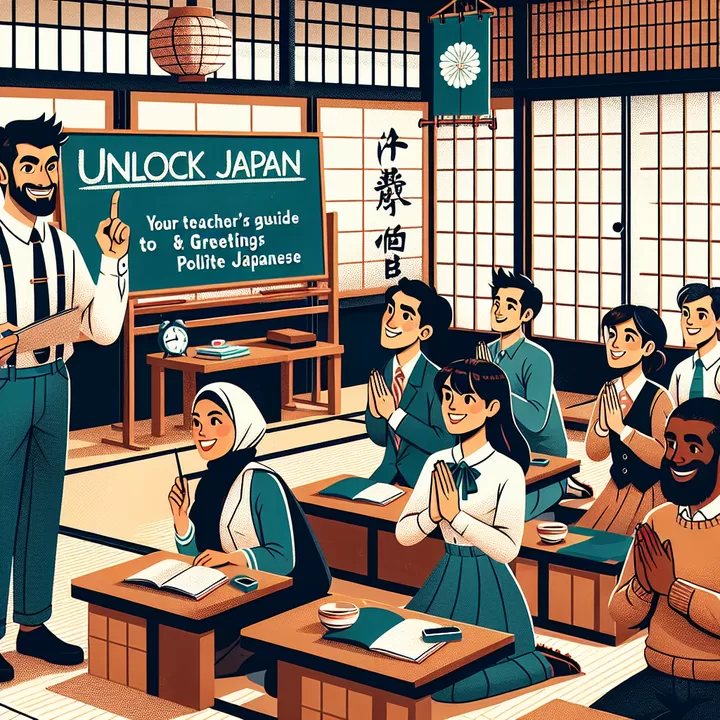
Unlock Japan: Your Teacher’s Guide to Greetings & Polite Japanese 🇯🇵✨
Konnichiwa, future Japan adventurers! Are you dreaming of living, studying, or working in the beautiful land of the rising sun? That’s an amazing goal, and I’m here to help you take your first, most important steps towards it. As your teacher, I know that truly connecting with Japan begins not just with grammar, but with genuine communication. And where better to start than with greetings and polite language?
For us Filipinos, politeness is deeply ingrained in our culture. We say “po” and “opo,” we respect elders, and we value harmonious relationships. This shared value will be a great foundation for learning Japanese politeness! However, the *ways* we express politeness can be quite different. This guide will walk you through the essential greetings and polite expressions you’ll need, along with cultural insights and tips tailored specifically for Filipino learners. Let’s make you confident and comfortable from your very first “Ohayou gozaimasu”!
💡 Teacher’s Tip:
Don’t just memorize phrases! Try to understand the context and nuances behind them. Japanese politeness is highly situational, and knowing when to use what is key.
The Power of a Japanese Greeting: More Than Just Words 👋🎌
In Japan, greetings are not just formalities; they are crucial building blocks for relationships and a sign of respect. A proper greeting shows you acknowledge the other person’s presence and are ready to engage. It’s an unspoken rule that opens doors!
Let’s dive into the absolute must-know greetings you’ll use every single day.
Essential Daily Greetings (Nichijou no Aisatsu)
| Japanese Phrase | Romaji (Pronunciation Tip) | English Meaning | Usage Context |
|---|---|---|---|
| おはようございます | Ohayou gozaimasu (long ‘o’ sound at the end) | Good morning | Formal, used until around noon. “Ohayou” is casual. |
| こんにちは | Konnichiwa (pronounced “konnichi-WA”) | Good afternoon / Hello | Most common all-purpose greeting during the day. |
| こんばんは | Konbanwa (pronounced “konban-WA”) | Good evening | Used from sunset onwards. |
| おやすみなさい | Oyasuminasai | Good night | When parting ways for the night, or before sleeping. “Oyasumi” is casual. |
| さようなら | Sayounara | Goodbye | Usually implies a longer, more definite parting. Use with care. |
⚠️ Common Mistake Alert for Filipinos:
Be careful with 「Sayounara」. Unlike our “Goodbye,” which we use frequently, 「Sayounara」 often carries a sense of finality. For casual, everyday partings with friends or colleagues you’ll see again, it’s more common to say 「またね」(Mata ne – See you), 「じゃあね」(Jaa ne – Bye!), or even 「お疲れ様でした」(Otsukaresama deshita – You’ve worked hard/Thank you for your effort) in a work/school setting.
Beyond Basic Greetings: Situational Phrases You’ll Love ❤️
Japanese politeness extends to specific situations. Mastering these will make you sound much more natural and appreciative.
Common Situational Phrases
-
いってきます (Ittekimasu)
“I’m going (and coming back).” Said when you leave home or the office. Think of it as “I’m off!”
-
いってらっしゃい (Itterasshai)
“Please go (and come back).” The response to Ittekimasu. It’s like “Have a good day!” or “Be careful!”
-
ただいま (Tadaima)
“I’m home / I’m back now.” Said upon returning to your home or a familiar place.
-
おかえりなさい (Okaerinasai)
“Welcome back.” The response to Tadaima. “Okaeri” is casual.
-
いただきます (Itadakimasu)
“I humbly receive (this food).” Said before eating. It expresses gratitude for the food, the person who prepared it, and all who were involved in bringing it to you.
-
ごちそうさまでした (Gochisousama deshita)
“It was a feast / Thank you for the meal.” Said after eating. It’s an expression of gratitude for the meal you’ve just enjoyed.
-
おつかれさまでした (Otsukaresama deshita)
“You must be tired.” This is a versatile phrase used to acknowledge someone’s hard work or effort. Use it when leaving work/school, or when a colleague finishes a task. Often used like “Good job” or “Thank you for your hard work.”
The Essentials: Thank You, Excuse Me, and Apologies 🙏
Knowing how to express gratitude and apology is crucial for smooth interactions.
🚨 Pay Close Attention! These are different from Tagalog!
While we Filipinos often say “thank you” or “sorry” quite readily, Japanese usage can be more nuanced and frequent in certain contexts. For example, 「Sumimasen」 (Excuse me/Sorry) is used for a vast array of situations, not just when you’ve done something wrong!
Words of Gratitude & Apology
| Japanese Phrase | Romaji | English Meaning | Usage & Nuance |
|---|---|---|---|
| ありがとうございます | Arigatou gozaimasu | Thank you (polite) | Standard polite “thank you.” Use “Arigatou” for casual settings (friends/family). |
| どうも | Doumo | Thanks / Very much (casual/versatile) | Extremely versatile. Can mean “hello,” “thanks,” or “sorry.” Often used by itself in casual situations or as an intensifier (e.g., 「どうもありがとう」). |
| すみません | Sumimasen | Excuse me / I’m sorry / Thank you | Your multi-tool!
|
| ごめんなさい | Gomen nasai | I’m sorry (casual/standard) | A more direct apology for mistakes. “Gomen” is very casual. Use “Sumimasen” for general apologies in public. |
| 申し訳ありません | Moushiwake arimasen | I am truly sorry (deep apology) | Highly formal and deep apology, used for serious mistakes or in business settings. |
💡 Teacher’s Tip for Filipinos:
The “Thank you” usage of 「Sumimasen」 can be confusing! It’s used when you feel a slight burden has been put on someone or when they’ve gone out of their way, making you feel a bit apologetic for their effort. It’s like saying, “Excuse me for troubling you, but thank you.”
Navigating Politeness Levels: Desu/Masu Form and Beyond 📈
Japanese politeness is often categorized into different levels, primarily dictated by verb endings and specific vocabulary. For beginners, mastering the **polite form (desu/masu form)** is your priority. This is the standard, neutral-polite way of speaking that is appropriate in most situations with people you don’t know well, elders, or superiors.
Mastering the Desu/Masu Form
✅ Why it’s Important:
Using 「です (desu)」 for nouns/adjectives and 「ます (masu)」 for verbs shows respect and is the safest way to speak when you’re unsure. It’s the standard for polite conversation and what you’ll typically learn first in language schools.
* **「です (desu)」:** Used at the end of sentences for nouns and adjectives.
* Examples:
* 私は学生です。(Watashi wa gakusei desu.) – I am a student.
* これは本です。(Kore wa hon desu.) – This is a book.
* このリンゴはおいしいです。(Kono ringo wa oishii desu.) – This apple is delicious.
* **「ます (masu)」:** Used as a verb ending for polite statements.
* Examples:
* ご飯を食べます。(Gohan wo tabemasu.) – I eat rice.
* 日本語を勉強します。(Nihongo wo benkyou shimasu.) – I study Japanese.
* 毎日学校へ行きます。(Mainichi gakkou e ikimasu.) – I go to school every day.
**Casual vs. Polite (Common Trap for Filipino Learners):**
In Tagalog, we often simply add “po” to make a sentence polite. In Japanese, it’s a grammatical change to the verb or sentence ending. Avoid dropping “desu/masu” unless you are speaking with close friends or family, or you explicitly understand the casual form rules. Filipinos are naturally friendly, but using casual Japanese with strangers or superiors can be seen as impolite.
💡 Teacher’s Tip:
Practice converting casual sentences to polite ones! For instance, 「食べる」(taberu – to eat, casual) becomes 「食べます」(tabemasu – polite). This active practice will solidify your understanding.
Introducing Yourself: Your First Impression 🤝✨
One of the first things you’ll do is introduce yourself. This isn’t just about your name, but about showing willingness to connect.
The Self-Introduction (Jikoshoukai) Formula
-
はじめまして (Hajimemashite)
“Nice to meet you (for the first time).” This literally means “it’s the first time.” Always start your self-introduction with this!
-
[Your Name] です ([Your Name] desu)
“I am [Your Name].” Example: 「マリアです。(Maria desu.)」 – “I am Maria.”
-
[Your Nationality/From where] から来ました ([Your Nationality/From where] kara kimashita)
“I came from [Your Nationality/Place].” Example: 「フィリピンから来ました。(Filipin kara kimashita.)」 – “I came from the Philippines.”
-
どうぞよろしくおねがいします (Douzo yoroshiku onegaishimasu)
This is a profound phrase with no direct English equivalent. It means something like, “Please treat me well,” “I look forward to working with you,” or “I hope we have a good relationship.” It’s an essential closing for an introduction, showing your willingness to build a harmonious relationship. You can shorten it to 「よろしくお願いします」(Yoroshiku onegaishimasu) in most situations.
**Example Full Introduction:**
はじめまして。マリアです。フィリピンから来ました。どうぞよろしくお願いします。
(Hajimemashite. Maria desu. Filipin kara kimashita. Douzo yoroshiku onegaishimasu.)
Nice to meet you. I am Maria. I came from the Philippines. Please treat me well.
Cultural Insights for Filipinos: Bridging the Gap 🌉
Your Filipino background gives you a fantastic head start with politeness, but understanding subtle differences will make your journey smoother.
* **Bowing (お辞儀 – Ojigi):** While we may nod, Japanese people bow. A slight bow accompanies most greetings and apologies. Observing and imitating will help you learn the appropriate depth of bow for different situations (from a slight nod for acquaintances to a deep bow for apologies or showing deep respect).
* **Indirectness (察する – Sassuru):** Japanese communication can be more indirect than what we’re used to. People often expect you to “read between the lines” or infer their meaning. This means actively listening, observing body language, and sometimes pausing before responding. Don’t be afraid to ask for clarification politely if you’re truly unsure, but try to grasp the context first.
* **”Uchi” (内) and “Soto” (外) – In-group vs. Out-group:** This concept is vital. Your language changes depending on whether you’re speaking to someone in your “uchi” (family, close friends, immediate colleagues) or “soto” (strangers, customers, superiors). This is why learning the polite “-masu” form is so important – it’s generally safe for “soto” interactions.
* **Honorifics (さん, 様, 君, ちゃん):**
* **-san (さん):** The most common and versatile honorific. Use it for almost anyone’s name unless they are a very close friend or family. (e.g., Maria-san, Tanaka-san). Never use it for yourself.
* **-sama (様):** More respectful than -san, used for customers, deities, or highly respected individuals.
* **-kun (君):** Often used for boys/young men, or by a superior to a male subordinate.
* **-chan (ちゃん):** Affectionate, used for small children, female family members, or close female friends.
🌟 Cultural Insight:
While Filipinos often use nicknames or direct addresses, in Japan, using -san with a person’s family name (e.g., Tanaka-san) is the standard and safest way to address someone you don’t know well. Avoid using first names without permission, especially with new acquaintances or superiors.
Your Path to Fluency Starts Here! 🎉
Learning greetings and polite Japanese isn’t just about memorizing words; it’s about understanding the heart of Japanese communication. It’s about showing respect, building trust, and navigating social situations with grace. As you practice these phrases, remember to also observe how native speakers use them – their tone, their body language, and the context.
Don’t be afraid to make mistakes! Every mistake is a learning opportunity. Filipinos are known for their warmth and adaptability, and these qualities will serve you well on your Japanese language journey. Stay curious, keep practicing, and remember that every “Ohayou gozaimasu” and “Arigatou gozaimasu” brings you one step closer to your dream life in Japan. Ganbatte kudasai! You can do this!
Contact & Follow Us
お問い合わせ
📞 電話: +63 997 093 4550
📧 メール: samuraijapan.bc@gmail.com
🏠 住所: Room D3, Freb Bldg, Villa Donata Subd, Muntinlupa
🏢 会社名: SAMURAI Japan Business Center Inc.
SNSでフォロー
🎵 Tiktok: @samuraijapan0221
📸 Instagram: @samuraijapan.bc
▶️ Youtube: @SamuraiJapan-bc
📘 Facebook: Visit our Page

Leave a Reply