

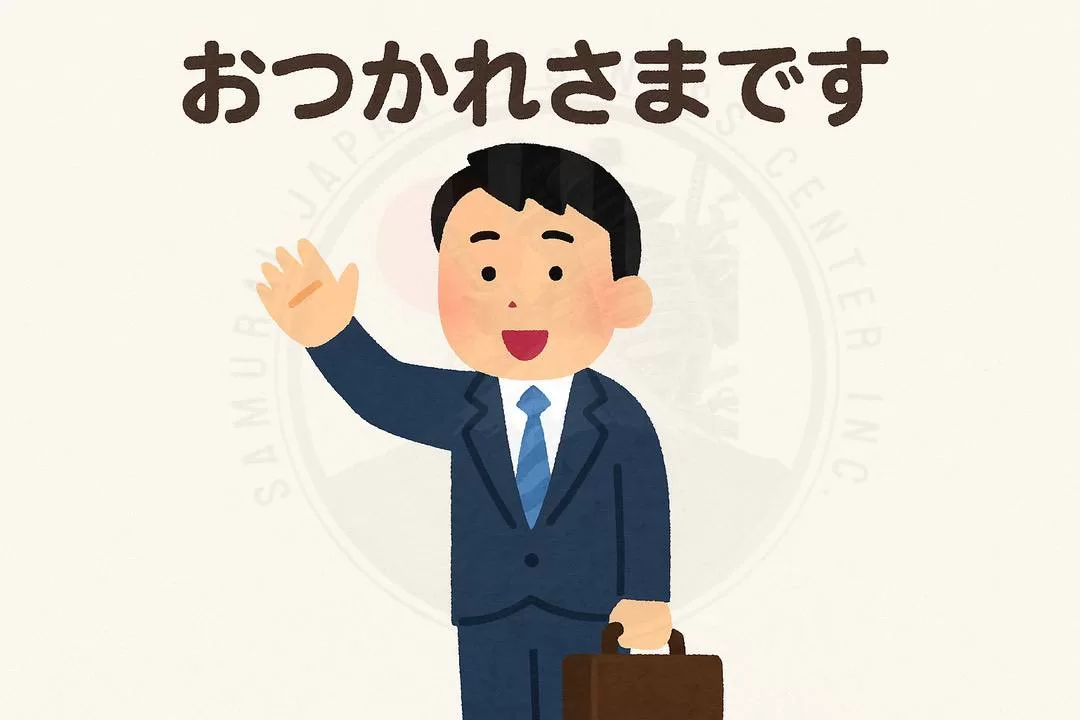
お疲れ様です (Otsukaresamadesu): Your Teacher’s Guide to Smooth Daily Japan Life 🇯🇵✨
Kon’nichiwa, future residents of Japan! Are you dreaming of experiencing life in the Land of the Rising Sun? Whether it’s for work, study, or cultural immersion, understanding daily Japanese communication and its underlying nuances is key to a smooth and enjoyable transition. As your teacher, I know how exciting yet daunting this journey can seem. That’s why today, we’re going to dive deep into the essential phrases and cultural insights that will help you connect with people and navigate daily life in Japan with confidence. We’ll start with a phrase you’ll hear and use countless times: 「お疲れ様です」(Otsukaresamadesu). Let’s make your dream life in Japan a reality, step by step! 🎉
Unlocking 「お疲れ様です」(Otsukaresamadesu): More Than Just “Good Work!” 💡
If you’ve spent any time around Japanese speakers, you’ve probably heard 「お疲れ様です」(Otsukaresamadesu). It’s often translated as “Good work,” “You must be tired,” or “Thanks for your hard work.” But its true meaning and usage are far more versatile and deeply embedded in Japanese culture. It’s an acknowledgment of effort, a sign of mutual respect, and a way to foster a sense of shared experience, especially in professional or group settings.
💡 Teacher’s Tip:
Think of 「お疲れ様です」 as a multi-purpose social lubricant. It’s used not just when someone finishes a task, but also to acknowledge someone’s presence, to say “hello” to a colleague who just arrived, or to say “goodbye” to someone leaving. It embodies the Japanese appreciation for effort and the understanding that everyone is working hard.
Here are some common scenarios where you’ll hear and use 「お疲れ様です」:
* **When someone leaves work or finishes a task:** “Otsukaresamadesu!” (Good job, you’re done for the day!)
* **When you greet a colleague who just arrived:** “Otsukaresamadesu!” (Hello, acknowledging they’re now at work/starting effort.)
* **When you pass a colleague in the hallway:** “Otsukaresamadesu!” (A quick, polite acknowledgement.)
* **After a meeting or presentation:** “Otsukaresamadesu!” (Thank you for your effort in the meeting.)
* **When you’re leaving a group activity:** “Otsukaresamadesu!” (Thank you for your participation and effort.)
The casual form is 「お疲れ様」(Otsukaresama), often used among friends, family, or close colleagues. Remember, mastering this phrase shows respect and helps you blend into Japanese daily life seamlessly!
Your Daily Dialogue Toolkit: Essential Greetings for Every Situation ✅
Beyond 「お疲れ様です」, daily greetings are the foundation of all communication. While you might know the basics, understanding when and how to use them with the right level of politeness is crucial. Filipino learners often excel at politeness, but Japanese politeness has its own specific set of rules.
| Japanese Phrase | Romaji | English Meaning | Usage Notes |
|---|---|---|---|
| おはようございます | Ohayō gozaimasu | Good morning | Used until around noon. “Ohayō” is casual. |
| こんにちは | Kon’nichiwa | Good afternoon / Hello | Used from noon onwards. General greeting. |
| こんばんは | Konbanwa | Good evening | Used after sunset. |
| おやすみなさい | Oyasumi nasai | Good night | Used before going to bed. “Oyasumi” is casual. |
| いってきます | Itte kimasu | I’m leaving (and coming back) | Said when leaving home or office. |
| いってらっしゃい | Itte rasshai | Go and come back | Reply to “Itte kimasu.” |
| ただいま | Tadaima | I’m home / I’m back | Said upon returning home or office. |
| おかえりなさい | Okaeri nasai | Welcome home / Welcome back | Reply to “Tadaima.” |
Practice these daily! They are more than just words; they are rituals that bond people in Japan.
Beyond the Basics: Navigating Social Interactions with Polite Phrases 🗣️
Once you’ve mastered greetings, the next step is to expand your conversational toolkit. Japanese politeness extends to every interaction, from asking for help to expressing gratitude or apology.
* **Thanking Others:**
* 「ありがとうございます」(Arigatō gozaimasu): The standard “Thank you.” Use it for almost anything.
* 「どうもありがとうございます」(Dōmo arigatō gozaimasu): A more emphatic “Thank you very much.”
* 「恐縮です」(Kyōshuku desu): This means “I’m much obliged” or “I feel humbled/grateful.” Use this in more formal or business settings when someone has done you a significant favor, or you feel a little apologetic for imposing.
* 「助かります」(Tasukarimasu): “That helps me greatly.” Use this when someone helps you out of a specific difficulty.
* **Apologizing & Getting Attention:**
* 「すみません」(Sumimasen): This is incredibly versatile. It means “Excuse me,” “I’m sorry,” and even “Thank you” in certain contexts (e.g., when someone goes out of their way for you, it’s an “I’m sorry for troubling you, but thank you”). Use it to get a waiter’s attention, to apologize for bumping into someone, or to express subtle gratitude.
* 「ごめんなさい」(Gomen nasai): “I’m sorry,” usually for personal apologies or minor mistakes. “Gomen” is casual.
* 「申し訳ありません」(Mōshiwake arimasen) / 「申し訳ございません」(Mōshiwake gozaimasen): Formal apologies. Use these in serious situations, especially in professional settings.
⚠️ Common Mistake Alert:
Filipino learners, accustomed to phrases like “pasensiya na po,” might sometimes over-apologize or use 「ごめんなさい」 too broadly. While politeness is valued, using a strong apology like 「ごめんなさい」 for minor things can sometimes sound too heavy. Often, 「すみません」 is more appropriate for minor inconveniences or to simply get attention.
* **Asking for Help/Favors:**
* 「お願いします」(Onegai shimasu): “Please.” This is used when making a request or asking for a favor. For example, 「これを手伝ってください、お願いします」(Kore o tetsudatte kudasai, onegai shimasu) – “Please help me with this.”
* 「手伝ってもらえませんか」(Tetsudatte moraemasen ka?): “Could you help me?” (Polite).
* 「教えていただけますか」(Oshiete itadakemasu ka?): “Could you teach/tell me?” (Polite).
Remember, sincerity in your tone and a slight bow can often convey more than words alone!
The Unwritten Rules: Mastering Japanese Cultural Nuances 🎎
Learning phrases is one thing; understanding the cultural context in which they are used is another. Japanese communication relies heavily on “reading the air” (空気を読む – kūki o yomu) and understanding unspoken cues.
| Aspect | Filipino Communication Style (General) | Japanese Communication Style (General) |
|---|---|---|
| Directness | Often direct, especially in close relationships. “Po/Opo” adds politeness without necessarily softening the core message. | Highly indirect, especially when conveying negative or sensitive information. Value harmony over explicit directness. |
| “Yes” vs. “No” | “Yes” (Opo/Oo) or “No” (Hindi po/Hindi) are commonly used directly. | Direct “No” is often avoided. Indirect refusal (e.g., “It’s a bit difficult,” “I will think about it”) or silence is common. “Yes” (はい – Hai) often means “I understand/I’m listening,” not necessarily “I agree.” |
| Expressions of Gratitude/Apology | Clear “Thank you” and “Sorry” are expected. Repetition for emphasis. | Often intertwined. 「すみません」 can mean both. Context and tone are crucial. Excessive apology can sometimes be seen as lacking confidence. |
| Uchi (Inner) & Soto (Outer) | While group distinction exists, the formality gap between inner and outer circles might be less pronounced than in Japan. | Very strong distinction. Language (e.g., keigo – honorifics), behavior, and expectations differ significantly depending on whether you’re speaking to someone in your “uchi” (in-group) or “soto” (out-group). |
💡 Teacher’s Tip: The “Hon-ne” and “Tatemae”
You’ll often hear about 「本音」(hon-ne), one’s true feelings, and 「建前」(tatemae), the public facade or expectation. In Japan, expressing hon-ne directly, especially if it’s negative or disruptive, is often avoided to maintain harmony. Observe how Japanese people communicate indirectly. They might use softening phrases, vague statements, or even silence to imply things rather than stating them outright. Your ability to pick up on these cues will greatly enhance your communication.
Practical Tips for Filipino Learners: Bridging the Cultural Gap 🌉
As a teacher, I’ve seen many Filipino students excel in Japanese, and a key factor is their inherent respect and warmth. Here are some tips to leverage your strengths and overcome common hurdles:
-
Observe and Listen Actively:
The best way to learn nuances is by watching native speakers. Pay attention to not just what they say, but *how* they say it, their body language, and the context. Listen to how they respond in different situations.
-
Embrace Indirectness (Initially):
While directness is valued in many Filipino contexts, try to practice indirect communication in Japan, especially in formal or new social settings. Instead of a direct “No,” try 「ちょっと難しいです」(Chotto muzukashii desu – It’s a bit difficult) or 「検討させていただきます」(Kentō sasete itadakimasu – I will consider it).
-
Don’t Fear Mistakes:
It’s okay to make mistakes! Japanese people are generally very understanding of foreigners trying to speak their language. What matters is your effort and willingness to learn. Use mistakes as learning opportunities.
-
Practice Pronunciation and Intonation:
Japanese is a pitch-accent language. Slight changes in pitch can change a word’s meaning. While not as critical as in tonal languages, practicing intonation will make you sound more natural and avoid misunderstandings. For Filipinos, differentiating ‘r’ and ‘l’ sounds (which are often merged in Tagalog) requires conscious effort for Japanese ‘r’ sound.
-
Bow Appropriately:
Bowing is a fundamental part of Japanese communication. A slight nod is enough for casual greetings, while a deeper bow signifies respect or apology. Observe and mimic others initially.
-
Ask for Clarification Politely:
If you don’t understand, don’t pretend you do. Politely ask 「もう一度お願いします」(Mō ichido onegai shimasu – One more time, please) or 「もう少しゆっくり話してください」(Mō sukoshi yukkuri hanashite kudasai – Please speak a bit slower).
Your journey to a successful life in Japan is a marathon, not a sprint. Be patient with yourself, celebrate small victories, and never stop learning. Each phrase you master, and each cultural nuance you understand, brings you closer to your dream. You’ve got this! Ganbatte kudasai! 💪
Contact & Follow Us
お問い合わせ
📞 電話: +63 997 093 4550
📧 メール: samuraijapan.bc@gmail.com
🏠 住所: Room D3, Freb Bldg, Villa Donata Subd, Muntinlupa
🏢 会社名: SAMURAI Japan Business Center Inc.
SNSでフォロー
🎵 Tiktok: @samuraijapan0221
📸 Instagram: @samuraijapan.bc
▶️ Youtube: @SamuraiJapan-bc
📘 Facebook: Visit our Page

Leave a Reply