

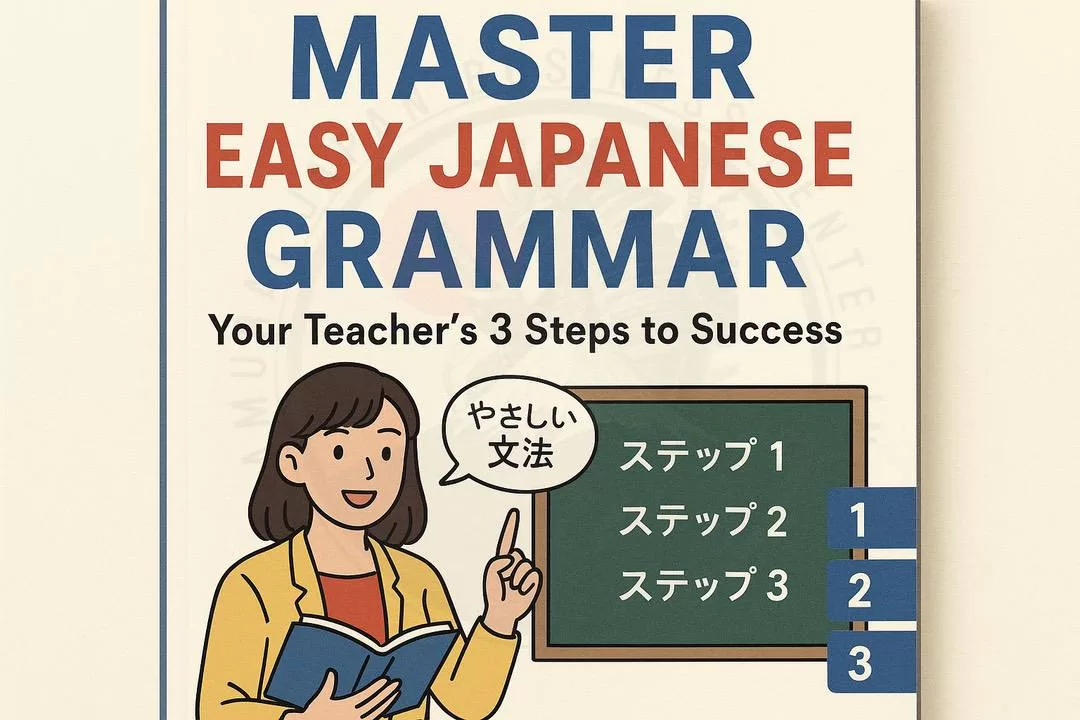
Master Easy Japanese Grammar: Your Teacher’s 3 Steps to Success 🇯🇵
Konnichiwa, aspiring Nihongo learners! Are you dreaming of experiencing the vibrant culture, delicious food, and beautiful landscapes of Japan? Whether you envision working, studying, or simply traveling there, mastering Japanese grammar is your essential first step. It might seem daunting at first, like a complex puzzle with many pieces. But don’t worry, as your teacher, I’m here to tell you that it’s absolutely achievable!
Many Filipinos approach Japanese grammar by trying to directly translate from Tagalog or English, which can sometimes lead to confusion because Japanese sentence structure is quite different. But with a systematic approach, you can build a strong foundation and speak with confidence. This guide will break down “easy” Japanese grammar into three clear, actionable steps, turning complex rules into digestible, fun lessons. Let’s unlock the secrets of Japanese grammar together! 🎉
Step 1: Building Your Foundation – Particles and Basic Structures 🧱
Think of Japanese grammar as building a house. Before you can put up walls or a roof, you need a strong foundation. In Japanese, this foundation is built with **particles (助詞 – joshi)** and fundamental sentence patterns. Particles are small words that indicate the grammatical function of the word or phrase preceding them. They’re like the glue that holds sentences together, and understanding them is crucial!
Let’s look at some of the most common and essential particles:
Essential Japanese Particles: Your Sentence Glue
| Particle | Pronunciation | Main Function(s) | Example Sentence |
|---|---|---|---|
| は | wa | Topic Marker: What you’re talking about. | 私はマリアです。(Watashi wa Maria desu.)
(I am Maria.) |
| が | ga | Subject Marker: Who/what performs the action or is newly introduced. | 猫がいます。(Neko ga imasu.)
(There is a cat.) |
| を | o | Direct Object Marker: The receiver of an action. | ご飯を食べます。(Gohan o tabemasu.)
(I eat rice.) |
| に | ni | Location (destination), Time, Indirect Object Marker. | 日本に行きます。(Nihon ni ikimasu.)
(I go to Japan.) |
| で | de | Location (action takes place), Means/Method. | 学校で勉強します。(Gakkou de benkyou shimasu.)
(I study at school.) |
| と | to | And (for nouns), With (someone). | 友達と話します。(Tomodachi to hanashimasu.)
(I talk with a friend.) |
💡 Teacher’s Tip: Don’t Translate, Understand Function!
Many Filipino learners try to find direct Tagalog equivalents for particles, which doesn’t always work perfectly. Instead, focus on understanding the *function* of each particle. Does it mark the topic? The direct object? The place of an action? Practice with many example sentences until it becomes intuitive!
After particles, focus on basic sentence structures:
* **Noun です (desu):** This is the simplest and most common structure, meaning “is/am/are.”
* 例: 私 は 学生 です。 (Watashi wa gakusei desu.) – I am a student.
* **Noun Verb ます (masu):** The polite form of verbs, indicating present or future tense.
* 例: 毎日 日本語 を 勉強します。 (Mainichi Nihongo o benkyoushimasu.) – I study Japanese every day.
⚠️ Common Mistake Alert: Omitting Particles!
In casual Filipino conversation, we often drop prepositions. For example, “Kumain bigas” instead of “Kumain *ng* bigas.” In Japanese, particles are almost always necessary for clarity, especially in polite speech. Always double-check if you’ve included the correct particle!
Step 2: Conquering Conjugations – Verbs and Adjectives! 💪
Once you have your foundation, it’s time to make your language move! This means understanding how verbs and adjectives change their forms (conjugate) to express different tenses, moods, or to connect with other words. This step might seem like a lot, but it’s incredibly systematic.
**Verbs (動詞 – Doushi):**
Japanese verbs don’t change based on who is doing the action (like “I eat,” “he eats” in English). Instead, they change based on tense (past, present, future), politeness level, and how they connect to other sentences. The simplest and most practical approach is to learn the `ます` form first, then expand to other forms.
Basic Verb Conjugations: Polite Forms
| Verb | Meaning | ます Form (Polite Present/Future) | ません Form (Polite Negative) | ました Form (Polite Past) |
|---|---|---|---|---|
| 食べる | to eat | 食べます (tabemasu) | 食べません (tabemasen) | 食べました (tabemashita) |
| 飲む | to drink | 飲みます (nomimasu) | 飲みません (nomimasen) | 飲みました (nomimashita) |
| する | to do (Irregular) | します (shimasu) | しません (shimasen) | しました (shimashita) |
💡 Teacher’s Tip: The Power of Te-form!
While `masu` and `mashita` are crucial, the 「て形」(te-form) is a true grammar powerhouse. It connects sentences, requests actions, indicates ongoing actions, and much more! Dedicate extra time to mastering the te-form of all verb groups. It will unlock so many expressive possibilities!
**Adjectives (形容詞 – Keiyoushi):**
Japanese has two main types of adjectives: `い-adjectives` (i-adjectives) and `な-adjectives` (na-adjectives). They conjugate differently for negative and past forms.
Adjective Conjugations: Making Descriptions Dynamic
| Type | Positive Present | Negative Present | Positive Past | Negative Past |
|---|---|---|---|---|
| い-Adjective (e.g., 高い – takai, expensive/tall) | 高い (takai) | 高くないです (takakunai desu) | 高かったです (takakatta desu) | 高くなかったです (takakunakatta desu) |
| な-Adjective (e.g., 静か – shizuka, quiet) | 静かです (shizuka desu) | 静かじゃありません (shizuka ja arimasen) | 静かでした (shizuka deshita) | 静かじゃありませんでした (shizuka ja arimasen deshita) |
Step 3: Expanding Your Expression – Connecting Ideas and Conditionals 🔗
Now that you can form basic sentences and conjugate verbs and adjectives, it’s time to build more complex and natural-sounding Japanese sentences. This step focuses on connecting ideas smoothly and expressing conditional statements.
**Connecting Sentences:**
Instead of speaking in choppy, short sentences, you’ll learn how to link ideas using conjunctions and linking forms.
* **て (te-form) for sequence/reason:** Often used to connect two clauses where the first action leads to the second, or the first is the reason for the second.
* 例: 起きて、朝ごはんを食べます。 (Okite, asagohan o tabemasu.) – I wake up, and then eat breakfast.
* **から (kara) for “after” or “because”:**
* 例: ご飯を食べますから、行きます。 (Gohan o tabemasu kara, ikimasu.) – Because I will eat, I will go. (or After eating, I will go.)
* **ので (node) for mild reason:** Similar to “because,” but often softer or more objective than `から`.
* 例: 雨が降っているので、傘を持って行きます。 (Ame ga futte iru node, kasa o motte ikimasu.) – Because it’s raining, I’ll take an umbrella.
* **けど / が (kedo / ga) for “but / although”:** Used to connect contrasting ideas. `けど` is more casual.
* 例: 日本語は難しいですが、面白いです。 (Nihongo wa muzukashii desu ga, omoshiroi desu.) – Japanese is difficult, but it’s interesting.
**Conditional Forms:**
These forms allow you to express “if X, then Y.” Japanese has several conditional forms, each with slightly different nuances. Start with the most common ones.
Common Conditional Forms: If This, Then That!
| Form | Meaning / Nuance | Example Sentence |
|---|---|---|
| 〜と (to) | Natural consequence, always happens. “When/If X, then Y naturally happens.” | 春になると、桜が咲きます。(Haru ni naru to, sakura ga sakimasu.)
(When spring comes, cherry blossoms bloom.) |
| 〜たら (tara) | Specific condition, often for future events or actions. “If/When X, then Y.” Very versatile. | 雨が降ったら、家で勉強します。(Ame ga futtara, ie de benkyou shimasu.)
(If it rains, I’ll study at home.) |
| 〜なら (nara) | Based on premise or information provided. “If that’s the case…” Often used for advice. | 日本へ行くなら、事前に調べてください。(Nihon e iku nara, jizen ni shirabete kudasai.)
(If you’re going to Japan, please research beforehand.) |
💡 Teacher’s Tip: Practice in Context!
Don’t just memorize tables. Create your own sentences using these connectors and conditionals. Try to describe your daily routine, your plans, or hypothetical situations. The more you use them in context, the more natural they’ll become!
Beyond the Basics: Practical Tips for Grammar Mastery 💡
Learning grammar isn’t just about memorizing rules; it’s about applying them. Here are some actionable tips to help you truly master Japanese grammar and confidently use it in your journey towards Japan:
-
Listen Actively and Imitate:
Exposure is key! Watch Japanese anime, dramas, or YouTube videos. Don’t just watch for fun; pay attention to how native speakers use particles, verb forms, and sentence structures. Try to imitate their pronunciation and intonation. This trains your ear and helps you internalize grammar naturally. Many Filipino learners struggle with certain Japanese sounds (like the distinct ‘R’ sound, or double consonants like ‘っ’). Listening closely helps immensely!
-
Speak, Speak, Speak (and Make Mistakes!):
The best way to solidify grammar is to use it. Find a language partner, join a Japanese conversation club, or even talk to yourself in Japanese! Don’t be afraid to make mistakes. Mistakes are your best teachers, showing you where you need to improve. Filipinos are often shy about making mistakes, but remember, everyone makes them when learning a new language!
-
Read Simple Texts Regularly:
Once you’ve grasped hiragana and katakana, start reading simple Japanese texts. Graded readers, children’s books, or even simple news articles are great. This helps you see grammar in action and expands your vocabulary organically. Even a few minutes a day can make a big difference.
-
Be Consistent, Not Just Intense:
It’s better to study for 30 minutes every day than for 5 hours once a week. Consistency builds habits and keeps the information fresh in your mind. Break down your study goals into manageable daily tasks.
-
Understand Cultural Context:
Grammar often reflects cultural nuances. For instance, understanding the different politeness levels (Keigo) is not just a grammar point but a reflection of Japanese respect for hierarchy and relationships. Begin with the polite `ます` form, which is universally safe and suitable for most situations, especially when you’re starting out in Japan.
⚠️ Overcoming Common Filipino Learner Challenges:
• Particle Confusion: Since Tagalog doesn’t have direct particle equivalents, this can be tricky. Don’t translate; learn the *function*. Practice by filling in the blanks in sentences.
• Pronunciation: The Japanese “R” is unique, not like English or Tagalog “R.” The “Ts” in “tsunami” is one sound. Focus on listening to native speakers and imitating precisely. There are many online resources for pronunciation practice.
Your Journey to Fluent Japanese Starts Now! 🎉
Mastering Japanese grammar is a journey, not a race. By focusing on these three steps—building your foundation with particles and basic structures, conquering conjugations of verbs and adjectives, and then expanding your expression with connectors and conditionals—you are setting yourself up for incredible success.
Remember, every small step forward is progress. Don’t be discouraged by challenges; embrace them as opportunities to learn and grow. Your dream life in Japan is within reach, and with dedication and the right approach to grammar, you’ll soon be speaking Japanese with confidence and enjoying everything Japan has to offer. Ganbatte kudasai! You can do this! 👍
Contact & Follow Us
お問い合わせ
📞 電話: +63 997 093 4550
📧 メール: samuraijapan.bc@gmail.com
🏠 住所: Room D3, Freb Bldg, Villa Donata Subd, Muntinlupa
🏢 会社名: SAMURAI Japan Business Center Inc.
SNSでフォロー
🎵 Tiktok: @samuraijapan0221
📸 Instagram: @samuraijapan.bc
▶️ Youtube: @SamuraiJapan-bc
📘 Facebook: Visit our Page

Leave a Reply