

{
“title”: “Why You Should Never Leave a Tip in Japan: Understanding the Culture of Omotenashi 🎌”,
“content”: “
Why You Should Never Leave a Tip in Japan: Understanding the Culture of Omotenashi 🎌
\n
By SAMURAI Japan Business Center | Life in Japan | 📖 10 min read
\n
\n\n
If you have ever visited a restaurant in the Philippines, you know that leaving a little extra cash on the table is a common way to say \”thank you\” for great service. Whether it’s 20 pesos or 100 pesos, that tip is a sign of appreciation for the waiter who kept your glass full or the chef who prepared your meal perfectly. But what happens when you bring that Filipino habit to the Land of the Rising Sun?
\n\n
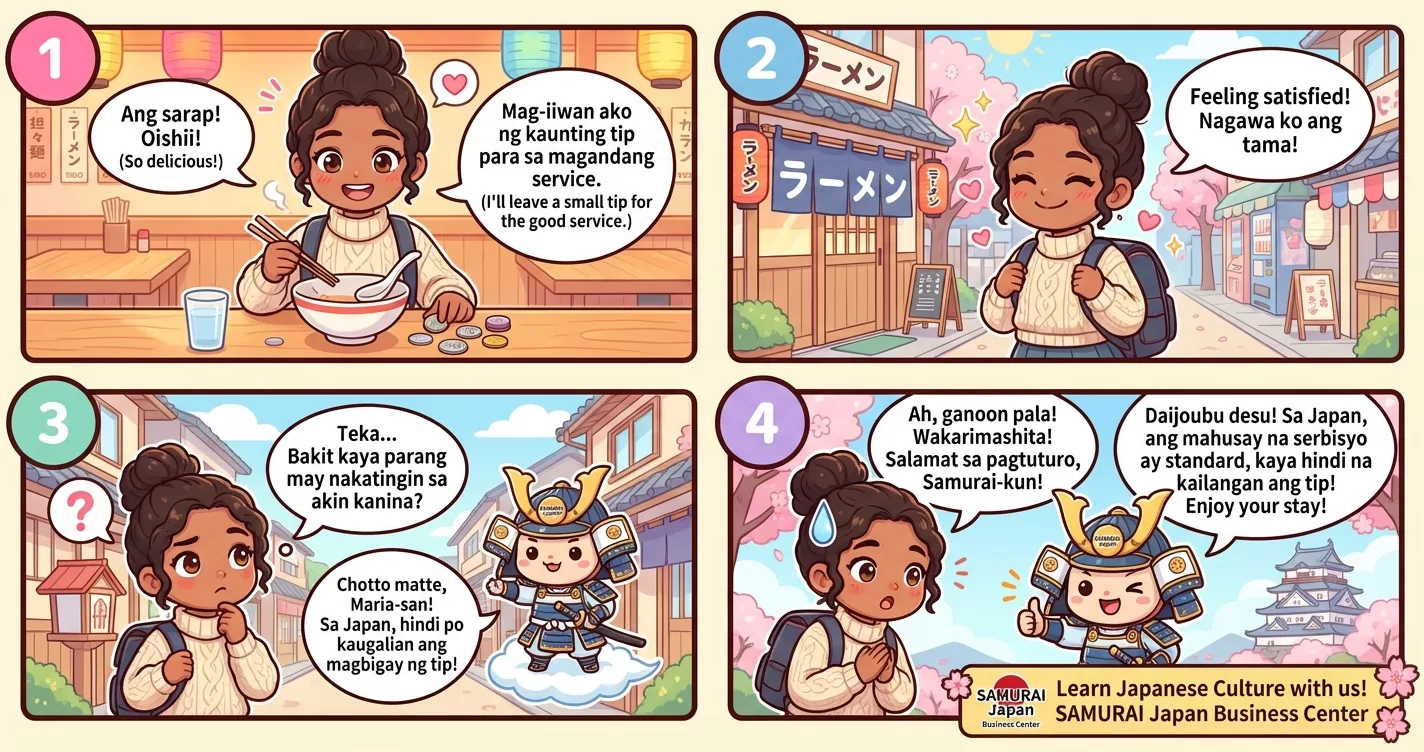
In our latest manga story, we follow Maria, a Filipina student who just finished a delicious bowl of ramen. Wanting to be kind, she leaves a few coins on the table as a tip. As she walks away with a smile, she’s suddenly chased down by the waiter! No, she didn’t break a bowl—the waiter was actually running to return her \”forgotten\” money. In Japan, leaving a tip can actually lead to a very confusing (and slightly embarrassing) situation for both you and the staff!
\n\n
💡 Did You Know?
\n
The Japanese word for tip is チップ (chippu), but it is rarely used in daily life. Unlike many Western countries or the Philippines, Japanese service culture is built on the philosophy that the price you see on the menu already includes the highest level of hospitality possible.
\n
\n\n
🍵 The Heart of Service: What is Omotenashi?
\n\n
To understand why tipping is unnecessary in Japan, we first have to talk about おもてなし (omotenashi). This word is often translated as \”hospitality,\” but it goes much deeper than that. Omotenashi means to look after guests wholeheartedly. It is a selfless form of service that dates back to traditional tea ceremonies, where the host would spend days preparing to ensure the guest had the most perfect experience possible.
\n\n
In Japan, providing excellent service is considered a matter of pride and a basic professional duty. Whether you are at a high-end sushi restaurant in Ginza or a small convenience store (konbini) in the countryside, the staff will treat you with respect, bow, and handle your items with care. They don’t do this because they are waiting for an extra 500 yen tip; they do it because it is the standard of 仕事 (shigoto) or work in Japan.
\n\n
For many Filipinos, this can feel strange. We are used to the idea that \”extra effort deserves extra pay.\” However, in Japanese culture, offering a tip can sometimes be interpreted as an insult. It might imply that the person only worked hard for the money, rather than out of professional pride, or it might suggest that the employer isn’t paying them enough. To keep things simple: the price on the bill is the final price, and nothing more is expected.
\n\n
🏃♂️ The \”Wasuremono\” Incident: Why Staff Will Chase You
\n\n
As seen in Maria’s story, if you leave money on the table and walk out, the most likely result is that the staff will think you accidentally left your change behind. They will call out, 「お客様、お忘れ物ですよ!」 (Okyaku-sama, wasuremono desu yo!), which means \”Customer, you forgot something!\”
\n\n
Imagine the scene: You are walking down a busy street in Tokyo, feeling good about your generous tip, when suddenly a breathless waiter catches up to you, bowing deeply and handing you 200 yen. It’s a testament to Japanese honesty, but it can also be a bit awkward! This is why it’s important for Filipino students at SAMURAI Japan Business Center to learn these cultural nuances early on. Understanding the local customs helps you navigate life in Japan with confidence and respect.
\n\n
💡 先生のポイント (Teacher’s Tip):
\n
If you want to show your appreciation for a great meal, instead of leaving money, use your words! A simple, sincere ごちそうさまでした (Gochisousama deshita) while leaving the restaurant is the best way to make the staff smile. It literally means \”It was a feast,\” and it acknowledges their hard work perfectly.
\n
\n\n
🌟 A Real-Life Scenario: The Power of Sincere Gratitude
\n\n
Let’s look at a practical scenario to see how this works in real life. Imagine a Filipino student named Paolo who is studying Japanese at a local business center. He goes to a traditional 居酒屋 (izakaya) with his classmates. The service is incredibly fast, the waiter is friendly, and they even give the group a free small appetizer.
\n\n
The Mistake: Paolo thinks, \”Wow, that was amazing service! I’ll leave 500 yen under my plate so the waiter finds it later.\” He leaves, but five minutes later, the waiter finds him at the train station entrance. The waiter is worried that Paolo made a mistake with his payment. Now, Paolo has to explain in his limited Japanese that it was a gift, but the waiter insists on returning it because the restaurant policy forbids taking tips. Paolo feels shy, and the waiter feels pressured.
\n\n
The Better Way: Instead of leaving money, Paolo finishes his meal and makes eye contact with the staff. As he pays at the counter, he says, 「美味しかったです。ありがとうございました!」 (Oishikatta desu. Arigatou gozaimashita!). He might even add, \”The service was great!\” in Japanese. The staff bows happily, says 「またお越しください」 (Mata okoshi kudasai) (Please come again), and Paolo leaves with his dignity and his 500 yen intact. He can use that money for his next Japanese lesson or a treat for himself!
\n\n
The Benefit: By following the local custom, Paolo avoids a confusing confrontation and builds a positive relationship with the shop. In Japan, being a \”good customer\” means following the rules and showing verbal appreciation rather than monetary rewards.
\n\n
💳 Are There Any Exceptions?
\n\n
While 99% of situations in Japan require no tipping, there are very rare exceptions where a small gift or \”service fee\” might be involved. However, even these are very different from the Filipino style of tipping. For example, at a high-end 旅館 (ryokan) (traditional Japanese inn), some people leave a small amount of money called 心付け (kokorozuke) for the room attendant. But this is not left on a table; it is placed inside a special decorative envelope and handed over at the beginning of the stay, not the end!
\n\n
For most students and travelers, you will never need to worry about this. Whether you are at a taxi, a hair salon, or a cafe, the price is the price. Some modern tourist-heavy areas might have a tip jar, but even then, it is absolutely not expected. Your polite behavior and your effort to speak Japanese are much more valuable to the staff than a few coins.
\n\n
💡 先生のポイント (Teacher’s Tip):
\n
In the Philippines, we often see a \”Service Charge\” added to the bill. In Japan, this is sometimes called サービス料 (saabisu ryou). It is usually only found in expensive restaurants or hotels. If it’s on the bill, it’s already calculated, so you don’t need to add anything extra on top of it!
\n
\n\n
📚 Key Vocabulary
\n
| Japanese | Reading | English | Tagalog |
|---|---|---|---|
| お客様 | Okyaku-sama | Customer/Guest | Customer / Bisita |
| 忘れ物 | Wasuremono | Forgotten item | Naiwang gamit |
| お釣り | Otsuri | Change (money) | Sukli |
| 美味しい | Oishii | Delicious | Masarap |
| ちょっと待って | Chotto matte | Wait a moment | Sandali lang |
\n\n
✏️ Try It Yourself!
\n
Practice these sentences to use next time you eat at a Japanese restaurant:
\n
- \n
- すみません、お釣り(おつり)を忘れました!
\n (Sumimasen, otsuri wo wasuremashita!)
\n English: Excuse me, I forgot my change!
\n Tagalog: Pasensya na po, nakalimutan ko ang sukli ko! - ラーメンはとても美味しかったです。
\n (Raamen wa totemo oishikatta desu.)
\n English: The ramen was very delicious.
\n Tagalog: Napakasarap ng ramen. - お客様、ちょっと待ってください!
\n (Okyaku-sama, chotto matte kudasai!)
\n English: Customer, please wait a moment!
\n Tagalog: Customer, sandali lang po!
\n \n
\n \n
\n
\n
\n\n
よくある質問 (FAQ)
\n\n
Q: 日本ではチップは本当に必要ないのですか? (Is a tip really not needed in Japan?)
\nA: はい、必要ありません! (Yes, it is not necessary!) In fact, as we saw in the story, staff will often return the money to you. The best way to show thanks is to say \”Gochisousama deshita\” when you leave.
\n\n
Q: サービスがとても良かった場合、どうすればいいですか? (What if the service was extremely good?)
\nA: If you really want to show extra appreciation, you can give a small verbal compliment to the manager or leave a positive review online. This helps the business more than a small cash tip ever would!
\n\n
Q: 日本のレストランで「サービス料」と書いてあるのは何ですか? (What is the \”Service Charge\” written in some Japanese restaurants?)
\nA: Some high-end restaurants or hotels add a 10-15% サービス料 (saabisu ryou) to the bill automatically. This is the only form of \”tipping\” that exists, and it is part of the official bill. You do not need to pay anything extra beyond that.
\n\n
Learning Japanese is not just about memorizing words; it’s about understanding the beautiful culture and the heart of the people. At SAMURAI Japan Business Center, we believe that cultural lessons are just as important as grammar. By understanding Omotenashi, you are one step closer to sounding—and acting—like a true local in Japan! Keep practicing, stay curious, and remember: your gratitude is the best tip you can give! ✨
\n\n
💡 Today’s Lesson:
\n
In Japan, great service is the standard, so there’s no need to leave a tip! Express your gratitude through polite Japanese phrases instead.
\n
\n\n
🇯🇵 日本語で新しい可能性を広げよう! ✨
\n
SAMURAI Japan Business Centerは、あなたの日本語学習を全力でサポートします。
Let’s achieve your dreams together!
\n
🚀 Start Your Learning Journey Today!
\n
Ready to learn Japanese? Apply for our programs now!
\n 👉 Application Form\n
\n
🏫 お問い合わせ (Contact Us)
\n
📞 Phone: +63 997 093 4550
\n
📧 Email: samuraijapan.bc@gmail.com
\n
🏢 Address: Room D3, Freb Bldg, Villa Donata Subd, Muntinlupa
\n
\n
📱 SNSで楽しく学ぼう!
\n
- \n
- 🎵 Tiktok: @samuraijapan0221
- 📸 Instagram: @samuraijapan.bc
- ▶️ Youtube: @SamuraiJapan-bc
- 📘 Facebook Page
\n
\n
\n
\n
\n
\n
\n
”
}
