

{
“title”: “Kanji Magic: Can You Spot the Nature Elements in the Days of the Week? 🌙🔥💧”,
“content”: “
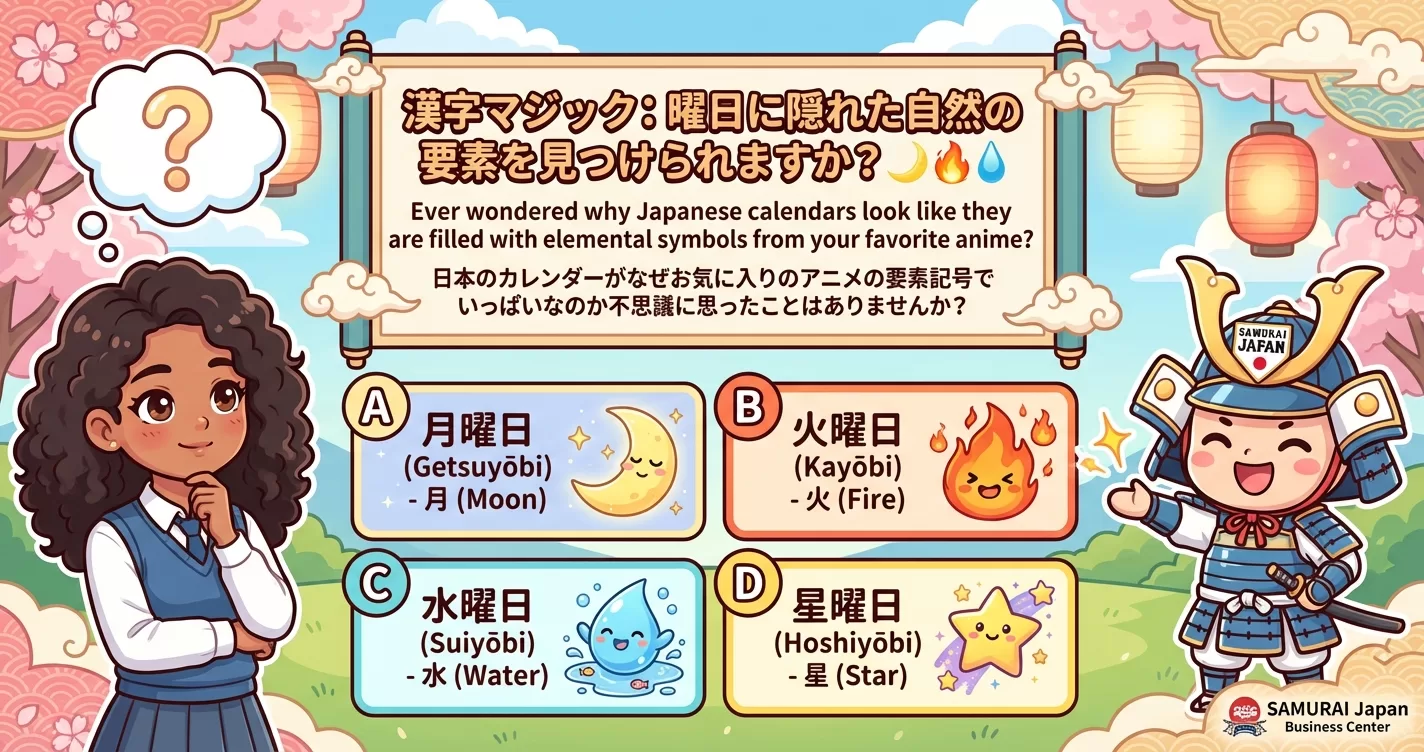
Kanji Magic: Can You Spot the Nature Elements in the Days of the Week? 🌙🔥💧
\n\n
Ever wondered why Japanese calendars look like they are filled with elemental symbols from your favorite anime? Kung mahilig ka sa Naruto, Demon Slayer, or even Avatar: The Last Airbender, siguradong mapapansin mo ang similarities! In Japanese culture, every day of the week is beautifully connected to a specific element of nature. This isn’t just a naming convention; it is a system that dates back centuries, blending astronomy, philosophy, and linguistics into one beautiful package.
\n\n
Imagine you are looking at your planner to schedule a study session. Understanding the meaning behind these characters makes memorizing them much more fun and meaningful. Imbes na basta-basta mo lang silang kabisaduhin bilang \”Monday, Tuesday, Wednesday,\” you will start seeing them as \”The Moon Day, The Fire Day, and The Water Day.\” Let’s test your N5/N4 Kanji knowledge with today’s challenge and explore the deep, elemental roots of the Japanese week!
\n\n
✏️ Quiz Time!
\n
Question: Which Kanji corresponds to Tuesday (Kayoubi) and what nature element does it represent?
\n
A) 水 (みず / Mizu) – Water
B) 火 (ひ / Hi) – Fire
C) 月 (つき / Tsuki) – Moon
\n
\n
Answer: B) 火 (か / Ka)
\n
Explanation: Sa Japanese, ang Tuesday ay tinatawag na 火曜日 (かようび / Kayoubi). Ang unang Kanji nito ay 火, which can be read as Hi (Kun-yomi) or Ka (On-yomi). Ang ibig sabihin nito ay apoy (fire). Very easy to remember because Tuesday is \”Fire Day\”! Sa Taglish, isipin mo na lang na ang Tuesday ay ang araw na \”naglalayab\” ang iyong spirit to start the work week!
\n
\n\n
💡 Did You Know? The names for the days of the week in Japan were actually adopted from the Seven Luminaries (Shichiyosei). This system is based on the Sun, the Moon, and the five planets visible to the naked eye (Mars, Mercury, Jupiter, Venus, and Saturn). These planets were named after the five elements of ancient Chinese philosophy (Wu Xing). Kaya naman ang Japanese week is actually a trip through our solar system!
\n
\n\n
1. The Cosmic Connection: Bakit Elements ang Ginamit?
\n
Before the modern era, people looked at the stars to determine the passage of time. In Japan, this celestial logic was integrated into the language through the Onmyodo (traditional Japanese cosmology). The seven-day cycle was officially adopted during the Meiji era to align with the Western calendar, but the roots are much older.
\n
Each day is represented by a Kanji that carries the essence of a planet. For example, Mars is known as Kasei (Fire Star), hence Tuesday (Kayoubi) becomes Fire Day. Mercury is Suisei (Water Star), making Wednesday the Water Day. When you learn these Kanji, you aren’t just learning how to read a calendar; you are learning how the ancient Japanese viewed the harmony between the heavens and the earth.
\n\n
💡 先生のポイント (Sensei’s Point): Kapag nag-aaral ng Kanji para sa mga araw ng linggo, laging tandaan na ang dulo ay laging 曜日 (ようび / Youbi). Ang pinaka-importante ay ang unang character. If you master the elements (Fire, Water, Wood, Metal, Earth), you automatically master the days of the week!
\n
\n\n
2. The Bookends: The Sun and The Moon (Sunday & Monday)
\n
Everything starts with the two most prominent celestial bodies. Sunday is 日曜日 (Nichiyoubi). The Kanji 日 (Hi/Nichi) represents the sun. It makes sense, right? Sunday is the \”Day of the Sun.\” It’s the day of brightness and rest.
\n
Then we have Monday, which is 月曜日 (Getsuyoubi). The Kanji 月 (Tsuki/Getsu) represents the moon. Just as the moon follows the sun, Monday follows Sunday. In many languages, including English (Mon-day = Moon-day), this connection exists. For a Filipino student, you can think of it this way: ang Monday ay parang \”liwanag sa dilim\” after a long weekend of rest, guiding you back to your routine.
\n\n
3. The Elemental Core: Tuesday to Friday
\n
This is where most students get a bit confused, but there is a beautiful logic to it. Let’s break it down using a specific, practical scenario to help you visualize it.
\n\n
Scenario: Isipin mo na ikaw ay isang student sa SAMURAI Japan Business Center. Nakatanggap ka ng schedule para sa iyong Japanese Language Proficiency Test (JLPT) review classes. Nakita mo ang mga sumusunod na schedule:
\n
- \n
- 火 (Ka): Oral Practice Session
- 水 (Sui): Listening Lab
- 木 (Moku): Reading Comprehension
- 金 (Kin): Mock Exam
\n
\n
\n
\n
\n\n
Why does this matter? If you only know the English translations, you are just memorizing words. But if you see the elements, you can use mnemonics! \nSa Tuesday (火 – Fire), you are \”fired up\” for speaking! \nSa Wednesday (水 – Water), let the Japanese audio \”flow\” through your ears like water. \nSa Thursday (木 – Wood/Tree), think of the paper of your books coming from trees. \nAnd on Friday (金 – Gold/Money), you’ve reached the \”golden\” end of the week where you get your \”reward\” (rest)!
\n\n
💡 先生のポイント (Sensei’s Point): Mapapansin mo na ang Kanji para sa Gold/Money (金) at ang Friday ay pareho. Kaya naman sa Japan, ang Friday is often associated with the phrase \”Premium Friday\” or a time to spend your hard-earned money!
\n
\n\n
4. Saturday: The Earth Connection
\n
Finally, we have Saturday, 土曜日 (Doyoubi). The Kanji 土 (Tsuchi/Do) represents the earth, soil, or ground. After a week of fire, water, and metal, we return to the earth to ground ourselves. Saturday is the time to stay grounded and enjoy home life. In the context of learning at our Business Center, Saturday is often a great time for self-study and \”planting the seeds\” of knowledge that will grow in the coming weeks.
\n\n
5. Visualizing the Sequence: A Master Mnemonic
\n
Para hindi ka malito sa pagkakasunod-sunod ng Tuesday to Friday (the hardest part for most beginners), try this story:
\n
Imagine a small campfire (火 – Tuesday). You need to put it out, so you pour water (水 – Wednesday) on it. Near the damp ground, a tree (木 – Thursday) grows from the moisture. Hidden beneath the roots of that tree, you discover a chest of gold (金 – Friday)!
\n
This simple visual story connects all four days in order. This is the secret to moving from N5 to N4 proficiency—using imagination instead of just repetitive writing.
\n\n
Vocabulary Table: The Elemental Week
\n
| Kanji | Reading (Romaji) | English | Tagalog Element |
|---|---|---|---|
| 日曜日 | Nichiyoubi | Sunday | Araw (Sun) |
| 月曜日 | Getsuyoubi | Monday | Buwan (Moon) |
| 火曜日 | Kayoubi | Tuesday | Apoy (Fire) |
| 水曜日 | Suiyoubi | Wednesday | Tubig (Water) |
| 木曜日 | Mokuyoubi | Thursday | Kahoy/Puno (Tree) |
| 金曜日 | Kinyoubi | Friday | Ginto (Gold/Metal) |
| 土曜日 | Doyoubi | Saturday | Lupa (Earth) |
| 何曜日 | Nanyoubi | What day of the week? | Anong araw? |
\n\n
✏️ Try It Yourself! (Subukan Natin!)
\n
Try to translate these sentences to test your understanding. Pay attention to the Kanji and the particles!
\n
- \n
- 今日は火曜日です。
(Kyou wa Kayoubi desu.)
Tagalog: Ngayon ay Martes (Fire day). - 木曜日にテストがあります。
(Mokuyoubi ni tesuto ga arimasu.)
Tagalog: May test sa Huwebes (Tree day). - 水曜日は忙しいですか?
(Suiyoubi wa isogashii desu ka?)
Tagalog: Busy ka ba sa Miyerkules (Water day)? - 金曜日に友達と会います。
(Kinyoubi ni tomodachi to aimasu.)
Tagalog: Makikipagkita ako sa kaibigan sa Biyernes (Gold day). - 日曜日は休みです。
(Nichiyoubi wa yasumi desu.)
Tagalog: Ang Linggo (Sun day) ay day-off/rest day.
\n
\n
\n
\n
\n
\n\n
よくある質問 (FAQ)
\n
Q1: Bakit may dalawang reading ang Kanji sa mga araw? Halimbawa, \”Nichi\” at \”Hi\” para sa Sun?
A: Ang tawag dito ay On-yomi at Kun-yomi. Sa mga araw ng linggo, karaniwang ginagamit ang On-yomi (Chinese-derived reading) gaya ng Getsu, Ka, Sui. Pero kapag ang element lang ang tinutukoy mo (like saying \”There is fire!\”), gagamitin mo ang Kun-yomi (Japanese reading) gaya ng Hi, Mizu, Tsuchi.
\n \n
Q2: Bakit \”Gold\” (金) ang ginamit para sa Friday at hindi iba?
A: It relates to the planet Venus, which in East Asian cosmology is the \”Gold Star\” (Kinsei). Metals and gold represent strength and value, making it a perfect symbol for the culmination of the work week.
\n\n
Q3: Kailangan ko ba talagang isulat ang Kanji, o pwedeng Hiragana lang?
A: Sa simula, okay lang ang Hiragana, but in real life in Japan, halos lahat ng calendars at schedules ay naka-Kanji. Ang SAMURAI Japan Business Center ay naghihikayat na matutunan ang Kanji early on para mas mabilis kang masanay sa professional environment.
\n
\n\n
🌟 Lesson Summary
\n
The Japanese week is a cycle of nature. By connecting the days to elements (Sun, Moon, Fire, Water, Wood, Metal, Earth), you unlock a deeper understanding of the Japanese language and culture. Remember our campfire story to never forget the sequence again! Keep practicing, and you’ll be reading calendars like a pro in no time.
\n
Gambatte kudasai! You are doing great on your learning journey!
\n
\n\n
🇯🇵 日本語で新しい可能性を広げよう! ✨
\n
SAMURAI Japan Business Centerは、あなたの日本語学習を全力でサポートします。
\n\n
🚀 Start Your Learning Journey Today!
\n
Ready to learn Japanese? Apply for our programs now!
\n 👉 Application Form\n
\n\n
🏫 お問い合わせ (Contact Us)
\n
📞 Phone: +63 997 093 4550
\n
📧 Email: samuraijapan.bc@gmail.com
\n
🏢 Address: Room D3, Freb Bldg, Villa Donata Subd, Muntinlupa
\n
\n\n
📱 SNSで楽しく学ぼう!
\n
- \n
- 🎵 Tiktok: @samuraijapan0221
- 📸 Instagram: @samuraijapan.bc
- ▶️ Youtube: @SamuraiJapan-bc
- 📘 Facebook Page
\n
\n
\n
\n
\n
\n
\n
”
}
