

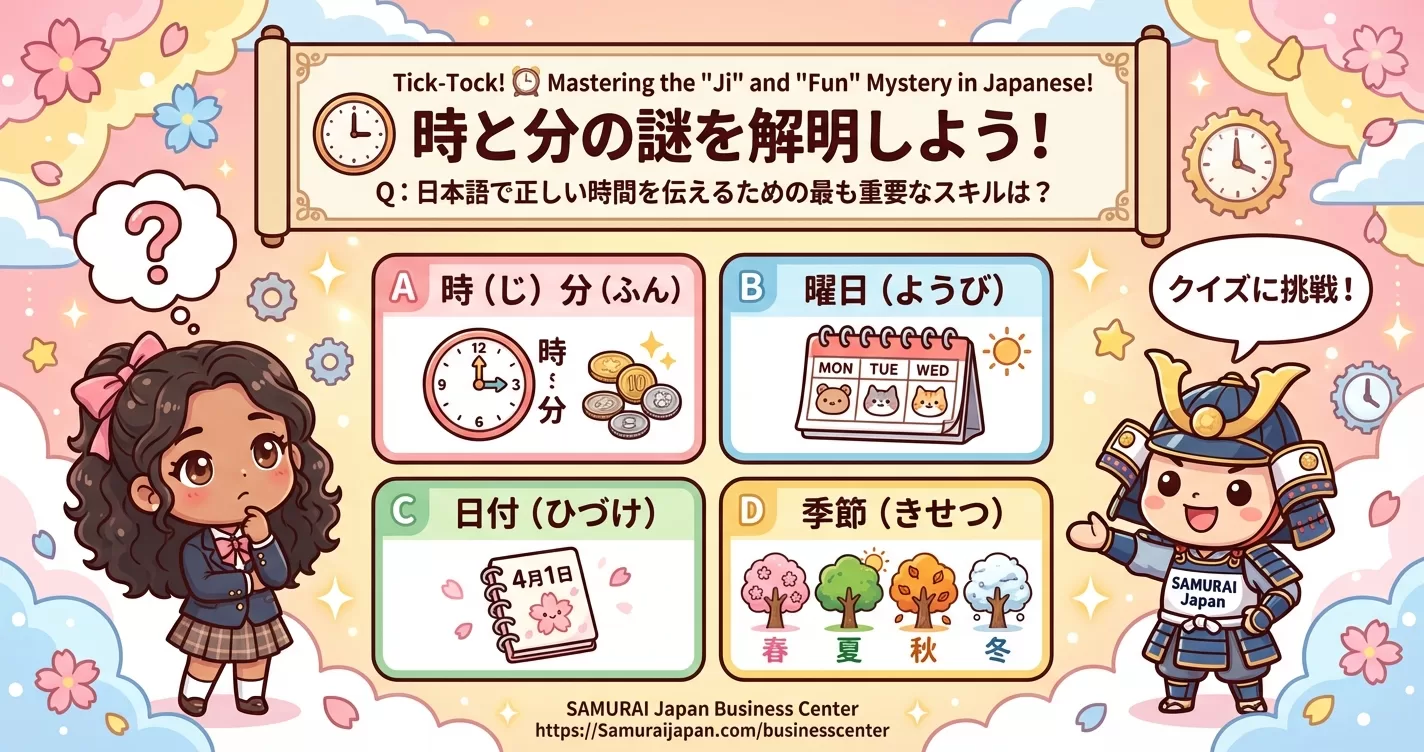
Tick-Tock! 🕰️ Mastering the “Ji” and “Fun” Mystery in Japanese! 🎌
Imagine this: You finally arrive in Tokyo, and you have a very important meet-up with a Japanese friend at a cozy cafe in Shibuya. You agreed to meet at 4:30 PM. You look at your watch, but suddenly, your mind goes blank. Is it “Yon-ji”? Is it “Shi-ji”? And how do you say “thirty minutes” again? Is it “San-juu-fun” or “San-juu-pun”? Before you know it, you are sweating more than you should just by looking at a clock!
Being able to tell the time correctly is one of the most vital “Survival Japanese” skills you can learn. Here at SAMURAI Japan Business Center, we believe that mastering the basics—like time—is the foundation for building confidence in the language. Whether you are checking the schedule for the Shinkansen (Bullet Train), setting an alarm for your favorite anime broadcast, or simply making plans with classmates, time is the heartbeat of daily life in Japan.
Japan is world-famous for its punctuality. In fact, if a train is even one minute late, the railway company might issue a “Delay Certificate” (Chien Shoumeisho) so passengers can prove to their bosses or teachers why they were tardy! Being “on time” in Japan usually means arriving 5 to 10 minutes before the agreed time.
The Quiz: Let’s Test Your Time-Telling Skills!
Before we dive into the deep explanations, let’s see if you can solve our time mystery today! Look at the digital clock below. How would you read this time aloud in a polite Japanese conversation?
いま、なんじですか? (Ima, nanji desu ka?)
[ 4:30 ]
A) よんじ さんじゅっぷん (Yonji sanjuppun)
B) よじ はん (Yoji han)
C) しじ さんじゅっぷん (Shiji sanjuppun)
Correct Answer: B) よじ はん (Yoji han)
Explanation (Taglish):
Medyo tricky ito, ‘di ba? Don’t worry, even advanced students sometimes trip up here! Kasi naman, in Japanese, the number “4” can be “Yon” or “Shi.” Pero pagdating sa Time (Hours), specific rule ang sinusunod natin. Never nating sinasabi ang “Yon-ji” o “Shi-ji.” It must always be よじ (Yoji).
Also, instead of saying “Sanjuppun” (30 minutes), common practice sa Japan na gamitin ang はん (Han), which means “half.” Parang sa English na “half-past four.” So, the most natural way to say 4:30 is Yoji han. Kung gagamit ka naman ng minutes, tandaan na ang 30 minutes ay special case: “Sanjuppun” (with a double ‘p’ sound) and not “Sanjuufun.” Practice makes perfect, kaya let’s break it down further! at SAMURAI Japan Business Center, we make sure these small details stick to your memory!
1. The “Hours” (Ji) and the Three Rebels 🕒
Counting hours in Japanese is generally simple: you take the number and add ~じ (ji). For example, 1:00 is Ichi-ji, and 2:00 is Ni-ji. However, there are three “rebels” in the clock that don’t follow the standard rules. These are the numbers 4, 7, and 9.
Why are they rebels? Because they have multiple readings, but for time-telling, only ONE is correct. If you use the wrong one, a Japanese person will still understand you, but it will sound very “clunky” and unnatural. Let’s look at the SAMURAI breakdown:
- 4:00 (Yoji): Most people learn “Yon” or “Shi” for 4. But for hours, we drop the “n” or the “i” and just say Yo-ji. (Note: “Yonji” is a very common beginner mistake!)
- 7:00 (Shichiji): Even though “Nana” is very popular for 7, for time, we almost exclusively use Shichi-ji.
- 9:00 (Kuji): We use “Kyuu” for the number 9, but for hours, it shortens to Ku-ji.
To remember 4, 7, and 9, think of them as the “Shorty” numbers. They like to keep their names short when they are attached to “Ji”!
4 = Yo (not Yon) | 7 = Shichi (not Nana) | 9 = Ku (not Kyuu).
2. The Minute Maze: “Fun” vs. “Pun” ⏳
This is where most students get a bit of a headache! When counting minutes, the word ~ふん (fun) changes its sound to ~ぷん (pun) depending on the number before it. This happens because of a linguistic phenomenon called euphony—basically, it’s easier to say it that way!
Here is the secret pattern to mastering the first 10 minutes:
| Minute | Japanese Reading | Sound Type |
|---|---|---|
| 1 min | いっぷん (Ippun) | PUN |
| 2 min | にふん (Nifun) | FUN |
| 3 min | さんぷん (Sanpun) | PUN |
| 4 min | よんぷん (Yonpun) | PUN |
| 5 min | ごふん (Gofun) | FUN |
| 6 min | ろっぷん (Roppun) | PUN |
| 7 min | ななふん (Nanafun) | FUN |
| 8 min | はっぷん (Happun) | PUN |
| 9 min | きゅうふん (Kyuufun) | FUN |
| 10 min | じゅっぷん (Juppun) | PUN |
Did you notice the pattern? Numbers 1, 3, 4, 6, 8, and 10 take the “PUN” sound. These are usually accompanied by a small “tsu” (っ) which indicates a double consonant sound (except for 3 and 4).
When you get into higher numbers, like 25 minutes, you just look at the last digit. 25 ends in 5, so it follows the rule for 5: Nijuu-gofun. 48 ends in 8, so it follows the rule for 8: Yonjuu-happun. Simple, right?
3. AM vs. PM: Gozen and Gogo 🌅🌃
In the Philippines, we often say “4 PM” or “Sa hapon.” In Japan, the markers for AM and PM are ごぜん (Gozen) and ごご (Gogo).
The most important thing to remember here is the Word Order. In English, we say “Time + PM” (4:00 PM). In Japanese, it is flipped! You must say the AM/PM marker before the time.
- English: 8:00 AM
- Japanese: ごぜん はちじ (Gozen Hachiji)
- English: 3:00 PM
- Japanese: ごご さんじ (Gogo Sanji)
If you’re ever confused which is which, think of “Gozen” as “Go-Early” (AM) and “Gogo” as “Go-Late” (PM). Or, remember that the letter ‘E’ in Gozen comes before ‘O’ in Gogo alphabetically, just like AM comes before PM!
4. Essential Time Phrases for Daily Life
Knowing the numbers is great, but you need to know how to use them in a sentence. Here are the most common phrases you will use when talking about time. At SAMURAI Japan Business Center, we emphasize practical application!
1. Ima nan-ji desu ka? (What time is it now?)
This is your bread and butter. Ima means “now,” and Nan-ji means “what hour.” Add “desu ka” to make it a polite question.
2. [Event] wa nan-ji kara desu ka? (What time does [Event] start?)
Kara means “from.” If you want to know when a class or a movie starts, this is the phrase to use.
Example: Jugyou wa nan-ji kara desu ka? (What time is the lesson from/starting?)
3. [Event] wa nan-ji made desu ka? (What time does [Event] end?)
Made means “until.”
Example: Shigoto wa nan-ji made desu ka? (Until what time is work?)
4. [Time] ni [Action]. (At [Time], I do [Action].)
The particle ni is used to point at a specific point in time.
Example: Shichi-ji ni okimasu. (I wake up at 7:00.)
Vocabulary Table: Time Mastery 📚
Let’s summarize the key vocabulary you’ve learned in this lesson. Practice saying these aloud to get the rhythm of the language!
| Japanese | Reading | English | Tagalog |
|---|---|---|---|
| いま | Ima | Now | Ngayon |
| なんじ | Nan-ji | What time? | Anong oras? |
| ごぜん | Gozen | A.M. (Morning) | Umaga (A.M.) |
| ごご | Gogo | P.M. (Afternoon) | Hapon/Gabi (P.M.) |
| はん | Han | Half (30 mins) | Kalahati / Medya |
| あさ | Asa | Morning | Umaga |
| よる | Yoru | Night | Gabi |
| とけい | Tokei | Clock / Watch | Relo / Orasan |
✏️ Try It Yourself! (Practice Time)
Can you translate these Tagalog/English sentences into Japanese? Try to use the correct Hours (Ji) and Minutes (Fun/Pun). Don’t forget your AM (Gozen) and PM (Gogo)!
-
It is 7:00 AM now.
(Ngayon ay alas-siyete ng umaga.)
Answer: Ima gozen shichi-ji desu. -
The meeting is at 9:00.
(Ang meeting ay alas-nuebe.)
Answer: Kaigi wa ku-ji ni arimasu. -
I sleep at 11:30 PM.
(Natutulog ako ng alas-onse medya ng gabi.)
Answer: Gogo juu-ichi-ji han ni nemasu. -
What time is it now? It is 6:10.
(Anong oras na? Alas-sais dyes na.)
Answer: Ima nan-ji desu ka? Roku-ji juppun desu. -
Lunch is at 12:00.
(Ang tanghalian ay alas-dose.)
Answer: Hirugohan wa juu-ni-ji desu.
📝 Lesson Summary Banner
✅ Hours: Remember the rebels: 4 (Yo-ji), 7 (Shichi-ji), 9 (Ku-ji).
✅ Minutes: Follow the Fun/Pun rules. 1, 3, 4, 6, 8, 10 use “Pun”!
✅ Half-past: Use “Han” for 30 minutes.
✅ AM/PM: Put “Gozen” or “Gogo” BEFORE the time.
Learning time-telling might feel like a whirlwind of numbers and sound changes, but remember that every master was once a beginner who kept trying. Each time you check your watch or look at your phone, try to say the time in Japanese in your head. Eventually, “Yoji han” will come out of your mouth as naturally as your own name!
Here at SAMURAI Japan Business Center, we are dedicated to making your Japanese learning journey as smooth and enjoyable as possible. We focus on these tiny nuances that make a huge difference in how you are perceived by Japanese speakers. Keep up the great work, and don’t let the clock discourage you—you’re doing great!
Ganbatte kudasai! (Do your best!) 🌸
🇯🇵 日本語で新しい可能性を広げよう! ✨
SAMURAI Japan Business Centerは、あなたの日本語学習を全力でサポートします。
🚀 Start Your Learning Journey Today!
TikTok: @samuraijapan0221 / Instagram: @samuraijapan.bc
