

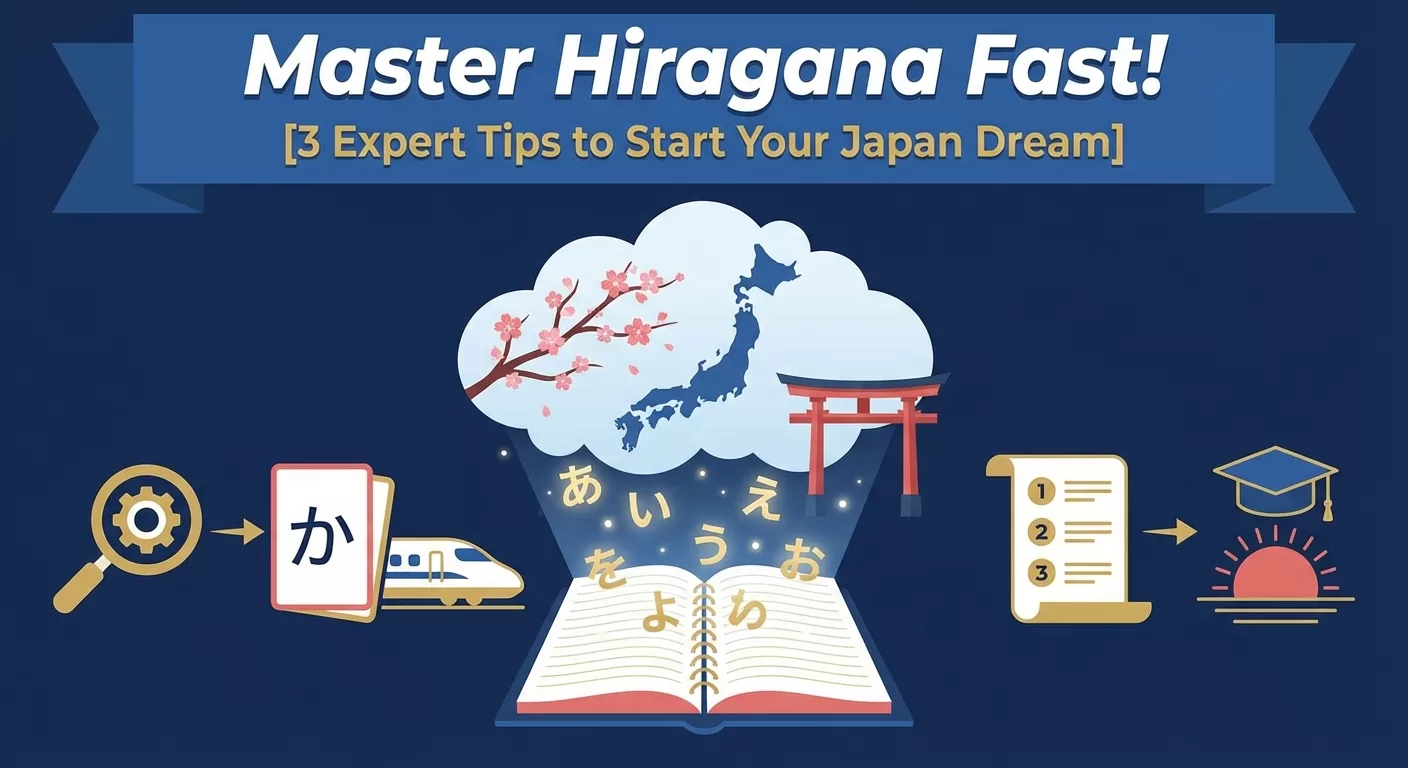
Master Hiragana Fast! [3 Expert Tips to Start Your Japan Dream]
Konnichiwa, future Japan travelers and students! If you are reading this, it means you have taken the first courageous step toward your dream of living and working in the Land of the Rising Sun. Learning a new language can feel like climbing Mount Fuji, but every great journey begins with a single step. For Japanese, that step is Hiragana. It is the foundation of everything you will do, from reading street signs in Tokyo to texting your new Japanese friends.
こんにちは、将来日本で活躍することを目指している皆さん!この記事を読んでいるということは、日本で暮らす、あるいは働くという夢に向かって、勇気ある第一歩を踏み出したということですね。新しい言語を学ぶのは、まるで富士山に登るような挑戦に感じるかもしれませんが、どんなに長い旅も最初の一歩から始まります。日本語におけるその一歩こそが「ひらがな」です。東京で看板を読んだり、日本の友人とメッセージをやり取りしたり、すべての基礎となるのがひらがななのです。
💡 Teacher’s Insight:
Many Filipino students try to rely on “Romaji” (Japanese written with English letters) for too long. My advice? Drop Romaji as soon as possible! Learning Hiragana immediately improves your pronunciation and helps you understand the rhythm of the language.
💡 先生からのアドバイス:
多くのフィリピン人学習者が、いつまでも「ローマ字」に頼ってしまいがちです。私からのアドバイスは、「できるだけ早くローマ字を卒業すること」です!ひらがなを覚えることで、発音が劇的に良くなり、日本語特有のリズムを理解できるようになります。
1. Use the Power of Mnemonics (Visual Associations)
The human brain is wired to remember images much better than abstract lines. When you look at a Hiragana character like 「あ」(a), don’t just see strokes—see a story! For example, many students imagine 「あ」 looks like an “Apple” with a stem. Or look at 「く」(ku); it looks exactly like a “Cuckoo” bird’s beak opening to sing!
人間の脳は、抽象的な線よりも画像を覚えるのが得意です。「あ」という文字を見るとき、ただの線として捉えるのではなく、物語として捉えてみましょう!例えば、多くの学生は「あ」をリンゴ(Apple)の形に見立てて覚えます。また、「く」はどうでしょうか。クックー(カッコウ)のくちばしが開いているように見えませんか?
- Character:「し」(shi)
Imagine a “Fishing Hook”. It’s a simple curve that looks just like the tool you use to catch fish.
- Character:「へ」(he)
Think of a “Heavenly Mountain” or a hill. It’s a simple upward and downward slope.
- Character:「も」(mo)
Think of “More fish” on a hook. It looks like the hook 「し」 but with two extra lines to catch more fish!
- 文字:「し」
釣り針(Fishing Hook)をイメージしてください。魚を釣る道具そっくりのシンプルなカーブです。
- 文字:「へ」
高い山(Heavenly Mountain)や丘を思い出してください。登って下りるだけのシンプルな形です。
- 文字:「も」
釣り針にもっと(More)たくさんの魚がかかっている様子です。「し」の形に2本の線が加わっていますね。
⚠️ Common Mistake Alert:
Filipino learners often confuse 「め」(me) and 「ぬ」(nu). Remember: 「ぬ」 has a “noodle” loop at the end, while 「め」 does not. Just think: “No Noodle in Me (め)!”
⚠️ よくある間違い:
フィリピン人学習者はよく「め」と「ぬ」を間違えます。覚え方はこうです。「ぬ」には最後にヌードル(麺)のような「結び目」がありますが、「め」にはありません。「め」にはヌードルは無い、と覚えましょう!
2. Master the “Gojuon” Chart Structure
Instead of trying to memorize 46 random characters, view them as a logical grid. This is called the Gojuon (50 Sounds) chart. It is organized by 5 vowels (A, I, U, E, O) and consonant groups (K, S, T, N, H, M, Y, R, W). Understanding this pattern makes learning feel like a game of Bingo!
46個の文字をバラバラに覚えようとするのではなく、論理的な表として捉えましょう。これは「五十音図」と呼ばれます。5つの母音(あ・い・う・え・お)と、子音グループ(か・さ・た・な・は・ま・や・ら・わ)で構成されています。このパターンを理解すれば、まるでビンゴゲームのように楽しく覚えられます!
The Basic Hiragana Groups
| Vowel → | A | I | U | E | O |
|---|---|---|---|---|---|
| Basic | あ (a) | い (i) | う (u) | え (e) | お (o) |
| K-Group | か (ka) | き (ki) | く (ku) | け (ke) | こ (ko) |
| S-Group | さ (sa) | し (shi) | す (su) | せ (se) | そ (so) |
By learning one row per day, you can finish all the basic characters in less than two weeks! Don’t rush. Spend your morning writing the “K-row” and your evening testing yourself. Consistency is much better than cramming for 5 hours in one day.
1日に1行ずつ覚えれば、2週間足らずで基本的な文字をすべてマスターできます!焦る必要はありません。午前中に「か行」を書き、夜に自分でテストをしてみましょう。1日に5時間詰め込むよりも、毎日コツコツ続けることが大切です。
3. Immerse Yourself: Write and Read Daily
To truly own Hiragana, you must bring it into your real life. Stop writing your name in English; start writing it in Katakana (or Hiragana for practice). Label items around your house like 「つくえ」(tsukue – desk) or 「いす」(isu – chair). When you see a Japanese word on a snack wrapper, try to sound it out even if you don’t know the meaning yet.
ひらがなを完全に自分のものにするためには、日常生活に取り入れる必要があります。自分の名前を英語で書くのをやめて、練習のためにひらがな(あるいはカタカナ)で書いてみましょう。家の中の物に「つくえ」や「いす」といったラベルを貼るのも効果的です。お菓子のパッケージに日本語を見つけたら、意味がわからなくても声に出して読んでみてください。
- Use Flashcard Apps:
Apps like Anki or Duolingo are great, but physical flashcards help with muscle memory. Writing by hand is a “cheat code” for learning!
- Follow Japanese Social Media:
Look at simple Japanese Instagram accounts. Seeing Hiragana in colorful, real-world contexts makes it less scary.
- The 5-Minute Rule:
Commit to reading just 5 Hiragana words every morning while drinking your coffee. Small habits lead to big results.
- 単語カードアプリを使う:
AnkiやDuolingoなどのアプリも素晴らしいですが、手書きの単語カードは筋肉の記憶(マッスルメモリー)を助けます。手で書くことは、学習における「裏技」です!
- 日本のSNSをフォローする:
簡単な日本語を使っているInstagramアカウントを見てみましょう。カラフルでリアルな文脈の中でひらがなを見ることで、苦手意識がなくなります。
- 5分間ルール:
毎朝コーヒーを飲みながら、ひらがなの単語を5つだけ読むと決めてください。小さな習慣が大きな成果につながります。
Special Advice for Filipino Students
As a teacher who has helped many Filipinos, I’ve noticed that your English and Tagalog skills are actually a huge advantage! The Japanese vowel sounds (A-I-U-E-O) are very similar to the Tagalog vowels. You already have the basic “tuning” for Japanese pronunciation!
多くのフィリピン人学生を指導してきた教師として、皆さんの英語やタガログ語のスキルは実は大きな武器になると感じています!日本語の母音(あ・い・う・え・お)は、タガログ語の母音と非常によく似ています。皆さんはすでに、日本語の発音のための「基礎知識」を身につけているのです!
💡 Pronunciation Tip:
In Tagalog, the “R” sound is often rolled or very strong. In Japanese, the 「ら・り・る・れ・ろ」 (Ra-Ri-Ru-Re-Ro) sounds are softer, almost like a mix between “L” and “D”. Imagine tapping the roof of your mouth gently with your tongue!
💡 発音のコツ:
タガログ語では「R」の音が巻き舌になったり、強く発音されたりすることが多いです。しかし、日本語の「ら・り・る・れ・ろ」はもっと柔らかく、「L」と「D」の中間のような音です。舌の先で口の天井を軽く叩くようなイメージで発音してみましょう!
Conclusion: Your Future in Japan Starts Now!
Learning Hiragana might feel like a small thing, but it is the key that unlocks the door to your future. Once you can read Hiragana, you can start learning grammar, vocabulary, and eventually pass the exams needed for your journey. Don’t worry about being perfect. Even the best Japanese speakers started with 「あ」, 「い」, 「う」!
ひらがなを覚えることは小さなことに思えるかもしれませんが、それはあなたの未来の扉を開く鍵です。ひらがなが読めるようになれば、文法や語彙の学習が始まり、最終的には夢の実現に必要な試験にも合格できるようになります。完璧主義になる必要はありません。どんなに日本語が上手な人も、みんな最初は「あ・い・う」から始めたのです!
Believe in yourself, keep practicing every day, and we will be here to support you every step of the way. Your Japan dream is closer than you think. Let’s study together! Ganbatte kudasai! 🇯🇵💪
自分を信じて、毎日練習を続けてください。私たちは皆さんの歩みを一歩一歩サポートします。日本での夢は、思ったよりもすぐ近くにあります。一緒に勉強しましょう!頑張ってください!🇯🇵💪
🚀 Start Your Journey to Japan!
Ready to learn Japanese? Apply for our programs now!
Contact & Follow Us
お問い合わせ
📞 電話: +63 997 093 4550
📧 メール: samuraijapan.bc@gmail.com
🏠 住所: Room D3, Freb Bldg, Villa Donata Subd, Muntinlupa
🏢 会社名: SAMURAI Japan Business Center Inc.
SNSでフォロー
🎵 Tiktok: @samuraijapan0221
📸 Instagram: @samuraijapan.bc
▶️ Youtube: @SamuraiJapan-bc
📘 Facebook: Visit our Page
