

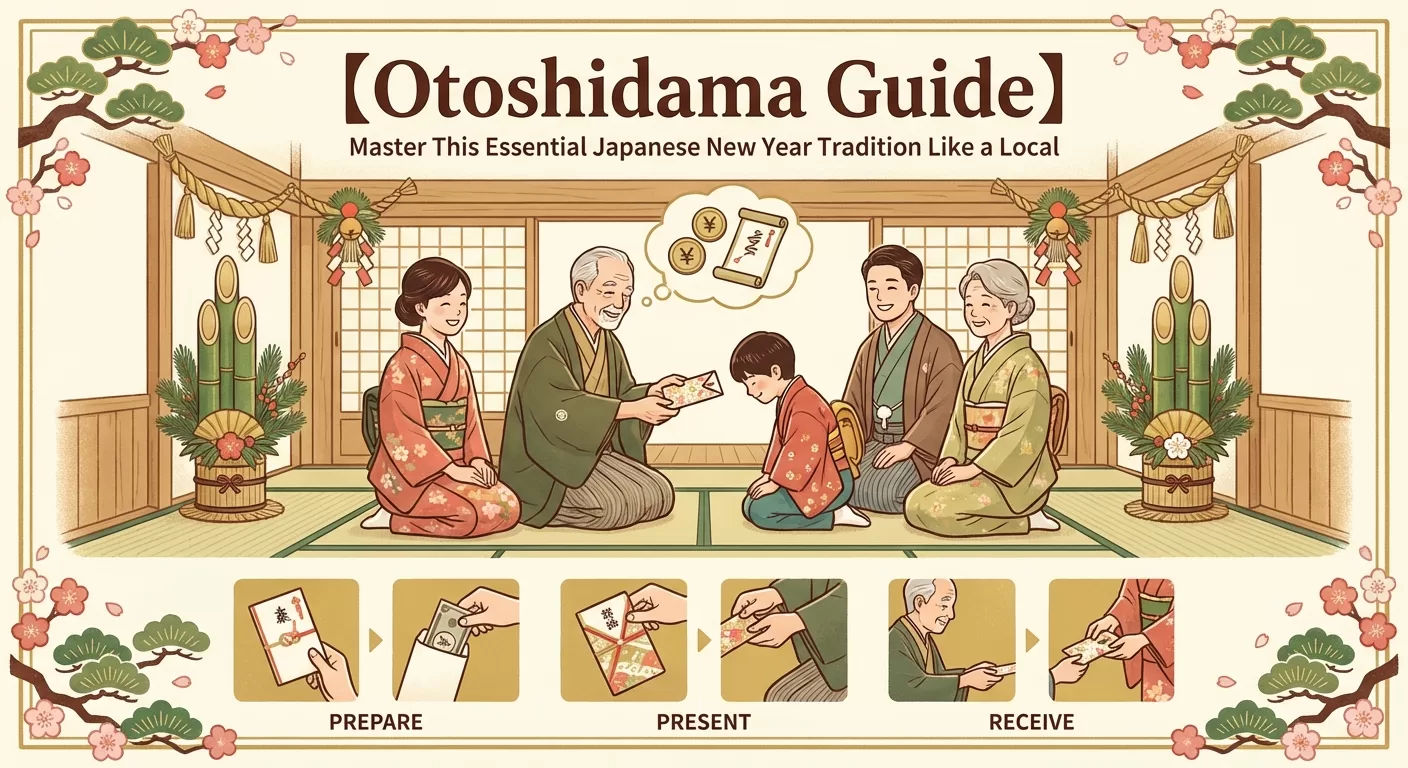
【Otoshidama Guide】Master This Essential Japanese New Year Tradition Like a Local
Akemashite Omedetou Gozaimasu (Happy New Year)! 🇯🇵 If you are planning to live in Japan or are already there, the New Year (Oshogatsu) is the most significant holiday of the year. While the Philippines has its wonderful traditions like Noche Buena and the colorful “Aguinaldo,” Japan has a very special custom called Otoshidama (お年玉).
For many Filipino students and workers, experiencing your first Japanese New Year can be both exciting and a bit confusing. You might see cute little envelopes in convenience stores or watch children bowing politely to their elders before receiving a gift. This is Otoshidama—the tradition of giving money to children during the first few days of January. Understanding this custom isn’t just about money; it’s about showing respect, building relationships, and integrating into Japanese society. In this guide, I will walk you through everything you need to know to master this tradition like a pro! 💡
💡 Teacher’s Tip:
Just like the “Ang Pao” or “Aguinaldo” in the Philippines, Otoshidama is about the spirit of giving. However, Japanese culture places a very high value on the *manner* in which you give. Following the rules of etiquette shows your Japanese friends and neighbors that you truly respect their culture.
1. What exactly is Otoshidama? (History & Meaning)
- The Origin of the Name
The word “Otoshidama” literally translates to “New Year’s Gift.” Historically, it comes from the phrase “Toshigami-sama no mi-toshi-dama” (the spirit/soul of the New Year God). In ancient times, people didn’t give money. Instead, they offered round rice cakes called Kagami-mochi to the gods, and then shared those rice cakes with children to symbolize passing on the “soul” or “strength” for the new year.
- The Modern Practice
Over time, the tradition shifted from rice cakes to small gifts, and eventually to cash during the Edo period. Today, it is a standard practice for adults (parents, grandparents, aunts, uncles, and family friends) to give money to the children in their lives. It usually applies to children from infancy all the way through university age.
- The Timing
Otoshidama is strictly a New Year activity. It is typically given during the first three days of January, known as “Sanganichi.” If you meet a friend’s child later in January, it is still acceptable to give, but the prime time is the very start of the year.
2. The Art of the Pochi-bukuro (Envelopes)
In Japan, you should never give cash “naked” (bare bills). Handing someone an uncovered bill is considered quite rude. Instead, you must use special small envelopes called Pochi-bukuro (ポチ袋). 🧧
- Where to buy them
Starting in December, you will see these everywhere! You can find them at 100-yen shops (like Daiso), convenience stores (Lawson, 7-Eleven), stationery stores, and even supermarkets. They come in thousands of designs, from traditional Japanese patterns to popular anime characters like Pikachu or Demon Slayer.
- Choosing the right design
If you are giving to a young child, a character-themed envelope is usually a big hit! For older students (high school or university), a more elegant or “cool” traditional design is more appropriate. The word “Pochi” actually comes from a Kansai dialect word meaning “a little bit,” implying that the gift is a small token of your feelings.
⚠️ Common Mistake Alert:
Never use envelopes intended for weddings (Shuugibukuro) or funerals (Koudenbukuro) for Otoshidama. Wedding envelopes are usually very large and ornate with gold strings, while funeral ones use black and white. Stick to the small, palm-sized Pochi-bukuro!
3. The Golden Rules: How Much Should You Give?
This is the question every Filipino in Japan asks! While there is no “law,” there are social standards based on the child’s age. Giving too much can actually make the parents feel burdened (because they might feel they have to give a large amount back to your children!), and giving too little might seem stingy.
Typical Otoshidama Amounts (Per Child)
| Child’s Age/Grade | Recommended Amount (Yen) | Notes |
|---|---|---|
| Preschool (3-6 years) | 1,000 – 2,000 JPY | A single 1,000 yen bill is perfect. |
| Lower Elementary (Grades 1-3) | 2,000 – 3,000 JPY | Often three 1,000 yen bills. |
| Upper Elementary (Grades 4-6) | 3,000 – 5,000 JPY | 5,000 yen is very common here. |
| Junior High School | 5,000 JPY | The standard for teens. |
| High School / University | 5,000 – 10,000 JPY | Depends on your closeness to the family. |
⚠️ Numbers to Avoid:
Avoid giving amounts starting with 4 (Shi = Death) or 9 (Ku = Suffering). These are considered unlucky in Japan. Stick to amounts like 1,000, 3,000, 5,000, or 10,000.
4. Step-by-Step Guide: Folding Bills and Writing Names
Because the Pochi-bukuro envelopes are small, you cannot put a flat bill inside. You have to fold it, but there is a specific way to do it correctly! 📝
- Use Crisp, New Bills
In Japan, it is highly preferred to use “Shin-satsu” (freshly printed, crisp bills). It shows that you prepared in advance for the recipient. If you can’t get new ones from the bank, use the cleanest ones you have.
- The “Three-Fold” Technique
1. Place the bill face up on the table (the side with the portrait).
2. Fold the left third of the bill toward the center.
3. Fold the right third over that.
4. The bill should now be a small rectangle. Insert it into the envelope so that when the child pulls it out and unfolds it, the portrait is facing them. - Writing on the Envelope
On the front of the envelope (usually top left), write the child’s name with the honorific “-chan” or “-kun.” For example: 「たろうくんへ」(To Taro-kun). On the back, write your own name so the parents know who gave it.
5. The Etiquette of Giving and Receiving
Manners (Reigi) are the heart of Japanese culture. Whether you are the one giving or the one helping your child receive, keep these points in mind: ✅
- How to Give
Always hold the envelope with both hands when handing it to the child. This shows sincerity. Avoid giving it while the child’s parents aren’t looking; it’s better to give it in front of them so they can acknowledge it.
- What to Say
While handing it over, you can say: 「あけましておめでとう。今年(ことし)もよろしくね。」(Akemashite omedetou. Kotoshi mo yoroshiku ne.) which means “Happy New Year. Let’s have a good year together.”
- Teaching your children to Receive
If your child receives Otoshidama, make sure they use both hands to take it and say 「ありがとうございます」(Arigatou gozaimasu). In Japan, it is also considered polite not to open the envelope immediately in front of the giver. Children should wait until they are home or in private.
💡 Teacher’s Tip for Parents:
If your child receives Otoshidama from a Japanese friend, you should thank the friend later too. A simple message or saying “Thank you for the Otoshidama the other day” next time you meet is very appreciated.
6. Key Vocabulary and Phrases for Oshogatsu
To help you feel more confident during the New Year celebrations, let’s learn some essential Japanese vocabulary related to this season! 🇯🇵
- お年玉 (Otoshidama)
New Year’s monetary gift for children.
- ポチ袋 (Pochi-bukuro)
Small envelopes used for Otoshidama.
- あけましておめでとうございます (Akemashite omedetou gozaimasu)
Happy New Year! (Use this from January 1st onwards).
- 今年もよろしくお願いします (Kotoshi mo yoroshiku onegaishimasu)
Please treat me well again this year. (A very important polite phrase).
- お正月 (Oshogatsu)
The Japanese New Year period.
Summary Checklist for Otoshidama
| Item | Check ✅ |
|---|---|
| Pochi-bukuro Envelope | Prepared in advance (not bare cash). |
| Crisp Bill (Shin-satsu) | Clean, new bills used. |
| Correct Folding | Folded in three, portrait facing in. |
| Names Written | Recipient on front, sender on back. |
| Two-Handed Delivery | Given politely with both hands. |
Conclusion: Celebrate and Connect!
Mastering the custom of Otoshidama is a wonderful way to show your commitment to living and thriving in Japan. It might seem like a lot of small rules at first, but remember that the goal is to build “Kizuna” (bonds) with the people around you. Whether you are giving 1,000 yen to a neighbor’s toddler or teaching your own children how to bow and say “Arigatou,” you are participating in a beautiful, centuries-old tradition.
Don’t worry if your folding isn’t perfect or if you feel a little nervous. Japanese people usually appreciate the effort that foreigners make to learn their customs. The fact that you are trying to do it “the Japanese way” will leave a lasting positive impression. 🇯🇵✨
We hope this guide helps you feel ready for your next Oshogatsu! Stay curious, keep practicing your Japanese, and enjoy the wonderful cultural experiences that Japan has to offer. You’ve got this! Ganbatte kudasai!
Contact & Follow Us
お問い合わせ
📞 電話: +63 997 093 4550
📧 メール: samuraijapan.bc@gmail.com
🏠 住所: Room D3, Freb Bldg, Villa Donata Subd, Muntinlupa
🏢 会社名: SAMURAI Japan Business Center Inc.
SNSでフォロー
🎵 Tiktok: @samuraijapan0221
📸 Instagram: @samuraijapan.bc
▶️ Youtube: @SamuraiJapan-bc
📘 Facebook: Visit our Page
