

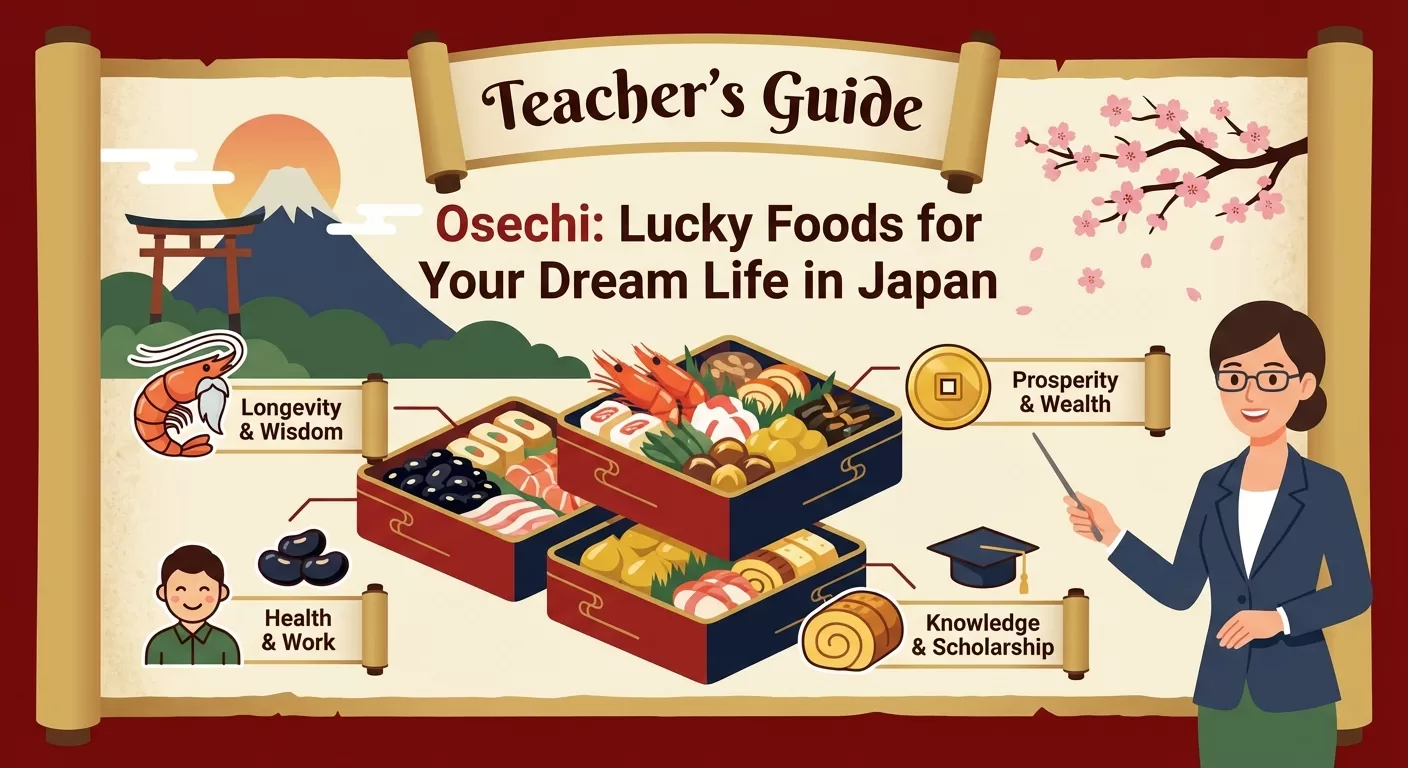
【Teacher’s Guide】 Osechi: Lucky Foods for Your Dream Life in Japan 🍱✨
Mabuhay! Are you dreaming of starting a new chapter in the Land of the Rising Sun? As you prepare for your journey to Japan, learning the language is just the beginning. To truly feel at home and succeed in your new environment, understanding the heart of Japanese culture—its traditions and food—is essential! 🇯🇵
Today, we are going to dive into one of the most important and beautiful parts of the Japanese New Year (Oshougatsu): Osechi Ryori (おせち料理). Think of it as the Japanese version of “Noche Buena,” but specifically for the New Year. These are not just delicious dishes; they are “lucky foods” filled with wishes for health, wealth, and happiness. Let’s explore these colorful boxes together so you’ll be ready to celebrate like a local!
💡 Teacher’s Insight:
In Japan, the New Year is the most significant holiday of the year. While Filipinos celebrate loudly with fireworks, the Japanese New Year is usually quiet, solemn, and focused on family. Knowing about Osechi will give you a great “conversation starter” when talking with Japanese people!
🍱 The Tradition of Osechi Ryori: More Than Just a Meal
The tradition of Osechi began over a thousand years ago. Originally, it was considered a way to offer food to the gods (Toshigami-sama) who visit each home during the New Year. One interesting fact is that Osechi dishes are designed to last for several days without refrigeration. Why? Because in the past, it was a taboo to use a hearth or cook during the first three days of the New Year, giving the “God of Fire” a rest—and giving hardworking mothers a well-deserved break from the kitchen! 🏠✨
Osechi is served in special lacquered boxes called Juubako (重箱). These boxes are stacked on top of each other. The stacking symbolizes the idea of “stacking up luck” (shiawase wo kasaneru) for the coming year. Usually, there are three to four layers, each filled with different types of food.
⚠️ Culture Note:
When you are invited to a New Year gathering, remember that Osechi is shared. Use the serving chopsticks (取り箸 – toribashi) provided rather than your own personal chopsticks to take food from the Juubako. It’s all about respect and hygiene!
🥢 Decoding the Lucky Ingredients: What Should You Eat?
Every single item in an Osechi box has a specific meaning. If you want to have a successful “Dream Life” in Japan, you might want to eat a lot of these! Here are the most famous ingredients and the “luck” they bring:
- Kuromame (黒豆 – Black Soybeans)
The word “mame” means bean, but it also sounds like the word for “working hard” or “health” (mame ni hataraku). Eating these sweet, shiny black beans represents a wish to live and work hard in good health throughout the year. 💡 For Filipino learners, this is a great reminder to stay “mame” with your Japanese studies!
- Kazunoko (数の子 – Herring Roe)
“Kazu” means number and “ko” means child. Because herring roe contains thousands of tiny eggs, it symbolizes the wish for many children and a prosperous family lineage. It’s crunchy, salty, and very popular!
- Tazukuri (田作り – Candied Sardines)
The name literally translates to “rice paddy maker.” Historically, small sardines were used as fertilizer for rice fields. Eating these symbolizes a wish for an abundant harvest—or in modern terms, success in your endeavors and “reaping what you sow.”
- Kurikinton (栗きんとん – Mashed Sweet Potato with Chestnuts)
Because of its bright golden color, Kurikinton represents wealth and financial prosperity. The word “kinton” (金団) literally means “golden dumpling.” Eat this if you want to save up for your future goals in Japan! 💰
- Ebi (海老 – Shrimp)
Look at a shrimp—it has a curved back and long whiskers. This looks like an elderly person! Therefore, Ebi represents a wish for longevity—living until your back is bent and you have a long beard. It’s a wish for a long, happy life.
- Datemaki (伊達巻 – Sweet Rolled Omelet)
This looks like a scroll (makimono). In ancient Japan, scrolls were used for knowledge and learning. Eating Datemaki is a wish for progress in your studies and gaining wisdom. 📚
Summary of Osechi Meanings
| Dish Name | Symbolism | Wish For… |
|---|---|---|
| Kuromame | Black Beans | Health & Hard Work |
| Kurikinton | Golden Chestnuts | Wealth & Money |
| Ebi | Shrimp | Long Life |
| Datemaki | Rolled Omelet | Knowledge & Study |
🌸 Essential New Year Vocabulary for Filipino Learners
When you are in Japan during the New Year, you will hear many specific phrases. Let’s learn the most important ones so you can greet your Japanese friends and neighbors confidently!
- Akemashite Omedetou Gozaimasu (あけましておめでとうございます)
This is the standard way to say “Happy New Year.” Wait! Only use this after January 1st. If you want to say “Have a good year” before December 31st ends, say “Yoi otoshi wo!”
- Oshougatsu (お正月)
The Japanese New Year period. Usually, the first three days are the most important (Sanganichi).
- Hatsumode (初詣)
The very first visit to a shrine or temple in the New Year. People go to pray for safety and success in the coming year. You might see long lines at famous shrines!
- Otoshidama (お年玉)
This is something many Filipino students find interesting! It is the tradition of giving money to children in decorated envelopes. It’s similar to the “Ampao” or “Aginaldo” we have in the Philippines, but specifically for New Year’s Day.
- Ozouni (お雑煮)
A traditional soup containing Mochi (rice cakes) and vegetables. Be careful when eating Mochi—it is very sticky! Every region in Japan has a different style of Ozouni (clear soup vs. miso soup).
🌟 Overcoming Cultural Hurdles: Tips for Success
Moving to a new country can feel overwhelming, but don’t worry! As your teacher, I want to share a few tips on how to embrace these traditions to make your life easier:
- Don’t Be Shy to Try:
Some Osechi flavors might be new to you—some are very sweet, and some are fishy. Even if it’s unfamiliar, try a small piece. Japanese people deeply appreciate it when foreigners show interest in their traditional food.
- Learn the “Pun” Culture:
As you saw with Kuromame and Tazukuri, Japanese culture loves wordplay (puns). Learning the “why” behind the food helps you remember the vocabulary. This “playful” side of the language makes learning much more fun!
- Practice Your Greetings:
In the Philippines, we are very warm and vocal. In Japan, the New Year greeting is often accompanied by a polite bow. Practice saying “Kotoshi mo yoroshiku onegaishimasu” (I look forward to your kindness again this year). It’s the perfect way to build strong relationships with your future Japanese colleagues.
💡 Teacher’s Tip for Exams:
If you are preparing for exams like the JFT-Basic or JLPT, cultural questions about “Oshougatsu” and “Osechi” often appear in the listening or reading sections. Knowing these terms now will give you a head start!
🌈 Conclusion: Your Future is “Stacked” with Luck!
Just like the layers of the Juubako, your journey to Japan is a process of stacking skills, language, and cultural understanding one by one. Learning about Osechi Ryori is more than just learning about food—it’s about understanding the Japanese spirit of gratitude, hope, and family.
Whether you are studying hard in Manila, Cebu, or anywhere in the Philippines, remember that every word you learn brings you one step closer to your dream life. Stay “Mame” (diligent), keep your eyes on the “Golden” opportunities, and always aim for a “Long and Prosperous” journey ahead. Japan is waiting for you with open arms and a delicious box of Osechi!
Ganbatte kudasai! You can do this! 🎉🇯🇵
Contact & Follow Us
お問い合わせ
📞 電話: +63 997 093 4550
📧 メール: samuraijapan.bc@gmail.com
🏠 住所: Room D3, Freb Bldg, Villa Donata Subd, Muntinlupa
🏢 会社名: SAMURAI Japan Business Center Inc.
SNSでフォロー
🎵 Tiktok: @samuraijapan0221
📸 Instagram: @samuraijapan.bc
▶️ Youtube: @SamuraiJapan-bc
📘 Facebook: Visit our Page
