

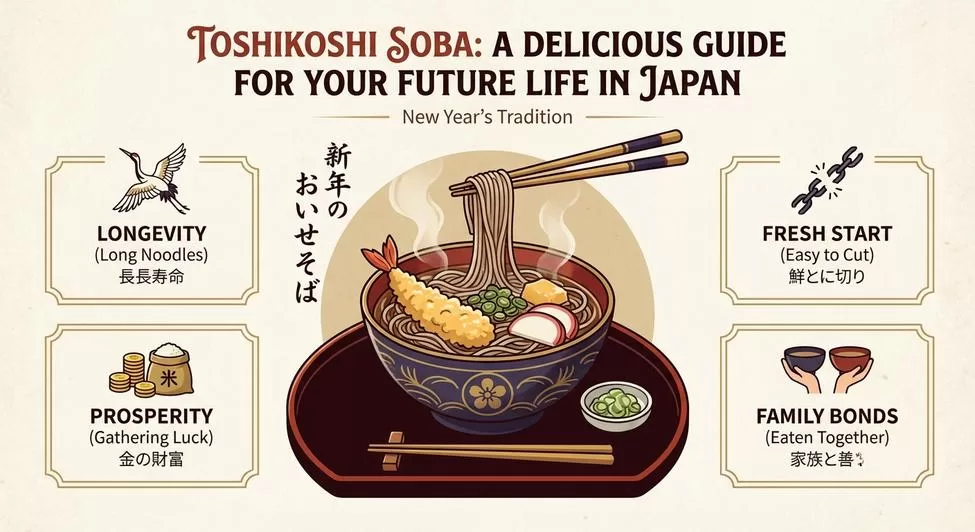
【New Year’s Tradition】 Toshikoshi Soba: A Delicious Guide for Your Future Life in Japan
Hello, everyone! 🇯🇵 Are you ready to step into a new chapter of your life in the Land of the Rising Sun? As your Japanese language teacher, I am always thrilled to see your progress. While learning grammar and Kanji is essential, understanding Japanese culture is just as important for your success and happiness once you arrive in Japan. 🌸
Today, we are going to talk about a very special tradition that happens every December 31st: Toshikoshi Soba (年越しそば). In the Philippines, we celebrate “Media Noche” with loud fireworks and a big family feast. In Japan, the atmosphere is more peaceful and reflective, and eating these long buckwheat noodles is the star of the night. Let’s dive into this delicious tradition so you can impress your Japanese friends and neighbors in the future! 🍜✨
1. What is Toshikoshi Soba? The Meaning Behind the Noodles 💡
The word Toshikoshi (年越し) literally means “crossing the year.” Therefore, Toshikoshi Soba is the “Year-Crossing Noodle.” This tradition started during the Edo period (more than 200 years ago!) and remains one of the most practiced customs in modern Japan.
💡 Teacher’s Insight:
Food in Japan is rarely “just food.” Almost every traditional dish has a symbolic meaning. When you eat Toshikoshi Soba, you aren’t just filling your stomach; you are participating in a ritual to wish for health and fortune in the coming year.
Why soba? Why not ramen or udon? Soba is made from buckwheat, and it has specific physical characteristics that represent four main wishes for the New Year:
The 4 Symbols of Toshikoshi Soba
| Symbol | Meaning | The Logic |
|---|---|---|
| Long Life | Longevity (長寿 – Chouju) | The long, thin shape of the noodle represents a long and healthy life. |
| Cutting Hardship | Breaking bad luck (厄切り – Yakugiri) | Soba noodles are easier to bite through than udon. This symbolizes “cutting off” the hardships of the past year. |
| Resilience | Strength | The buckwheat plant is strong and can survive harsh weather, representing a wish for a resilient spirit. |
| Wealth | Fortune (金運 – Kin’un) | Historically, goldsmiths used soba flour to gather up gold dust. Eating it is thought to attract wealth! |
2. When and How to Eat It: Don’t Make This Mistake! ⚠️
Timing is everything when it comes to Toshikoshi Soba. Unlike Media Noche, where we eat exactly at midnight, the rules for Toshikoshi Soba are a bit different. Most families eat it on the evening of December 31st (Omisoka). However, there is one very important rule you must remember.
⚠️ Common Mistake Alert:
You must finish eating your soba before the clock strikes 12:00 AM! It is believed that if you have leftover noodles when the New Year begins, you are “carrying over” the bad luck and hardships of the previous year into the new one. Finish your bowl early! ✅
Depending on which part of Japan you live in, the style of soba might change. For example:
- Kanto Region (Tokyo area): Darker, saltier broth made with dark soy sauce.
The flavor is bold and strong, which matches the fast-paced energy of Tokyo.
- Kansai Region (Osaka/Kyoto area): Lighter, clearer broth made with light soy sauce and kelp (kombu).
The taste is more delicate and focuses on the “umami” of the dashi.
3. Useful Vocabulary for Your First Japanese New Year 🗣️
As a student, learning the vocabulary related to these traditions will help you join conversations with Japanese coworkers or friends. Here are some key words to memorize!
| Japanese (Kanji/Kana) | Romaji | English Meaning |
|---|---|---|
| 大晦日 | Omisoka | New Year’s Eve (Dec 31) |
| 蕎麦 | Soba | Buckwheat noodles |
| だし | Dashi | Japanese soup stock |
| 薬味 | Yakumi | Condiments (Green onion, wasabi) |
| 明けましておめでとう | Akemashite Omedetou | Happy New Year! (Used after Jan 1) |
📝 Study Tip:
Practice saying 「良いお年を」(Yoi otoshi wo) on December 30th or 31st. It means “Have a good year (transition)!” It’s the standard greeting before the New Year actually starts.
4. Table Manners: To Slurp or Not to Slurp? 🍜
One of the biggest cultural shocks for Filipinos in Japan is the sound of people eating noodles. In the Philippines, slurping is often considered rude. However, in Japan, especially when eating soba, slurping is encouraged!
The sound “zuzuzu” (the Japanese onomatopoeia for slurping) actually serves a purpose:
- Better Flavor: Slurping brings air into your mouth along with the noodles, which enhances the aroma and flavor of the buckwheat.
- Cooling: It helps cool down the hot noodles as they enter your mouth.
- A Sign of Enjoyment: It shows the cook that you are enjoying the meal!
When you are sitting at a small soba shop in Japan, don’t be shy! Try to slurp just a little bit. It will make you feel like a local. 🇯🇵👍
5. Popular Toppings to Make Your Soba Special 🍤
While you can eat soba “Kake” style (plain noodles in hot broth), most people add delicious toppings to make it a festive meal. Here are some favorites you will find in Japanese supermarkets:
- Ebi-Ten (Shrimp Tempura): 🍤
The most popular choice for Toshikoshi Soba. Shrimp symbolize longevity because their curved bodies look like an elderly person’s back, and their long feelers look like a beard.
- Kamaboko (Fish Cake): 🍥
Usually pink and white. These colors are considered lucky in Japan and are often used during celebrations.
- Abura-age (Deep-fried Tofu): 🦊
Soba with this topping is called “Kitsune Soba.” It is sweet and savory, and very comforting during a cold winter night.
- Negi (Green Onions): 🟢
A simple but essential topping that adds a fresh crunch to the soup.
💡 Teacher’s Tip for Life in Japan:
On December 31st, Japanese supermarkets are extremely crowded. Everyone is buying tempura and soba. If you want to prepare your own Toshikoshi Soba, try to buy your ingredients a day early, or go very early in the morning!
Prepare for Your Dream Life in Japan! 🇯🇵🎉
Living in Japan is more than just working; it’s about experiencing a rich, beautiful culture that values tradition and community. Learning about customs like Toshikoshi Soba shows that you are not just a visitor, but someone who respects and wants to integrate into Japanese society. This attitude will take you very far in your journey!
I know learning Japanese can be hard sometimes. The Kanji can be confusing, and the particles can be tricky. But remember, every step you take brings you closer to your dream. Just like the soba noodles represent a long life, may your journey to Japan be long, prosperous, and filled with delicious memories!
Keep studying hard, stay curious about the culture, and never give up. We are here to support you every step of the way! Ganbatte kudasai! (Keep doing your best!) 💪✨
Contact & Follow Us
お問い合わせ
📞 電話: +63 997 093 4550
📧 メール: samuraijapan.bc@gmail.com
🏠 住所: Room D3, Freb Bldg, Villa Donata Subd, Muntinlupa
🏢 会社名: SAMURAI Japan Business Center Inc.
SNSでフォロー
🎵 Tiktok: @samuraijapan0221
📸 Instagram: @samuraijapan.bc
▶️ Youtube: @SamuraiJapan-bc
📘 Facebook: Visit our Page
