

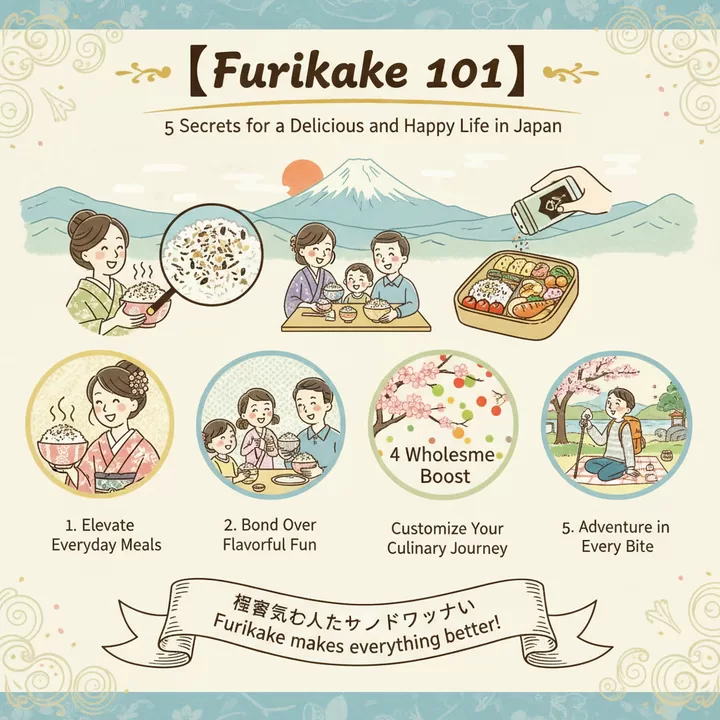
【Furikake 101】 5 Secrets for a Delicious and Happy Life in Japan
Kumusta, future Japanese language students and dreamers! 🇯🇵 Are you imagining your life in Japan? Perhaps you see yourself walking through cherry blossom parks, studying in a cozy library, or working in a bustling city. But let’s talk about something very important: What are you going to eat?
For us Filipinos, rice is life. We understand that a meal isn’t complete without a warm bowl of rice. In Japan, they feel the exact same way! However, if you are busy studying or working, you might not always have time to cook a grand Filipino feast like Adobo or Sinigang. This is where Furikake (ふりかけ) comes in. It is the “secret weapon” of every household in Japan, and today, I want to teach you how this simple seasoning can make your life in Japan much happier, easier, and more delicious.
As a teacher at a Japanese language school, I’ve seen many students struggle with the transition to a new food culture. Understanding furikake is more than just about food—it’s your first step into understanding the Japanese heart. Let’s dive into the 5 secrets of Furikake 101! 🍚✨
1. What is Furikake? The Magic Powder for Your Rice 🍚
The word furikake (ふりかけ) comes from the verb “furikakeru,” which means “to sprinkle over.” It is a dry Japanese seasoning meant to be sprinkled on top of cooked rice. It usually consists of a mixture of dried fish, sesame seeds, chopped seaweed (nori), sugar, salt, and sometimes even freeze-dried egg or vegetables.
- The History of Nutrition:
Did you know that furikake was originally invented by a pharmacist in the early 1900s? It was created to help Japanese people get more calcium in their diet! They ground up fish bones and mixed them with seeds. Today, it’s a delicious treat that everyone loves. 💡
- The Perfect Companion:
In Japan, furikake is often called “Gohan no Tomo” (ご飯の友), which literally means “A Friend for Rice.” For a student living on a budget or a busy worker, it provides an instant burst of flavor to a simple bowl of white rice.
💡 Teacher’s Tip:
Japanese rice is “sticky” (mochi-mochi) compared to the long-grain rice we usually have in the Philippines. Furikake sticks perfectly to Japanese rice, making every bite flavorful! Don’t be afraid to try different brands—they are very affordable, usually only 100 to 200 Yen per pack!
2. The Top 5 Flavors You Must Try 🌟
When you enter a Japanese supermarket like Seiyu, Aeon, or even a convenience store like Lawson, you will see an entire shelf dedicated to furikake. It can be overwhelming! To help you choose, I have prepared a table of the most popular flavors that Filipino students usually enjoy.
Recommended Furikake Flavors for Beginners
| Flavor Name | What’s Inside? | Taste Profile |
|---|---|---|
| Noritama (のりたま) | Seaweed (Nori) and Egg (Tama) | Sweet, savory, and very popular with kids and adults! |
| Sake (さけ) | Dried Salmon flakes | Salty and rich. Great for those who love seafood. |
| Katsuo (かつお) | Bonito flakes (Smoked Tuna) | Deep umami flavor with a hint of soy sauce. |
| Yukari (ゆかり) | Red Shiso (Perilla) leaves | Sour and salty. Very refreshing on a hot day! |
| Sukiyaki (すき焼き) | Beef flavor and soy sauce | Meaty and sweet. Tastes like a mini-beef bowl! |
3. Essential Vocabulary for Your Food Journey 🗣️
To survive and thrive in Japan, you need to know how to talk about your food! When you go to the supermarket or eat with your Japanese friends, using these words will make you sound more natural and polite. Let’s practice some “Foodie Vocabulary.”
- Oishii (おいしい):
This is the standard word for “Delicious.” Use this when you eat something you like! If you want to be very polite to your host, say “Oishii desu!”
- Umai (うまい):
This also means “Delicious” but is more casual. It’s often used by men or between close friends. Be careful not to use it in formal situations!
- Shoppai (しょっぱい):
This means “Salty.” Some furikake can be quite salty, so use this word to describe the intensity. “Chotto shoppai desu ne” (It’s a bit salty, isn’t it?).
- Amami (甘み):
This refers to “Sweetness.” Many Japanese seasonings have a balance of salt and sugar.
- Kakeru (かける):
This is the verb for “to pour” or “to sprinkle.” When you ask someone if they want furikake, you might hear: “Furikake wo kakemasu ka?”
⚠️ Common Mistake Alert:
Don’t confuse 「おいしい」(Oishii) with 「おそろしい」(Osoroshii)! Oishii means delicious, while Osoroshii means “scary” or “terrible.” You don’t want to tell your Japanese friend their cooking is scary! 😂
4. Beyond the Rice Bowl: Creative Furikake Hacks 💡
While furikake is famous for rice, its versatility is one of the secrets to a happy life in Japan. When you are living alone and trying to save money, you can get creative! Here are some ways to use furikake like a pro:
- The “Wafu” Pasta:
Boil some spaghetti, toss it with a little butter or olive oil, and sprinkle a generous amount of Noritama or Sake furikake. You’ve just made “Wafu” (Japanese-style) pasta in 10 minutes! 🍝
- Onigiri (Rice Balls):
When you make your lunch box (Bento) for school or work, mix the furikake directly into the rice before shaping it into a ball. This ensures every bite is flavorful, even when the rice is cold. ✅
- Popcorn Seasoning:
Want a unique snack while watching Netflix? Sprinkle some furikake over your popcorn. The savory and salty mix is addictive!
- Toast with a Twist:
Put a little mayonnaise on bread, sprinkle some furikake, and toast it. It sounds strange, but the “Mayo-Furikake Toast” is a secret favorite for many students! 🍞
✅ Cultural Insight:
In Japan, leaving even a single grain of rice in your bowl is considered disrespectful to the farmers. Furikake helps you enjoy every single grain, making it easy to finish your meal with a grateful heart!
5. Shopping and Etiquette: How to Buy Like a Local 🛒
When you arrive in Japan, one of your first missions will be grocery shopping. Here is how to navigate the furikake aisle and some manners to remember at the dining table.
- Where to Buy:
For the best variety, go to a large supermarket. For the best price, visit 100-yen shops like Daiso or Can-Do. They have surprisingly good selections of famous brands like Marumiya or Mishima.
- Check for Allergies:
If you are allergic to shrimp (ebi) or eggs (tamago), be sure to look at the back of the package. Look for these kanji: 卵 (Egg), えび (Shrimp), 小麦 (Wheat).
- The “Itadakimasu” Rule:
Before you sprinkle your furikake and start eating, always put your hands together and say 「いただきます」(Itadakimasu). This means “I humbly receive this meal.” After finishing, say 「ごちそうさまでした」(Gochisousama deshita).
- Sharing is Caring:
If you are eating in a dormitory or a shared house, offering to share your “discovery” of a new furikake flavor is a great way to start a conversation with your Japanese roommates! 🤝
Enjoy Your Journey to Japan! 🇯🇵🎉
Transitioning to life in Japan is an exciting adventure, but it’s the small things—like finding a favorite flavor of furikake—that truly make a place feel like home. By learning these simple words and cultural habits, you are already building a bridge between the Philippines and Japan.
Remember, language learning isn’t just about passing exams; it’s about the life you will live and the people you will meet. Don’t be afraid to try new things, even if it’s just a different color of seasoning on your rice. Your journey is just beginning, and we are here to support you every step of the way!
You can do this! Ganbatte kudasai! (Good luck!) 🌸
Contact & Follow Us
お問い合わせ
📞 電話: +63 997 093 4550
📧 メール: samuraijapan.bc@gmail.com
🏠 住所: Room D3, Freb Bldg, Villa Donata Subd, Muntinlupa
🏢 会社名: SAMURAI Japan Business Center Inc.
SNSでフォロー
🎵 Tiktok: @samuraijapan0221
📸 Instagram: @samuraijapan.bc
▶️ Youtube: @SamuraiJapan-bc
📘 Facebook: Visit our Page
