

{
“title”: “The ‘Moshi Moshi’ Panic 🎌”,
“content”: “
The ‘Moshi Moshi’ Panic 🎌
\n
By SAMURAI Japan Business Center | [Life in Japan] | 📖 10 min read
\n
\n\n
Have you ever spent hours studying your Japanese textbook, feeling like a total pro, only to have your mind go completely blank the moment you actually need to speak? For many Filipino students, this is a very common experience! We call it the \”Nihongo Freeze.\” You have the vocabulary, you know the grammar, but when the pressure is on—especially over the phone—everything just disappears into thin air.
\n\n
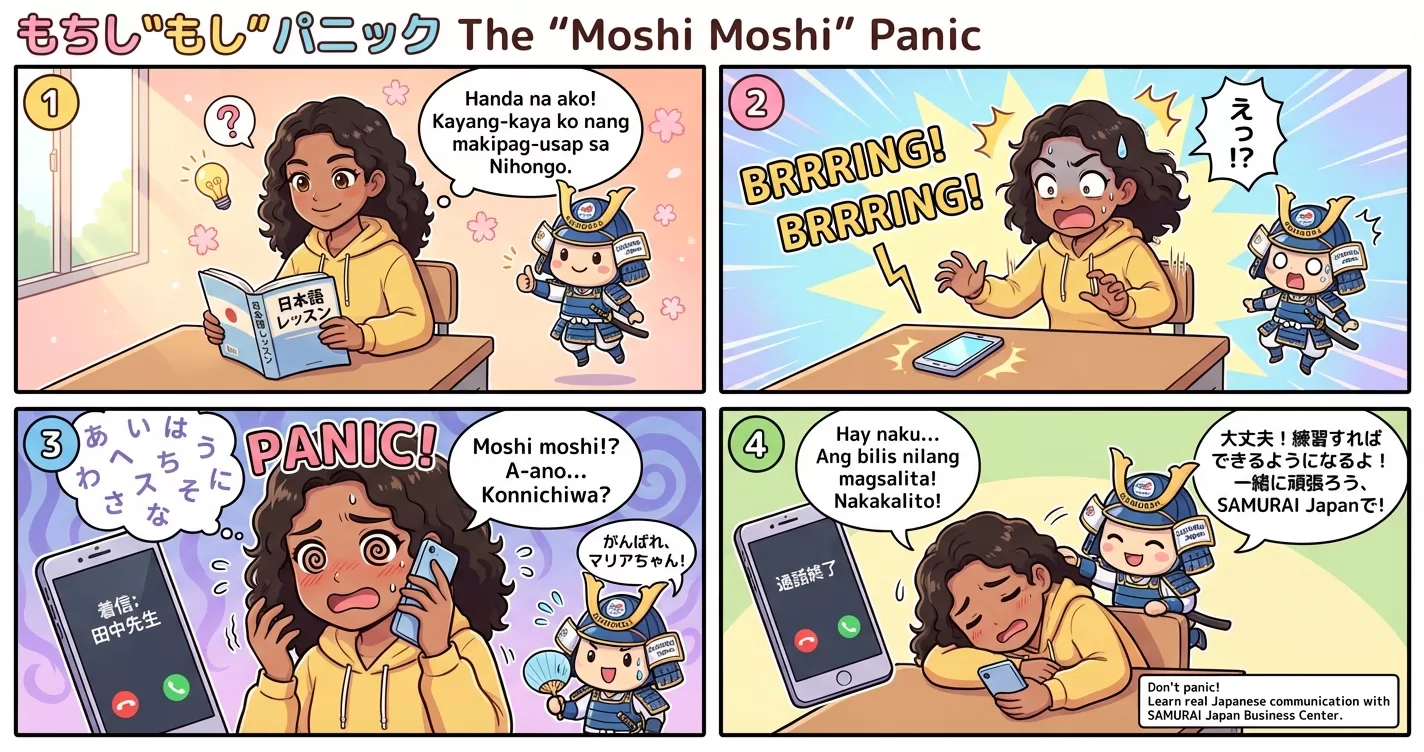
In our latest story, we meet Maria. She’s a dedicated student who was feeling incredibly confident about her skills. She had her textbook open, her notes ready, and she was telling herself, \”Handa na ako! Kayang-kaya ko nang makipag-usap sa Nihongo!\” (I’m ready! I can definitely speak in Japanese!). But then, her phone rang. Suddenly, the confidence turned into a \”Hala!\” moment. When she answered, the only words that came out were: もしもし (moshi moshi). Even though she knew so much more, that one simple phrase was her only lifeline!
\n\n
💡 Did You Know?
\n
The phrase \”Moshi Moshi\” is actually a shortened version of the polite verb \”mousu\” (申す), which means \”to say\” or \”to speak\” in a humble way. In the past, people would say \”Mousu, mousu\” to get someone’s attention. Over time, it evolved into the catchy \”Moshi Moshi\” we use today!
\n
\n\n
📞 Why Do We Say It Twice?
\n
You might wonder why Japanese people don’t just say \”Moshi\” once. There is a fascinating bit of Japanese folklore behind this! In Japanese legend, ghosts and shapeshifting foxes (kitsune) cannot say \”Moshi\” twice. They can only say it once. Therefore, by saying もしもし (moshi moshi), you are proving to the person on the other end that you are a human being and not a trickster spirit! While we don’t worry about foxes on the phone today, the habit has stayed with the language for centuries.
\n\n
For a beginner, もしもし (moshi moshi) is the ultimate safety net. It signals that you are there, you are listening, and you are ready to communicate. Even if you forget every other word like Maria did, saying this phrase keeps the conversation alive. It gives you those precious few seconds to breathe and remember the next part of your sentence.
\n\n
💡 先生のポイント (Teacher’s Tip):
\n
In Japan, we only use \”Moshi Moshi\” on the phone. Never use it to greet someone face-to-face! If you want to get someone’s attention in person, use \”Sumimasen\” instead. Using \”Moshi Moshi\” in person sounds a bit like saying \”Hello? Is anyone in there?\” and can come across as a bit rude!
\n
\n\n
🏢 Handling Professional Calls
\n
At SAMURAI Japan Business Center, we teach our students that while \”Moshi Moshi\” is great for friends and family, business situations are a bit different. In a professional setting, or even when calling a place of business, the etiquette changes. Often, the person answering the phone will not say \”Moshi Moshi\” at all. Instead, they will say the company name followed by でございます (de gozaimasu).
\n\n
For example, if you were to call us, you might hear, \”Hai, SAMURAI Japan Business Center de gozaimasu!\” In this case, your response shouldn’t be \”Moshi Moshi,\” but rather a polite greeting like お世話になっております (osewa ni natte orimasu). This phrase is a bit of a \”magic phrase\” in Japan—it basically translates to \”Thank you for our ongoing relationship/support.\” Even if it’s your first time calling, it’s a very polite way to start a conversation in a business-like environment.
\n\n
Practical Scenario: Imagine you need to call to inquire about Japanese language programs. You are nervous, just like Maria. Your heart is beating fast. Before you dial, write down a few key phrases on a piece of paper. This \”cheat sheet\” is your best friend! If you freeze up, you can simply look down and read the phrases. It helps prevent the \”brain fog\” that Maria experienced.
\n\n
🤝 The Importance of \”Aizuchi\” (Responsive Listening)
\n
One reason Maria might have panicked is the silence on the other end. In the Philippines, we might wait for the other person to finish a long sentence before responding. In Japan, however, phone conversations involve a lot of 相槌 (aizuchi). These are small \”nodding words\” that show you are still listening.
\n\n
When someone is talking to you on the phone in Japanese, you should frequently say things like はい (hai), ええ (ee), or そうですか (sou desu ka). If you stay silent for too long, the Japanese person on the other end might think the call has been disconnected! They might even ask, \”Moshi moshi?\” to check if you are still there. This is exactly what happened to Tanaka-sensei in our story—he heard Maria’s silence and kept checking if she was okay.
\n\n
💡 先生のポイント (Teacher’s Tip):
\n
Don’t be afraid to ask the speaker to slow down! You can say: ゆっくりお願いします (Yukkuri onegaishimasu). Most Japanese people are very patient with learners and will appreciate that you are trying your best to understand.
\n
\n\n
📚 Key Vocabulary
\n
| Japanese | Reading | English | Tagalog |
|---|---|---|---|
| もしもし | Moshi moshi | Hello (on phone) | Hello (sa telepono) |
| 電話 | Denwa | Telephone | Telepono |
| 緊張する | Kinjou suru | To get nervous | Kabahan / Ma-tense |
| 忘れる | Wasureru | To forget | Makalimot |
| もう一度 | Mou ichido | One more time | Isa pa / Ulitin |
| 失礼します | Shitsurei shimasu | Goodbye (polite) | Paalam (pormal) |
\n\n
✏️ Try It Yourself!
\n
Practice these sentences to boost your confidence before your next call:
\n
- \n
- もしもし、マリアです。
(Moshi moshi, Maria desu.)
Hello, this is Maria. / Hello, si Maria ito. - すみません、もう一度お願いします。
(Sumimasen, mou ichido onegaishimasu.)
Excuse me, one more time please. / Pasensya na po, paki-ulit po uli. - はい、わかりました。
(Hai, wakarimashita.)
Yes, I understand. / Opo, naintindihan ko. - では、失礼します。
(Dewa, shitsurei shimasu.)
Well then, goodbye. / Sige po, paalam na po.
\n
\n
\n
\n
\n
\n\n
よくある質問 (FAQ)
\n
Q: 「もしもし」の由来とは? (What is the origin of Moshi Moshi?)
\n
A: It comes from the humble verb \”mousu\” (to say). In the Meiji era, it was common to say \”moushi-moushi\” to politely get someone’s attention. It eventually became the standard way to answer the phone!
\n
\n
Q: ビジネスで「もしもし」を使わないのはなぜか? (Why is Moshi Moshi not used in business?)
\n
A: In a professional setting, \”Moshi Moshi\” is considered a bit too casual. Using the company name or saying \”Hai, [Your Name] desu\” is more respectful. It’s similar to how you wouldn’t just say \”Hey!\” when answering an office phone in the Philippines.
\n
\n
Q: 緊張して何も言葉が出てこない時はどうすればいいですか? (What should I do if I’m too nervous to speak?)
\n
A: Just remember Maria! Even if you only remember \”Moshi Moshi,\” that is okay. Take a deep breath, say \”Chotto matte kudasai\” (Please wait a moment), and look at your notes. The person on the other end will understand that you are a student!
\n
\n\n
Language learning is a journey filled with funny mistakes and small victories. Maria’s \”Moshi Moshi Panic\” is something we have all gone through. The key is not to be perfect, but to keep trying! At SAMURAI Japan Business Center, we believe that every mistake is a stepping stone to fluency. Tanaka-sensei wasn’t laughing at Maria; he was laughing with her because he knows how much effort she is putting in.
\n\n
💡 Today’s Lesson:
\n
Don’t be afraid of the telephone! Prepare a few basic phrases, use \”aizuchi\” to show you’re listening, and remember that even a simple \”Moshi Moshi\” is a successful start to a conversation. Keep practicing and your confidence will grow every day!
\n
\n\n
🇯🇵 日本語で新しい可能性を広げよう! ✨
\n
SAMURAI Japan Business Centerは、あなたの日本語学習を全力でサポートします。
Let’s achieve your dreams together!
\n
🚀 Start Your Learning Journey Today!
\n
Ready to learn Japanese? Apply for our programs now!
\n 👉 Application Form\n
\n
🏫 お問い合わせ (Contact Us)
\n
📞 Phone: +63 997 093 4550
\n
📧 Email: samuraijapan.bc@gmail.com
\n
🏢 Address: Room D3, Freb Bldg, Villa Donata Subd, Muntinlupa
\n
\n
📱 SNSで楽しく学ぼう!
\n
- \n
- 🎵 Tiktok: @samuraijapan0221
- 📸 Instagram: @samuraijapan.bc
- ▶️ Youtube: @SamuraiJapan-bc
- 📘 Facebook Page
\n
\n
\n
\n
\n
\n
\n
”
}
