
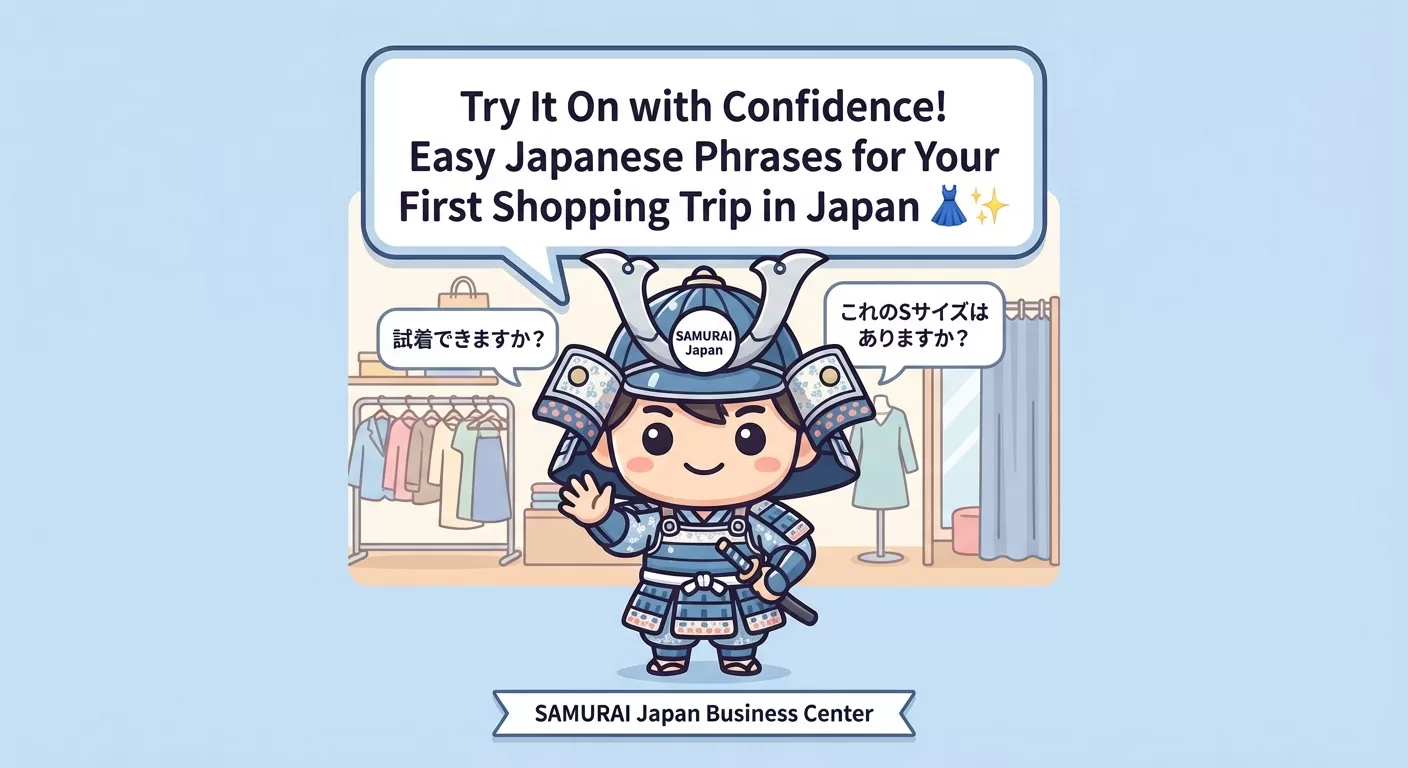
Try It On with Confidence! Easy Japanese Phrases for Your First Shopping Trip in Japan 👗✨
Executive Summary: Shopping for clothes in Japan is more than a transaction — it is a cultural exchange. When you step into a Japanese boutique, you are entering a space shaped by omotenashi (hospitality), precise etiquette, and precise language. This guide, prepared by the senior training consultants at SAMURAI Japan Business Center, gives you the essential phrases, manners, and professional communication patterns that transform nervous first-time shoppers into confident, respectful customers. From asking to try something on to confirming sizes, colors, and payment, every phrase here is a building block of your broader Business Manners and Language Training journey.
要約: 日本での洋服の買い物は、単なる取引ではなく文化的な交流です。日本のブティックに足を踏み入れることは、おもてなし、正確なマナー、そして正確な言葉に形作られた空間に入ることを意味します。SAMURAI Japan Business Centerのシニア・トレーニング・コンサルタントが作成したこのガイドは、緊張した初めての買い物客を、自信に満ちた敬意ある顧客に変える必須フレーズ、マナー、プロのコミュニケーションパターンをお伝えします。試着のお願いから、サイズ、色、支払いの確認まで、ここにあるフレーズひとつひとつが、あなたのビジネスマナーと言語トレーニング全体の基盤となるのです。
1. Entering the Store & Basic Greetings / 入店と基本の挨拶
When you enter a Japanese clothing store, staff will greet you with a cheerful 「いらっしゃいませ!」 (Irasshaimase!). This means “Welcome!” and does not require a verbal reply — a warm smile or a light bow is the ideal response. If you need help, begin every request with 「すみません」 (Sumimasen), which functions as a polite “Excuse me.”
日本の洋服店に入ると、スタッフが明るく「いらっしゃいませ!」と声をかけてくれます。これは「Welcome!」の意味で、言葉で返す必要はありません。笑顔や軽い会釈が最適な返事です。助けが必要なときは、必ず「すみません」から話し始めましょう。丁寧な「Excuse me」の役割を果たします。
At SAMURAI Japan Business Center, we teach that these small non-verbal cues are not trivia — they are core competencies of Business Manners. Recognizing how a Japanese professional greets and acknowledges a customer is the same skill you will need in a Japanese workplace.
SAMURAI Japan Business Centerでは、こうした小さな非言語のサインは雑学ではなく、ビジネスマナーの核心的な能力であると教えています。日本のプロがどのように挨拶し、お客様を認識するかを理解することは、日本の職場で必要となるスキルそのものです。
| English | Japanese | Romaji |
|---|---|---|
| Excuse me. | すみません。 | Sumimasen. |
| I’m just looking. | 見ているだけです。 | Miteiru dake desu. |
| Do you have this in another size? | これは他のサイズがありますか? | Kore wa hoka no saizu ga arimasu ka? |
2. Asking to Try Clothes On / 試着をお願いする
In Japan, you should always confirm with a staff member before using a fitting room. The fitting room is called 「試着室」 (Shichakushitsu). The key phrase is 「試着してもいいですか?」 (Shichaku shitemo ii desu ka?) — “May I try this on?”
日本では、試着室を使う前に必ず店員さんに確認しましょう。試着室は「試着室(しちゃくしつ)」と言います。中心となるフレーズは「試着してもいいですか?」です。
For students preparing to work in Japan, this pattern — polite permission-seeking — is used constantly in offices and factories. Practicing it in a shopping context builds the exact muscle memory you will later use in a workplace.
日本での就労を目指す学生にとって、この「丁寧に許可を求める」パターンは、職場や工場で頻繁に使われます。買い物の場面で練習しておくことが、後に職場でそのまま使える「筋肉記憶」を育てます。
Pro-Tip / お役立ち情報: Many Japanese stores provide a thin disposable “face cover” (フェイスカバー) so makeup does not stain the clothing. Also, always remove your shoes before stepping into the fitting room. This is a strict etiquette rule.
多くの日本の店では、メイクが服に付かないように薄い使い捨ての「フェイスカバー」が用意されています。また、試着室に入る前には必ず靴を脱いでください。これは厳格なマナーです。
| English | Japanese | Romaji |
|---|---|---|
| May I try this on? | 試着してもいいですか? | Shichaku shitemo ii desu ka? |
| Where is the fitting room? | 試着室はどこですか? | Shichakushitsu wa doko desu ka? |
| It is a little big. | ちょっと大きいです。 | Chotto ookii desu. |
3. Checking Sizes and Colors / サイズと色を確認する
If the item does not fit or you prefer another color, do not hesitate to ask. Use the pattern 「〜はありますか?」 (~ wa arimasu ka?) — “Do you have ~?” For example, 「小さいサイズはありますか?」 (Chiisai saizu wa arimasu ka?) means “Do you have a smaller size?”
サイズが合わない、あるいは別の色が良い場合は、遠慮なく聞きましょう。「〜はありますか?」というパターンを使います。例えば、「小さいサイズはありますか?」は、より小さいサイズがあるかを尋ねる表現です。
This is a transferable Business Manners skill: asking clarifying questions politely is one of the most valued behaviors in a Japanese operation floor. Whether you are confirming a shirt size or a shipment quantity, the tone of the question matters.
これは応用可能なビジネスマナーのスキルです。確認の質問を丁寧にする姿勢は、日本の現場で最も評価される行動のひとつです。シャツのサイズを確認する場合でも、出荷数量を確認する場合でも、質問の「トーン」が重要になります。
| English | Japanese | Romaji |
|---|---|---|
| Do you have a smaller size? | 小さいサイズはありますか? | Chiisai saizu wa arimasu ka? |
| Do you have other colors? | ほかの色はありますか? | Hoka no iro wa arimasu ka? |
| This one is a little small. | ちょっと小さいです。 | Chotto chiisai desu. |
4. Making a Decision and Paying / 決定と支払い
Once you have decided, head to the register. To say “I will take this,” use 「これをください」 (Kore o kudasai). If you need more time, politely decline with 「ちょっと考えます」 (Chotto kangaemasu) — “I will think about it.”
決まったら、レジへ向かいましょう。「これを買います」と言いたいときは、「これをください」を使います。もう少し考える必要がある場合は、「ちょっと考えます」と丁寧に伝えましょう。
When paying, you may want to ask about cards: 「カードは使えますか?」 (Kaado wa tsukaemasu ka?). For a broader look at managing money in Japan, see our related article on Master the ATM Like a Pro! Easy Kanji and Phrases for Your Japan Journey 🏧✨.
支払いの際は、カードについて尋ねることもあります。「カードは使えますか?」。日本でのお金の扱いについてさらに知りたい方は、関連記事Master the ATM Like a Pro! Easy Kanji and Phrases for Your Japan Journey 🏧✨もご覧ください。
- これをください (Kore o kudasai)
I will take this one. This is the most natural way to finalize a purchase at the counter.
これをください。カウンターで購入を確定する最も自然な言い方です。 - カードは使えますか? (Kaado wa tsukaemasu ka?)
Can I use a credit card? Always ask politely before assuming card acceptance.
クレジットカードは使えますか?カード利用が可能かどうか、必ず丁寧に確認しましょう。 - レシートをお願いします (Reshiito o onegaishimasu)
Receipt, please. Useful when you need proof of purchase or want to track your budget.
レシートをお願いします。購入の証明が必要なときや、予算管理をしたいときに便利です。
5. The SAMURAI Japan Methodology / サムライジャパンのメソッド
At SAMURAI Japan Business Center, shopping scenarios are integrated directly into our Professional Upskilling curriculum. We do not simply drill grammar — we simulate authentic social and commercial interactions. Students role-play entering a boutique, speaking with a clerk, checking sizes, and completing a purchase.
SAMURAI Japan Business Centerでは、買い物のシナリオをプロフェッショナル・アップスキリングのカリキュラムに直接組み込んでいます。文法を単純に反復するのではなく、実際の社会的・商業的なやり取りをシミュレーションします。学生はブティックに入り、店員と対話し、サイズを確認し、購入を完了するまでの流れをロールプレイで練習します。
This method closes the gap between textbook knowledge and real-life communication. It is the same structured, E-E-A-T-driven approach we apply to Business Manners training — building fluency, confidence, and cultural awareness together as one integrated skill set.
この方法は、教科書の知識と実生活でのコミュニケーションのギャップを埋めます。ビジネスマナー研修にも通じる、構造化されたE-E-A-T志向のアプローチであり、流暢さ、自信、文化理解を一体のスキルセットとして育てます。
Q&A / よくある質問
Q: Are there special rules when using a fitting room in Japan? / 試着室を使うとき、特別なルールはありますか?
A: Yes. Always take off your shoes before entering, and use the disposable face cover when provided so makeup does not stain the clothing. If the room has a curtain, close it fully before changing.
A: はい。試着室に入る前には必ず靴を脱ぎ、用意されていればメイク汚れ防止のフェイスカバーを使用しましょう。カーテンがある場合は、着替える前にしっかり閉めましょう。
Q: How can I communicate smoothly when my Japanese is still basic? / 日本語がまだ基礎レベルでもスムーズに伝えるには?
A: Use polite forms (desu / masu), begin with 「すみません」, and speak slowly. You may also preface a request with 「日本語は少しだけです」 (Nihongo wa sukoshi dake desu) — “I only speak a little Japanese.” This sets a cooperative, respectful tone.
A: 丁寧な形(です・ます)を使い、「すみません」から話し始め、ゆっくり話しましょう。「日本語は少しだけです」と前置きすることも有効です。協力的で敬意ある雰囲気を作ることができます。
Q: What else can I learn at SAMURAI Japan Business Center besides shopping phrases? / 買い物フレーズ以外に何を学べますか?
A: Our curriculum focuses on Language Training, Business Manners, and Professional Upskilling. You will practice bank and ATM scenarios, workplace greetings, formal self-introductions, and daily-life communication — all designed to help you operate confidently and respectfully in Japan.
A: 言語トレーニング、ビジネスマナー、プロフェッショナル・アップスキリングに重点を置いています。銀行やATMの場面、職場の挨拶、正式な自己紹介、日常生活のコミュニケーションなどを練習します。日本で自信を持ち、敬意を払って行動できるよう設計されています。
Conclusion / まとめ
Shopping in Japan should be a joy, not a source of anxiety. Every phrase in this guide is a small key that opens the door to deeper cultural understanding and greater personal confidence. Treat each interaction as a chance to grow your language skills and your professional character — the same mindset that turns a student into a trusted, capable member of a Japanese team.
日本での買い物は、不安の種ではなく喜びであるべきです。このガイドのフレーズひとつひとつが、より深い文化理解と、より大きな自信への扉を開く小さな鍵です。ひとつひとつのやり取りを、語学力とプロとしての人柄を育てるチャンスとして捉えてください。それは、学生を、日本チームの信頼される有能な一員へと変える心構えそのものです。
At SAMURAI Japan Business Center, we believe that language is a bridge — and every bridge begins with a single, well-chosen word. Start with 「すみません」 today, and step into your future with confidence. When you are ready to go further, we invite you to review our application form and take the next step in your learning journey.
SAMURAI Japan Business Centerでは、言葉は架け橋であると信じています。そして、どんな橋も、選び抜かれたひと言から始まります。今日は「すみません」から始めて、自信を持って未来へ踏み出してください。さらに先へ進みたいと思ったときは、ぜひ申し込みフォームを確認し、学習の旅の次の一歩を踏み出してください。
🇯🇵 日本語で新しい可能性を広げよう! ✨
SAMURAI Japan Business Centerは、あなたの日本語学習を全力でサポートします。
🚀 Start Your Learning Journey Today!
Ready to learn Japanese? Apply for our programs now!
🏫 お問い合わせ (Contact Us)
📞 Phone: +63 997 093 4550
📧 Email: samuraijapan.bc@gmail.com
🏢 Address: Room D3, Freb Bldg, Villa Donata Subd, Muntinlupa
📱 SNSで楽しく学ぼう!
Related posts:
 Win Hearts in Japan! The Magic Phrase for a Perfect End to Your Work Day ✨
 “Iru” or “Aru”? Master the Secret of Existence in Japanese!
 Cute or Scary?
 Tick-Tock! 🕰️ Mastering the “Ji” and “Fun” Mystery in Japanese!
 Maria: The Elevator Captain
 The Magic Power of Hai: How One Simple Word Wins Hearts in Japan! ✨
