

The Great Shower Gamble: Decoding Japan’s Secret Bathroom Language 🎌
By Samurai Japan | Life in Japan | 📖 8 min read
Kumusta, mga ka-Samurai! Have you ever experienced that “fresh and presko” feeling after a long day of school or work? In the Philippines, we love our showers, but moving to Japan brings a whole new level of “bath time” excitement. Imagine this: you just arrived in your cozy Japanese apartment, you’re tired, and you step into your ユニットバス (yunitto basu) or unit bath. You’re ready to wash away the stress, but then you look at the bottles on the shelf. Everything is in Katakana and Kanji!
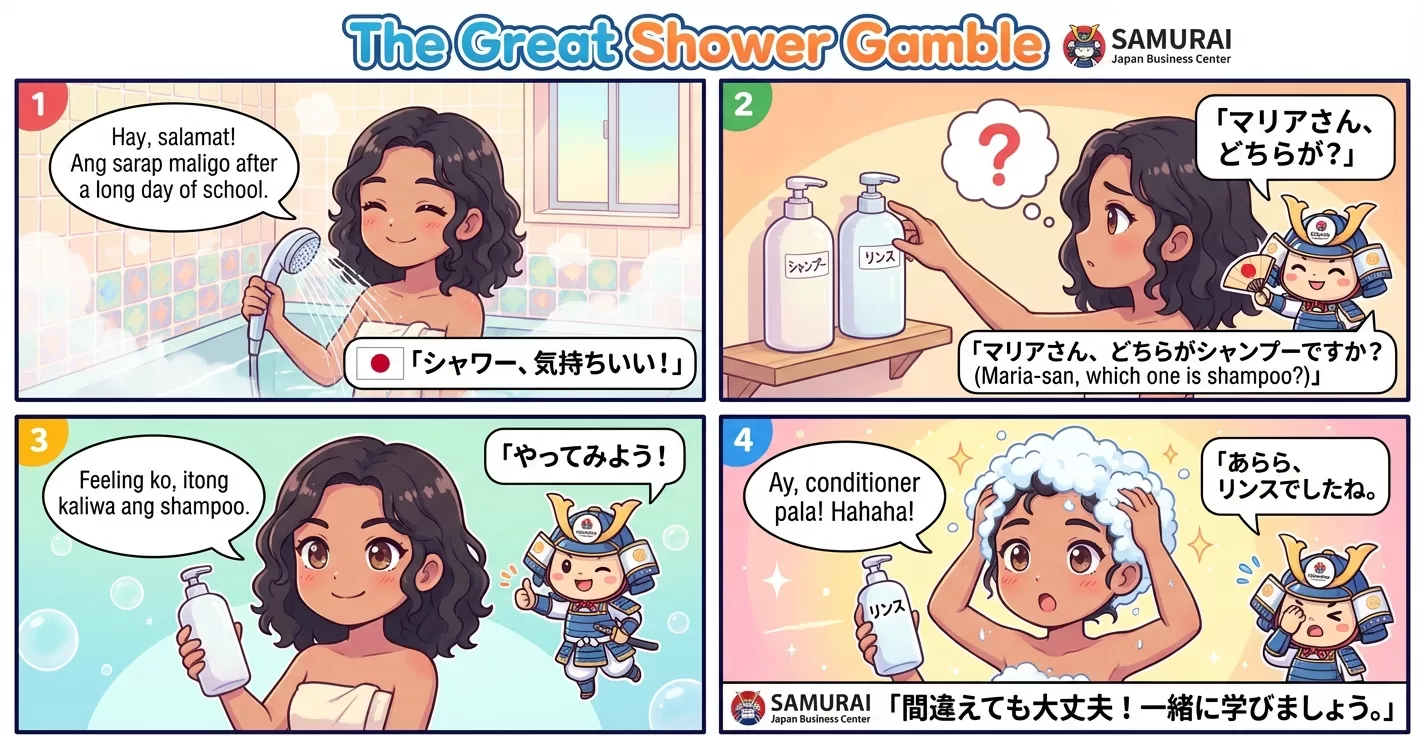
This is exactly what happened to Maria, one of our students. She was so excited to use her new Japanese shower, but she was faced with two identical white bottles. Without her glasses and with the steam rising, she couldn’t tell which one was the shampoo and which one was the conditioner. In a classic Pinoy move, she whispered, “Bahala na si Batman!” and picked the one on the left. It’s a 50/50 gamble that many of us have lost at least once! There is nothing quite like the realization that you just “washed” your hair with thick conditioner that won’t lather, or worse, used body soap as shampoo.
But did you know that in Japan, you don’t actually have to gamble? There is a hidden “secret code” built right into the packaging that allows you to tell them apart even if your eyes are closed or full of soap bubbles! Let’s dive into the fascinating world of Japanese “Universal Design” and learn how to navigate your bathroom like a pro.
💡 Did You Know?
The ridges on shampoo bottles weren’t always there! In 1991, the Japanese company Kao Corporation interviewed people with visual impairments who expressed how difficult it was to distinguish shampoo from conditioner. Kao invented the “notches” and, instead of patenting it for profit, they shared the design with other companies so that it could become a national standard across Japan! This is a beautiful example of Japanese “Omotenashi” or hospitality in product design.
🚿 The Secret of the “Gizagiza” (Ridges)
If you pick up a bottle of shampoo in Japan right now, run your fingers along the sides or the top of the pump. Do you feel those small, tactile bumps or ridges? In Japanese, these are often called ギザギザ (gizagiza). This onomatopoeic word describes something jagged or serrated. These ridges are the universal sign for シャンプー (shanpuu).
Why only the shampoo? The logic is simple: when you start your shower, your hair is dry and your eyes are open, but once you start lathering the shampoo, your eyes are often closed to avoid the sting. By the time you reach for the リンス (rinsu) or コンディショナー (kondishonaa), your hair is already wet and you need a way to confirm you’ve grabbed the right bottle without looking. The conditioner bottle is almost always smooth, providing a clear contrast to the “gizagiza” on the shampoo bottle.
For us Filipinos, this is a life-saver! We often buy “refill” packs to save money (just like we do with sachets back home), and we pour them into aesthetic, matching bottles. If you’re buying bottles in Japan, look for the ones that already have these ridges built-in. It saves you from the “Great Shower Gamble” every single morning. It’s these small details that make life in Japan so organized and thoughtful.
💡 先生のポイント (Teacher’s Tip):
When shopping at a drugstore like Matsumoto Kiyoshi or Welcia, you might see the word 詰め替え (tsumekae). This means “refill.” It is much cheaper than buying a new bottle! Just make sure you match the Katakana on the refill bag with the one on your bottle. Look for the “gizagiza” symbol (usually a small diagram of a bottle with lines on the side) on the packaging to confirm it’s shampoo!
🏷️ Decoding the Labels: Katakana Mastery
While the ridges are helpful, knowing how to read the labels is your best defense against bathroom blunders. Most bath products in Japan use Katakana because the words are borrowed from English. However, the pronunciation might sound a bit different to our Pinoy ears. For example, “shampoo” becomes シャンプー (shanpuu) with a long “u” sound at the end.
One tricky word is リンス (rinsu). In the Philippines, we usually just say “conditioner.” In Japan, “Rinse” was the traditional term for years, though “Conditioner” (コンディショナー) is now very common. They essentially do the same thing—making your hair soft and manageable. Then there is ボディソープ (bodi soopu). This one is easy to remember, but be careful! If you use body soap as shampoo, your hair might end up feeling very “buhaghag” (frizzy) because the formula is different.
If you want to be extra sure, look for the Kanji 髪 (kami) which means hair, and 体 (karada) which means body. Most labels will have these small Kanji to indicate where the product should be used. Learning these basic characters will not only help you in the shower but also when you’re browsing the massive aisles of a Japanese supermarket!
🏡 Universal Design Beyond the Bathroom
The “gizagiza” on shampoo bottles is part of a larger concept in Japan called Kyousu Design or Universal Design. Japan is a world leader in making daily life accessible for everyone, including the elderly and those with disabilities. Once you notice the shampoo ridges, you’ll start seeing these helpful clues everywhere!
For example, have you ever looked at a carton of 牛乳 (gyuunyuu) or cow’s milk? On the top of the carton, opposite the opening side, there is a small semi-circular notch. This notch tells visually impaired consumers that the carton contains 100% pure milk, rather than a “processed milk drink” or juice. It also tells them which side is the correct side to open!
Another example is found on お酒 (osake) cans. On the top of beer or chu-hi cans, you will often find Braille. This is to prevent people from accidentally drinking alcohol when they thought they were grabbing a can of soda. As students of the Japanese language, noticing these “hidden” features helps us appreciate the culture of Kikubari—the art of anticipating others’ needs. It’s not just about learning vocabulary; it’s about understanding the heart of Japanese society.
💡 先生のポイント (Teacher’s Tip):
When you are in a convenience store (Konbini), try to find these marks! It’s a great way to practice your “observation skills.” Living in Japan is like a constant scavenger hunt for these helpful little details. The more you notice, the more you’ll feel at home!
🛁 Tips for a Perfect Japanese Bath Experience
Now that you can identify your shampoo, let’s talk about the bath itself. In the Philippines, we are used to “tabo and balde” (dipper and bucket) or a quick standing shower. In Japan, the お風呂 (ofuro) is a place of deep relaxation.
If you are lucky enough to have a deep soaking tub, remember the golden rule: Wash your body BEFORE you get into the tub. The bath water is meant for soaking and warming up, not for cleaning. If you use soap in the bathwater, it’s considered a major “no-no,” especially if you are sharing the house with others or visiting a public 銭湯 (sentou).
Also, don’t be surprised by the control panel on the wall of your bathroom. This is the 給湯器 (kyuutouki) or water heater controller. You can set the exact temperature of your shower. For most people, 40°C to 42°C is the “sweet spot” for a relaxing soak. If you see a button that says 追い焚き (oidaki), it means “re-heat.” This is used to warm up the bathwater again if it gets cold. Just imagine—no more shivering while waiting for the kettle to boil back home!
📚 Key Vocabulary
| Japanese | Reading | English | Tagalog |
|---|---|---|---|
| シャンプー | shanpuu | Shampoo | Shampoo |
| リンス / コンディショナー | rinsu / kondishonaa | Conditioner | Conditioner |
| ギザギザ | gizagiza | Ridges / Notches | Uka / Gasgas / Bako-bako |
| ボディソープ | bodi soopu | Body Soap | Sabon pampaligo |
| お風呂 | ofuro | Bath / Bathtub | Paliguan / Batya |
| 詰め替え | tsumekae | Refill | Refill |
✏️ Try It Yourself!
1. シャンプーにはギザギザがあります。
(Shanpuu ni wa gizagiza ga arimasu.)
English: The shampoo has ridges.
Tagalog: May mga uka ang shampoo.
2. どっちがシャンプーですか?
(Dotchi ga shanpuu desu ka?)
English: Which one is the shampoo?
Tagalog: Alin dito ang shampoo?
3. お風呂はとても気持ちいいです!
(Ofuro wa totemo kimochi ii desu!)
English: The bath feels so good!
Tagalog: Napakasarap maligo!
💡 Today’s Lesson:
Japanese design is built around empathy and ease of use. You can distinguish shampoo from conditioner by feeling for the ridges (gizagiza) on the shampoo bottle. Learning Katakana and Kanji for bath products will help you avoid the “Shower Gamble” and make your daily life in Japan much smoother!
Studying a new language isn’t just about memorizing grammar rules from a textbook; it’s about these “Aha!” moments that make you smile in the middle of a shower. Every label you read and every “gizagiza” you feel is a step closer to mastering life in Japan. Don’t be afraid to make mistakes—even Maria’s “Bahala na si Batman” moment turned into a great lesson she will never forget!
At Samurai Japan, we believe that learning should be fun, practical, and deeply connected to real life. Whether you’re struggling with your first unit bath or preparing for the JLPT, we are here to guide you every step of the way. Keep going, kabayan! Your dream of living and working in Japan is within reach. Ganbare!
🇯🇵 日本語で夢を叶えよう! ✨
SAMURAI Japanは、あなたの日本での挑戦を全力でサポートします。
Let’s achieve your dreams in Japan together!
🏫 お問い合わせ (Contact Us)
📞 Phone: +63 997 093 4550
📧 Email: samuraijapan.bc@gmail.com
🏢 Address: Room D3, Freb Bldg, Villa Donata Subd, Muntinlupa
