

The Language Tug-of-War: Why Learning Japanese is a Two-Way Street! 🎌
By Samurai Japan | Life in Japan | 📖 10 min read
Naranasan niyo na ba yung feeling na super handa kayo? Nag-review kayo ng months, memorize niyo na ang Genki textbook, at handang-handa na ang inyong 自己紹介 (jikoshoukai) o self-introduction. You step outside, walk into a local Japanese cafe, and with all the courage in your heart, you utter your first sentence in Nihongo. You expect a deep, polite bow and a response in beautiful, flowing Japanese. But instead, you get: “HELLO! WELCOME! COFFEE? MILK? SUGAR?”
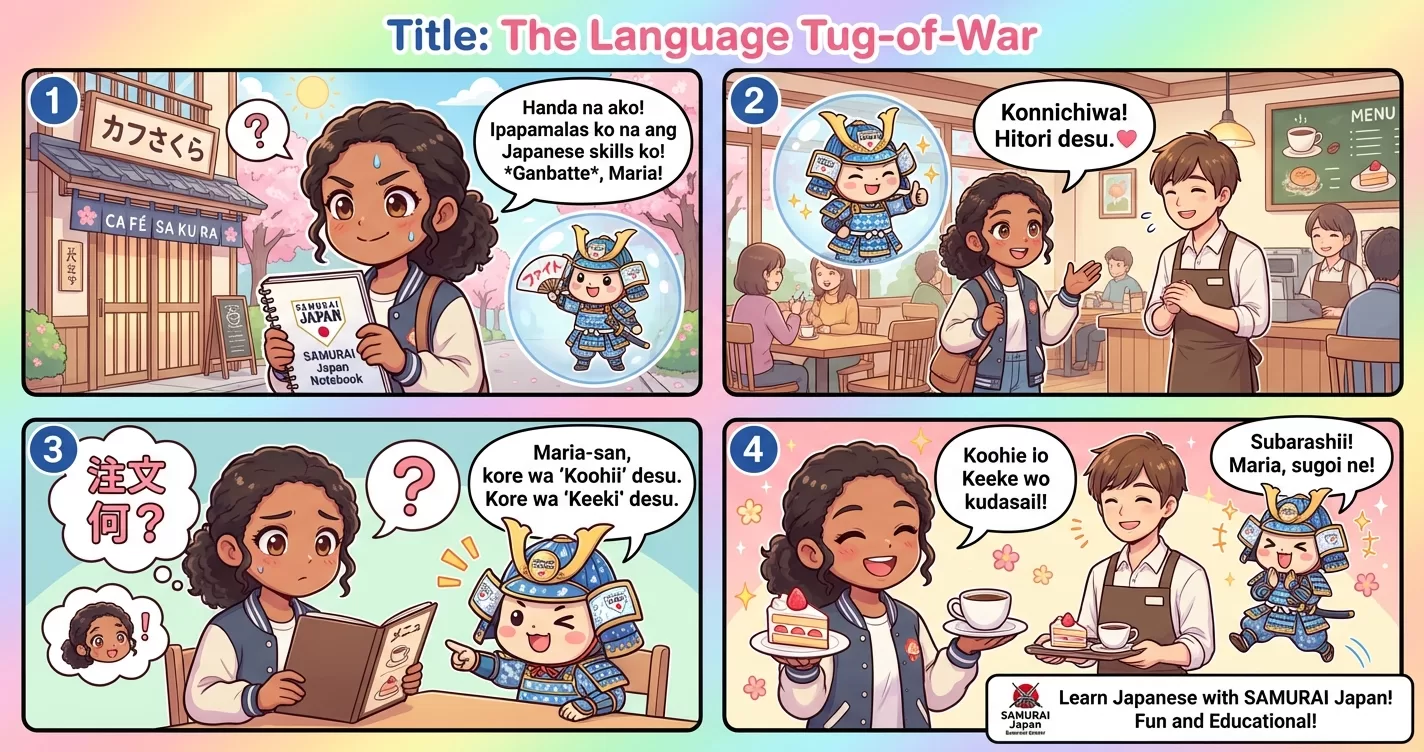
Wait, what happened? Just like Maria in our latest manga story, many Filipino students arrive in Japan eager to showcase their hard-earned skills, only to find themselves in a “Language Tug-of-War.” You want to practice your Japanese, but the locals—excited to see a foreigner—want to practice their English! It’s a hilarious, heartwarming, and sometimes frustrating situation that almost every language learner encounters. But don’t worry, this isn’t a sign that your Japanese is bad. In fact, it’s the start of a beautiful cultural bridge.
💡 Did You Know?
Japan has one of the largest markets for English language learning in Asia. Many Japanese people attend “Eikaiwa” (English conversation schools) for years and are often just as nervous to speak to you as you are to speak to them! When they see a foreigner, they often see a “Golden Opportunity” to test their skills, just like you do.
☕ The “Coffee Shop” Challenge: Why They Reply in English
When Maria walked into that cafe and said, 「コーヒーを一つください」 (Ko-hi- o hitotsu kudasai), she did everything right. Her grammar was spot on, and her pronunciation was clear. So why did the clerk shout back in English? In Japan, there is a concept called おもてなし (omotenashi), which refers to wholehearted hospitality. To many Japanese service workers, speaking English to a foreigner is seen as the ultimate form of kindness. They think, “This person might be struggling with Japanese, let me make it easier for them by using English!”
As Filipinos, we can actually relate to this very well. Think about when a tourist asks for directions in Manila. Even if they try to say “Salamat,” we often respond in full English to make them feel comfortable. It’s a sign of respect and helpfulness! In Japan, the clerk isn’t judging your Japanese; they are trying to meet you halfway. It becomes a “tug-of-war” because both parties are trying to be polite by using the other person’s perceived language. It’s a battle of kindness!
Understanding this mindset is key for your growth. Instead of feeling discouraged and thinking, “My Japanese must be terrible if they won’t speak it to me,” you should realize that you’ve successfully initiated a high-level social interaction. You’ve created an environment where two people from different worlds are trying their best to communicate. That is the true goal of language learning.
🗣️ Mastering the Art of Chuumon (Ordering)
Let’s look at what Maria used. She used the phrase 注文 (chuumon) or ordering. In Japan, ordering is one of the best ways to practice because the vocabulary is repetitive and the environment is controlled. Maria’s phrase 「〜を一つください」 (~o hitotsu kudasai) is a “magic phrase.” You can put almost anything in front of it and you will be understood. Whether it’s 水 (mizu) for water or お茶 (ocha) for tea, the structure remains the same.
💡 先生のポイント (Teacher’s Tip):
If you really want to keep the conversation in Japanese, don’t give up! Even if they reply in English, continue responding in Japanese. This is called “Language Persistence.” Often, once the Japanese person realizes you are serious about practicing, they will switch back to Nihongo. You can even say: 「日本語を勉強中ですので、日本語でお願いします」 (Nihongo o benkyouchuu desu node, Nihongo de onegaishimasu)—”I’m studying Japanese, so Japanese please!”
Another tip for our Kababayans: watch out for 和製英語 (wasei-eigo) or “Japanese-made English.” Sometimes, you might think you are speaking English, but the words are actually Japanese versions of English. For example, a “laptop” is a パソコン (pasokon) and a “french fry” is フライドポテト (furaido poteto). Maria was lucky that “Coffee” is very similar (コーヒー – ko-hi-), but knowing these small differences helps you navigate the “tug-of-war” more effectively.
💪 The Power of “Ganbatte”: Embracing Mistakes
In the first panel, Maria says to herself, 頑張って (Ganbatte)!. This is perhaps the most important word in any student’s vocabulary. It translates to “Do your best” or “Keep going.” For Filipino learners, we have a similar spirit—the “Laban” attitude. We don’t back down from challenges, whether it’s working abroad or learning a difficult language like Japanese.
The “Language Tug-of-War” is actually a sign of success. If a Japanese person wants to practice English with you, it means you have successfully made a connection. You are no longer just a tourist; you are a participant in a cultural exchange. In the manga, Maria and the clerk ended up laughing together. This is the “bridge” that the lesson talks about. Language is not about perfect grammar or passing the JLPT N1 (though those are great goals!); it’s about コミュニケーション (komyunikeishon).
Don’t be afraid to sound “silly.” Don’t be afraid to use your hands and feet to gesture. In Japan, people appreciate the effort more than the accuracy. When you show that you are trying to learn their culture, they open up. And if they reply in English, laugh it off! Tell them, “Your English is good!” and they might tell you, “Your Japanese is amazing!” This mutual encouragement is what keeps the “Samurai Japan” spirit alive.
🤝 Building a Bridge Between Tagalog, English, and Japanese
Filipinos have a unique advantage in learning Japanese. Because most of us are already bilingual (Tagalog and English), our brains are “wired” for code-switching. We are used to jumping between languages. When you encounter a clerk who wants to speak English while you want to speak Japanese, you can actually do both! This is called “Language Exchange.”
You can say, “I’ll teach you some English phrases if you help me with my Japanese ordering.” This turns a potentially awkward encounter into a networking opportunity. In Japan, building 人間関係 (ningen kankei) or human relationships is vital. Whether you are there for work, study, or travel, these small interactions at cafes or convenience stores build your confidence and your local reputation.
💡 先生のポイント (Teacher’s Tip):
Carry a small notebook like Maria did! Writing down new words you hear during these “tug-of-war” moments helps them stick in your memory. If the clerk uses a word you don’t know, don’t be shy to ask, 「それはどういう意味ですか?」 (Sore wa dou iu imi desu ka?)—”What does that mean?” It shows you are an active learner!
Remember, every expert was once a beginner. Even the most fluent speakers started by nervously ordering a coffee. The fact that you are even trying to speak Japanese puts you ahead of so many others. Keep that “Samurai” determination, keep your “Samurai Japan” notebook handy, and don’t let a little bit of English response stop your Japanese progress!
📚 Key Vocabulary
| Japanese | Reading | English | Tagalog |
|---|---|---|---|
| 頑張って | Ganbatte | Do your best | Galingan mo / Laban |
| コーヒー | Ko-hi- | Coffee | Kape |
| 練習 | Renshuu | Practice | Pagsasanay |
| 一つください | Hitotsu kudasai | One (item) please | Isa lang po pakiusap |
| 店員 | Ten-in | Shop clerk | Tindero/Tindera |
| 勉強中 | Benkyouchuu | Currently studying | Nag-aaral pa lang |
✏️ Try It Yourself!
1. コーヒーを一つください。
(Ko-hi- o hitotsu kudasai.)
English: One coffee, please.
Tagalog: Isang kape po, pakiusap.
2. 日本語を練習しています。
(Nihongo o renshuu shite imasu.)
English: I am practicing Japanese.
Tagalog: Nag-e-ensayo po ako ng Japanese.
3. 一緒に頑張りましょう!
(Issho ni ganbarimashou!)
English: Let’s do our best together!
Tagalog: Mag-sipag tayong pareho!
💡 Today’s Lesson:
Communication is a bridge, not a competition. Whether you speak Japanese or English, the goal is to connect with the person in front of you. Don’t let the “Language Tug-of-War” discourage you—embrace it as a shared learning experience!
Kaya sa lahat ng ating mga student dyan, wag kayong matatakot magkamali. Whether you’re ordering coffee like Maria or navigating your first day at a new job in Japan, remember that every interaction is a step forward. Even if they reply in English, it’s a chance to smile, laugh, and learn something new about the people you meet. Keep practicing, keep studying, and keep that “Ganbatte” spirit high!
Here at Samurai Japan, we believe that learning Japanese is the key to unlocking amazing opportunities. But more than that, it’s about the friendships and memories you make along the way. See you in the next lesson, and as always, Ganbatte kudasai!
🇯🇵 日本語で夢を叶えよう! ✨
SAMURAI Japanは、あなたの日本での挑戦を全力でサポートします。
Let’s achieve your dreams in Japan together!
🏫 お問い合わせ (Contact Us)
📞 Phone: +63 997 093 4550
📧 Email: samuraijapan.bc@gmail.com
🏢 Address: Room D3, Freb Bldg, Villa Donata Subd, Muntinlupa
