

Hai-Po! Why Your Filipino Politeness is Your Secret Superpower in Japan 🎌
By Samurai Japan | Life in Japan | 📖 10 min read
Have you ever been in a situation where you’re trying your absolute best to speak a new language, but your brain does a little “remix”? For many Filipino students learning Japanese, this happens more often than you’d think! You’re standing in front of your teacher, your heart is racing, and you want to show the utmost respect. You’ve practiced your です (desu) and ます (masu), but just as you open your mouth, a little piece of home slips out.
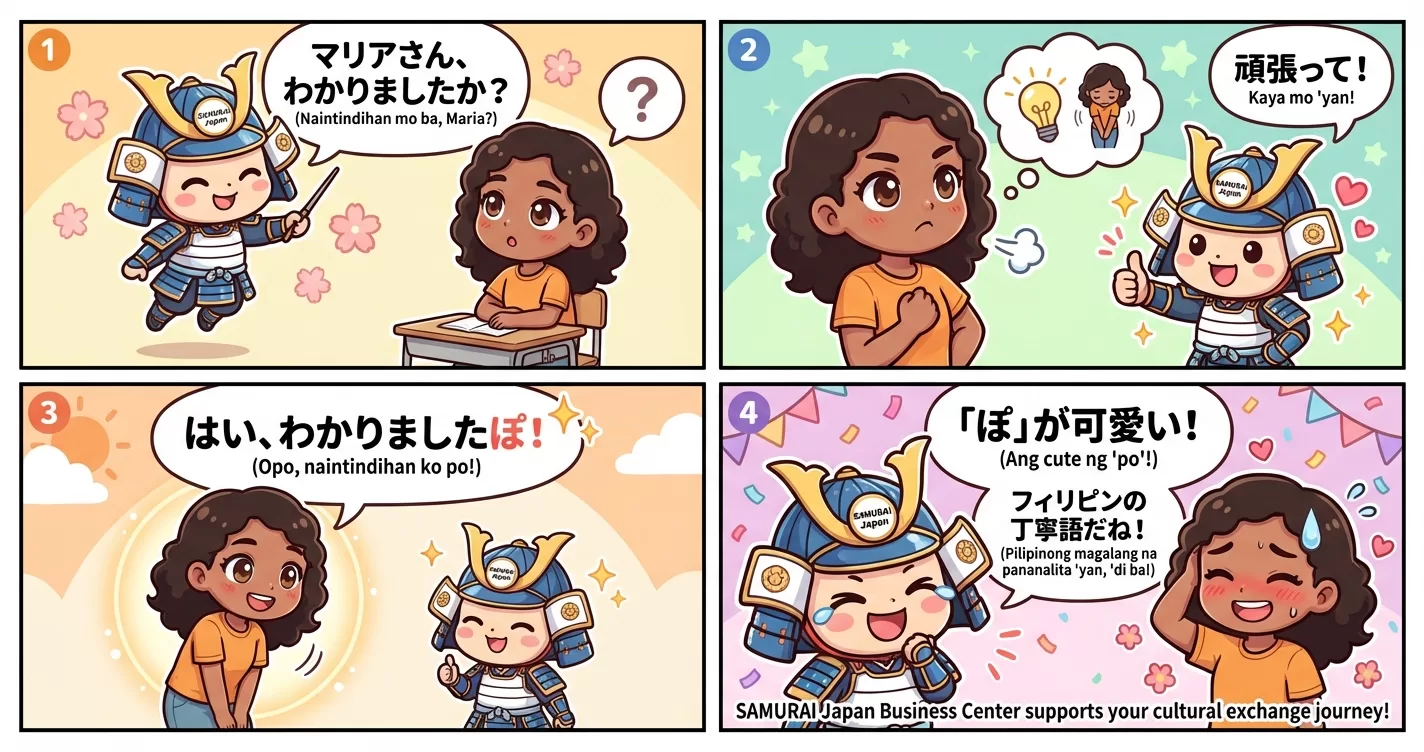
Take Maria, for example. In her recent lesson with Tanaka-sensei, she was asked the standard check-in question: 「マリアさん、わかりましたか?」 (Maria-san, wakarimashita ka? / Naintindihan mo ba, Maria?). Maria, being the diligent student she is, wanted to be extra polite. She took a deep breath, channeled her inner Nihongo pro, and shouted with confidence: “Hai-po! Wakarimashita-po!” It was a classic case of what we call the “Po” habit—the unintentional blending of Filipino honorifics with Japanese grammar. While Maria initially felt embarrassed, Tanaka-sensei couldn’t help but smile. He recognized the effort and the deep-rooted respect behind that “double politeness.”
💡 Did You Know?
The Filipino particles “Po” and “Opo” actually share a similar linguistic function with Japanese “Sentence-Ending Particles” (Shuujoshi). While “Po” indicates respect toward the listener regardless of the sentence structure, Japanese uses formal verb endings to signal that same level of respect. Both cultures are among the few in the world that have a dedicated, mandatory way to “mark” politeness in almost every sentence!
✨ The Psychology of the “Po” Reflex
Why do we say “Hai-po”? To understand this, we have to look at how the Filipino brain is wired. From the moment we learn to speak, we are taught that “Po” and “Opo” are the ultimate signs of 敬意 (keii – respect). It isn’t just a word; it’s a reflex. When we speak to someone in a position of authority, like a 先生 (sensei) or an elder, our brain automatically looks for a “politeness marker” to attach to the end of a thought.
In Japanese, politeness is often baked into the verb itself. For instance, the dictionary form of “to understand” is わかる (wakaru), but to make it polite, we change it to わかります (wakarimasu). However, for a Filipino learner, sometimes “Wakarimasu” doesn’t *feel* polite enough because it lacks that familiar “Po” sound. This creates a funny linguistic crossover where “Hai-po” becomes the “safe zone” for many students. It’s a sign that you are trying your best to bridge two very respectful cultures.
The good news? Japanese people, especially teachers, find this incredibly charming! They understand that you are transferring your cultural values into their language. Instead of seeing it as a mistake, think of it as “Politeness 2.0.” You aren’t just following Japanese rules; you’re bringing your Filipino heart into the conversation. This “Po” reflex is actually proof that you have a high level of social awareness, which is a key skill for anyone living and working in Japan.
💡 先生のポイント (Teacher’s Tip):
If you find yourself saying “Po” in the middle of a Japanese sentence, don’t panic! Just finish your sentence with a polite です (desu) or ます (masu). With enough practice, your brain will eventually start associating “Desu” as the new “Po.” Until then, a smile and a small bow will cover any “Hai-po” slips!
🤝 Shared Values: Respect in the Philippines and Japan
The reason Filipinos adjust so well to Japanese culture is that we share many core values. In the Philippines, we have “Paggalang” (Respect); in Japan, they have 礼儀 (reigi – etiquette/manners). Both cultures place a huge emphasis on hierarchy and the importance of acknowledging the status of the person you are talking to. When Maria accidentally said “Wakarimashita-po,” she was essentially using two languages to say the same thing: “I respect you, and I am listening.”
In Japanese society, there is a concept called 上下関係 (jouge kankei), which refers to the relationship between seniors (senpai) and juniors (kohai). This is very similar to our practice of using “Kuya” or “Ate” for older siblings or even acquaintances. While the words are different, the feeling is exactly the same. We don’t just call people by their names; we add a title. In Japan, you add ~さん (-san) or ~様 (-sama). So, when you struggle with Japanese politeness, remember that you already have the foundation from your Filipino upbringing!
Furthermore, both cultures value 和 (wa – harmony). We avoid direct conflict and prefer to use polite language to keep things smooth. The “Po” habit is just a symptom of this desire to maintain harmony. Even if your Nihongo isn’t perfect yet, your intention to be respectful communicates more than the words themselves. Japanese people often value the “Kokoro” (heart) behind the language more than perfect grammar.
🎓 Moving from “Hai-Po” to “Hai, Wakarimasu”
While “Hai-po” is cute and understandable, your goal as a student is eventually to master 丁寧語 (teineigo – polite Japanese). How do we transition? It starts with mastering the “Masu-form.” Instead of thinking of “Po” as a separate word to add at the end, try to view the ~ます (-masu) ending as the “Po” itself. When you say 食べます (tabemasu – I eat), that “masu” is doing the heavy lifting of showing respect.
Another tip is to focus on 相槌 (aizuchi). Aizuchi are the little responses we give during a conversation to show we are listening, like “un,” “sou desu ne,” or “hai.” In the Philippines, we often nod and say “Po” or “Opo” every few seconds. In Japan, they do the exact same thing! If you can replace your “Opo” with a crisp, clear 「はい!」 (Hai!) accompanied by a small nod, you will sound like a native in no time.
Remember, language learning is a marathon, not a sprint. It takes time for the “Filipino brain” to sync with the “Japanese mouth.” But having that instinct to be polite—that “Po” habit—is a huge head start. Many learners from other countries struggle with politeness because their native languages are very direct. For you, being polite is already your second nature. You’re not starting from zero; you’re just upgrading your existing skills!
💡 先生のポイント (Teacher’s Tip):
Try recording yourself speaking! Listen for those “Po” slips. When you hear one, repeat the sentence again but replace the “Po” with a long, polite です (desu). Eventually, your muscle memory will change, but your respectful spirit will remain!
📚 Key Vocabulary
| Japanese | Reading | English | Tagalog |
|---|---|---|---|
| はい | Hai | Yes | Opo / Oo |
| わかりました | Wakarimashita | I understood | Naintindihan ko po |
| 先生 | Sensei | Teacher | Guro |
| お願いします | Onegaishimasu | Please / I request you | Paki-usap po |
| ありがとうございます | Arigatou gozaimasu | Thank you (formal) | Salamat po |
| すみません | Sumimasen | Excuse me / Sorry | Paumanhin po |
✏️ Try It Yourself!
1. はい、わかりました。
(Hai, wakarimashita.)
Yes, I understood. / Opo, naintindihan ko po.
2. 先生、お願いします。
(Sensei, onegaishimasu.)
Teacher, please (help me/teach me). / Sensei, paki-usap po.
3. ありがとうございます、田中先生。
(Arigatou gozaimasu, Tanaka-sensei.)
Thank you, Tanaka-sensei. / Salamat po, Tanaka-sensei.
💡 Today’s Lesson:
Language and culture are inseparable! Don’t be afraid to make mistakes like saying “Hai-po.” Your natural Filipino politeness is a bridge that helps you connect with Japanese people more deeply. Focus on the intention of respect, and the grammar will follow with time.
To all our hard-working students at Samurai Japan, keep that respectful spirit alive! Whether you are studying for the JLPT, preparing for a job in Japan, or just learning for fun, remember that your Filipino background is an asset. Those “Po” and “Opo” reflexes show that you have the right heart for Japanese society. Japan is a country that prizes respect above all else, and you are already a master of that!
So, the next time you accidentally say “Arigatou-po,” don’t turn red like Maria. Just give a friendly smile, correct yourself if you can, and keep moving forward. You are doing great, and your dream of speaking fluent Japanese is getting closer every day. We are here to support you every step of the way. Let’s keep learning together!
🇯🇵 日本語で夢を叶えよう! ✨
SAMURAI Japanは、あなたの日本での挑戦を全力でサポートします。
Let’s achieve your dreams in Japan together!
🏫 お問い合わせ (Contact Us)
📞 Phone: +63 997 093 4550
📧 Email: samuraijapan.bc@gmail.com
🏢 Address: Room D3, Freb Bldg, Villa Donata Subd, Muntinlupa
