

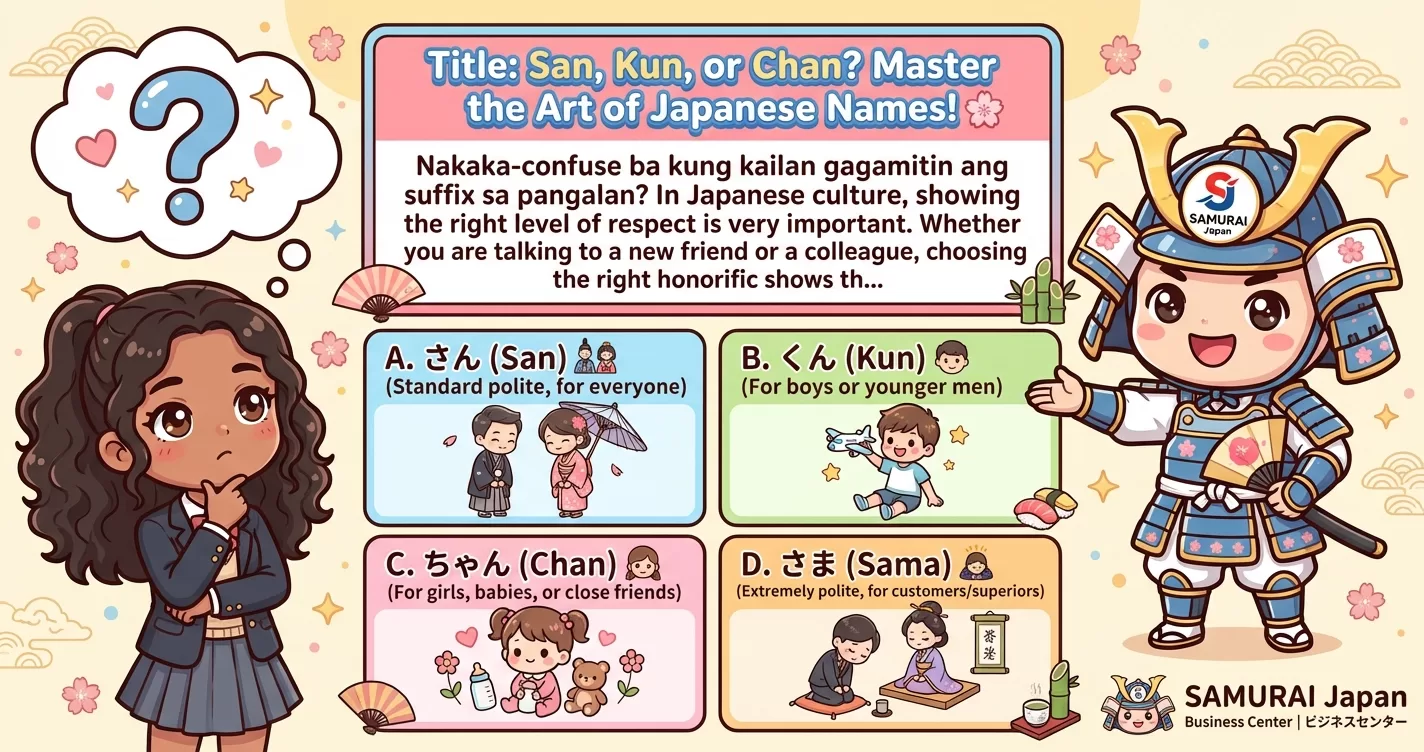
San, Kun, or Chan? Master the Art of Japanese Names! 🎌
Have you ever felt that mini-heart attack when you’re about to address someone in Japanese, pero bigla kang napatigil kasi hindi mo alam kung “San,” “Kun,” or “Chan” ang dapat gamitin? Don’t worry, you are not alone! Sa totoo lang, kahit ang ilang advanced learners ay minsan nag-aalangan pa rin sa tamang paggamit ng honorifics. In Japanese culture, names are not just labels; they are a reflection of the relationship, respect, and social distance between two people.
Dito sa SAMURAI Japan Business Center, we believe that mastering the language isn’t just about memorizing vocabulary or grammar patterns. It’s about understanding the heart of the culture. Learning how to properly address someone is the first step in building a bridge of respect and friendship. If you get it right, people will appreciate your effort to understand their customs. If you get it wrong, it might lead to some awkward (and sometimes funny!) misunderstandings.
In Japan, addressing someone by their name alone (without any suffix) is called “Yobisute” (呼び捨て). This is only done between the closest of friends, family members, or a spouse. Calling a stranger or a colleague by just their name without “-san” can be seen as very rude or overly aggressive!
Kaya naman, before we dive into the deep ocean of Japanese honorifics, let’s test your current knowledge with a quick scenario. Imagine you are entering your new workplace or a social gathering, and you meet a new person named Ms. Tanaka. How would you greet her?
✏️ The Quiz: Master the First Impression
田中(たなか)さんに 挨拶(あいさつ)します。
(Tanaka-san ni aisatsu shimasu.)
You are greeting Ms. Tanaka for the first time. What is the most appropriate way to address her?
A) Tanaka-chan (田中ちゃん)
B) Tanaka-kun (田中君)
C) Tanaka-san (田中さん)
Answer: C) Tanaka-san (田中さん)
Explanation:
Sa Japanese, ang “-san” ang ating “golden rule.” Ito ang pinaka-safe at universal honorific na pwede nating gamitin sa kahit kanino—mapa-babae man o lalaki, o kahit hindi mo pa sila masyadong kakilala. It is similar to saying “Mr.” or “Ms.” in English but much more common in daily conversation. Choosing “Tanaka-chan” right away might make you sound too “feeling close,” while “Tanaka-kun” is usually reserved for subordinates or younger males in a formal setting.
1. The Power of “-San”: The Universal Safety Net 🛡️
If you are ever in doubt, use -san (~さん). Ito ang pinaka-versatile na suffix sa lahat. Whether you are talking to your boss, a shopkeeper, or a person you just met at a bus stop, “-san” will never let you down. It shows a baseline level of respect that is expected in Japanese society.
Unlike in the Philippines where we use “Sir” or “Ma’am,” or even “Kuya” and “Ate,” the Japanese use “-san” regardless of gender. Nakakatuwa ‘di ba? One word fits all! Pero take note: unlike “Mr.” or “Ms.” in English, “-san” is almost always attached to the family name (surname) in formal settings, and to the first name only when you are already somewhat acquainted with the person.
For example, if you meet someone named “Sato Ken,” you would call him “Sato-san.” Once you become friends, you might start calling him “Ken-san.” Pero even then, using “-san” keeps a healthy level of polite distance (teinei). This “distance” isn’t a bad thing in Japan—it actually shows that you respect the other person’s personal space and social standing.
Did you know that you can also add “-san” to occupations or even objects? For example, a bookstore is Hon-ya-san and a baker is Pan-ya-san. It adds a touch of politeness and friendliness to the way you describe people’s roles in the community!
2. “-Kun” and “-Chan”: Adding Flavor to Friendships 🍬
Kapag mas naging close na kayo ng mga kasama mo, pwedeng-pwede mo nang gamitin ang “-kun” at “-chan.” Pero beware! May “unspoken rules” ang paggamit nito. If you use them incorrectly, you might sound like you’re talking down to someone or being unintentionally flirtatious.
-Kun (~くん/君):
Traditionally, “-kun” is used for males who are younger than you or of the same age. Sa school, teachers call their male students “-kun.” Sa business, sometimes a male boss might call his female subordinates “-kun” as well, though this is becoming less common. It has a slightly masculine feel, but it carries a sense of “camaraderie” or “junior status.”
-Chan (~ちゃん):
This is the “cute” suffix. It comes from “baby talk” where kids couldn’t pronounce the “s” in “-san” properly, so it became “-chan.” It is used for babies, children, pets, and female friends. Using “-chan” for a male friend is also possible, but it usually implies a very high level of intimacy or a “cute/younger brother” vibe.
Imagine calling your strict Japanese manager “Manager-chan.” That would definitely cause a scene! Use “-chan” only for those who are socially “below” you or very, very close to you. For instance, in the SAMURAI Japan Business Center community, students often use “-san” with each other to maintain a professional yet friendly atmosphere.
3. Going Pro: “-Sama” and Official Titles 👔
When you want to level up your politeness, especially in business or formal writing, “-san” might not be enough. This is where -Sama (~さま/様) comes in. This is the version of “-san” on steroids! It is used for customers (Okyaku-sama), people you deeply admire, or in formal emails.
However, avoid using “-sama” in casual conversation unless you are joking or being extremely sarcastic, as it can sound unnatural. Aside from “-sama,” Japanese people often use titles instead of names. For example, instead of “Tanaka-san,” if she is your teacher, you must call her “Tanaka-sensei.”
In a company setting, you might use:
- Bucho (Manager)
- Shacho (President)
- Senpai (Senior/Mentor)
Notice na kapag ginamit mo ang title na “Sensei” or “Senpai,” hindi mo na kailangang dagdagan ng “-san.” Saying “Sensei-san” is redundant and grammatically incorrect. It’s like saying “Teacher Mister.”
In an email, the standard way to address a client is [Family Name] + [Sama]. For example: “Sato-sama.” Even if you have met them many times, sticking to “-sama” in written correspondence shows your professionalism and high regard for the business relationship.
4. The Golden Rule: Never “San” Yourself! 🚫
Ito ang pinaka-common na mistake ng mga beginners. Dahil naririnig nila ang lahat na tumatawag sa kanila ng “[Pangalan]-san,” akala nila ay kailangan din nilang gamitin ito kapag nagpapakilala.
Mali: “Watashi wa Maria-san desu.” (I am Ms. Maria.)
Tama: “Watashi wa Maria desu.” (I am Maria.)
Remember, honorifics like -san, -kun, and -chan are used to show respect to others. Adding a respect suffix to your own name makes it sound like you are praising yourself or that you have an incredibly high ego. Parang sinasabi mo sa Tagalog, “Ako po ang Kagalang-galang na Maria.” Medyo weird, ‘di ba? Keep it humble. In Japan, humility is a virtue. At SAMURAI Japan Business Center, we always emphasize the concept of Kenjougo (humble Japanese) to help our students navigate social hierarchies smoothly.
5. Scenario Practice: When to Use Which? 🎭
Let’s look at some real-life situations to solidify your understanding:
- Scenario A: You are talking to a 5-year-old girl at the park.
Use: First name + -chan. (e.g., Hana-chan) - Scenario B: You are introduced to a new client named Mr. Yamamoto.
Use: Surname + -sama (in email) or -san (in person). - Scenario C: You are calling your male classmate who is the same age as you.
Use: Surname + -kun or -san. - Scenario D: You are referring to your boss, Mr. Honda, who is a Director.
Use: Honda-bucho or Honda-san.
Mastering these nuances takes time, but don’t be afraid to make mistakes! Most Japanese people are very understanding towards foreigners. What matters most is your kimochi (feeling) of respect. If you approach them with a polite smile and use “-san,” you’re already 90% of the way there.
📊 Vocabulary Spotlight
Here are some essential words related to our lesson today. Try to memorize these to improve your N5/N4 vocabulary list!
| Japanese | Reading | English | Tagalog |
|---|---|---|---|
| 名前 | Namae | Name | Pangalan |
| 挨拶 | Aisatsu | Greeting | Pagbati |
| 先生 | Sensei | Teacher/Master | Guro |
| 友達 | Tomodachi | Friend | Kaibigan |
| 先輩 | Senpai | Senior | Nakakatanda/Senior |
| お客様 | Okyaku-sama | Guest/Customer | Bisita/Mamimili |
✏️ Try It Yourself! (Practice Corner)
Can you fill in the blanks with the correct suffix or title? Check the Tagalog translations for clues!
- 田中______、おはようございます! (Greeting your teacher, Mr. Tanaka)
(Tanaka-______, ohayou gozaimasu!)
Tagalog: Tanaka-teacher, magandang umaga! - 私の名前はマリア______。 (Introducing yourself as Maria)
(Watashi no namae wa Maria ______.)
Tagalog: Ang pangalan ko ay Maria. (Note: Be careful here!) - あ、サトシ______!遊びましょう。 (Calling your 7-year-old male friend, Satoshi)
(A, Satoshi-______! Asobimashou.)
Tagalog: Oh, Satoshi-kun! Laro tayo. - 鈴木______、この書類をお願いします。 (Asking a senior colleague, Ms. Suzuki)
(Suzuki-______, kono shorui wo onegaishimasu.)
Tagalog: Ms. Suzuki, pakiusap po itong dokumento. - ワンちゃん、可愛い______ね! (Talking about a cute dog named Wan-chan)
(Wan-chan, kawaii ______ ne!)
Tagalog: Si Wan-chan, ang cute niya no!
(Answers: 1. Sensei, 2. [None/Desu], 3. Kun, 4. San, 5. [None/Desu])
📝 Lesson Summary
✅ -San: The “Safety First” honorific. Use for equals, strangers, and superiors.
✅ -Kun: For younger males, male friends, or subordinates.
✅ -Chan: For kids, pets, and very close female friends.
✅ -Sama: High-level respect for customers and formal letters.
✅ Titles: Use “Sensei” or “Senpai” directly—no need for “-san.”
🚫 Never: Use honorifics on your own name!
Learning Japanese is like building a house. Honorifics are the foundation of your social interactions. Kapag matibay ang foundation mo, mas madaling mag-build ng relationships at mas magiging confident ka sa pakikipag-usap.
Don’t be overwhelmed! Keep practicing, keep listening to how native speakers use these terms in anime or dramas, and most importantly, keep your passion for learning alive. Here at SAMURAI Japan Business Center, we are always here to guide you through the beautiful complexities of the Japanese language. Every “-san” and “-kun” you use correctly brings you one step closer to your goals. Kaya naman, let’s keep moving forward! Ganbatte kudasai! 🌟
🇯🇵 日本語で新しい可能性を広げよう! ✨
SAMURAI Japan Business Centerは、あなたの日本語学習を全力でサポートします。
🚀 Start Your Learning Journey Today!
TikTok: @samuraijapan0221 / Instagram: @samuraijapan.bc
