

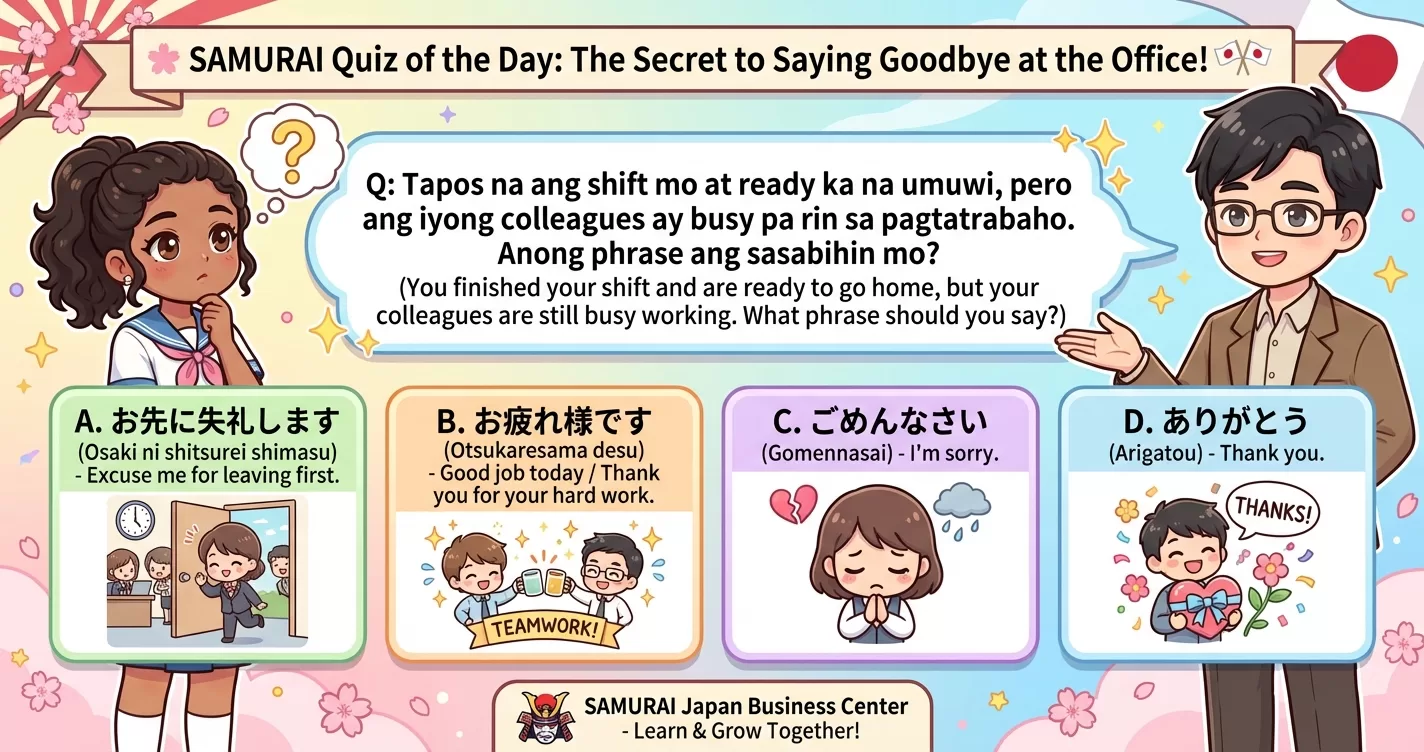
SAMURAI Quiz of the Day: The Secret to Saying Goodbye at the Office! 🎌
Magandang araw sa inyong lahat! Isang mabilis na tanong: Naranasan niyo na ba yung moment na tapos na ang shift niyo, ligpit na ang gamit, at ready na kayong mag-out, pero pagtingin niyo sa paligid, ang iyong mga colleagues at pati na ang inyong boss ay tutok na tutok pa rin sa kanilang mga computer? 😱
Dito sa Pilipinas, madalas ay sapat na ang isang simpleng “Bye guys, una na ako!” o kaya “Ingat kayo!” bago lumabas ng pinto. But in a Japanese professional setting, the way you leave the office is just as important as the way you start your day. It’s not just about ending your work; it’s about maintaining the “Wa” (和) or harmony within the team.
Sa Japan, mayroong tinatawag na “Aisatsu” (挨拶) culture. Hindi lang ito basta pagbati; ito ay isang social lubricant na nagpapanatili ng magandang relasyon sa pagitan ng mga tao. Ang hindi pag-alis nang may tamang pagbati ay maaaring ituring na “shitsurei” o pagiging rude, dahil parang hindi mo kinikilala ang paghihirap ng mga taong naiwan pa sa loob ng opisina.
Choosing the right phrase can make you look like a pro, even if you are still at the N5 or N4 level. Let’s dive deep into the world of Japanese office etiquette and unlock the secret to saying goodbye the right way!
1. The Golden Rule: “Osaki ni shitsurei shimasu”
As mentioned in our quiz today, the absolute “must-know” phrase when leaving the office is お先に失礼します (Osaki ni shitsurei shimasu). Pero bakit nga ba ito ang ginagamit? Let’s break it down linguistically para mas madali niyo itong matandaan.
- Osaki ni (お先に): This means “ahead” or “before you.” Ang root word nito ay “saki” (先), which refers to being first or in front.
- Shitsurei shimasu (失礼します): This literally translates to “I am doing a discourtesy” or “I am being rude.”
Kapag pinagsama mo sila, ang ibig sabihin nito ay: “Patawad at mauuna na ako sa inyong umuwi kahit kayo ay nagtatrabaho pa.” Napaka-humble, ‘di ba? Sa Japanese culture, there is a collective mindset. If you leave while others are working, you are technically “breaking” the collective effort for a moment, so you acknowledge it with this polite phrase.
Huwag itong sasabihin nang pabulong! Even if you are shy, make sure your voice is clear enough for your immediate teammates and your supervisor to hear. A cheerful but professional “Osaki ni shitsurei shimasu!” shows that you finished your work efficiently and you respect their ongoing effort.
2. The Essential Response: “Otsukaresama desu”
What if ikaw naman ang naiwan sa office at ang colleague mo ang nagsabi ng “Osaki ni shitsurei shimasu”? Ano ang dapat mong isagot? The standard response is お疲れ様でした (Otsukaresama deshita).
Ang salitang Otsukaresama ay galing sa verb na “tsukareru” (疲れる), which means “to get tired.” By saying this, you are literally saying, “You look tired,” but in a way that means “Thank you for your hard work” or “You worked hard today.”
Take note of the tense!
• Kapag nasa gitna pa ng trabaho: Otsukaresama desu (Present tense)
• Kapag tapos na ang shift o may aalis na: Otsukaresama deshita (Past tense)
3. Why Not “Sayonara” or “Oyasuminasai”?
Ito ang common mistake ng maraming beginners. Bakit hindi pwedeng sabihin ang “Sayonara” (さようなら)? Sa school settings o sa casual na usapan, okay ang “Sayonara.” Pero sa business world, ang “Sayonara” ay may dalang bigat—parang sasabihin mo na “Goodbye for a long time” o kaya ay hindi mo na sila makikita muli. It sounds too final and a bit cold for a daily office routine.
Paano naman ang “Oyasuminasai” (おやすみなさい)? Ibig sabihin nito ay “Good night.” Bagama’t gabi na nung umuwi ka, ang phrase na ito ay ginagamit lamang sa loob ng pamilya o kapag matutulog na talaga. Sa opisina, kahit 10 PM na kayo natapos, “Otsukaresama deshita” pa rin ang tamang bati.
Sa Japan, may tinatawag ding “Gokurousama” (ご苦労様). Warning: HUWAG itong sasabihin sa boss mo! Ang “Gokurousama” ay ginagamit lamang ng mga superior (boss) sa kanilang subordinates. Kung sasabihin mo ito sa boss mo, magmumukhang ikaw ang boss niya! Stick to “Otsukaresama” to be safe.
4. Advanced Tip: Combining Phrases for Extra Politeness
Kung gusto mong mag-stand out sa SAMURAI Japan Business Center bilang isang mahusay na student, subukan mong pagsamahin ang mga natutunan mo. Bago ka lumabas, lumapit nang bahagya sa iyong supervisor at sabihing:
“Otsukaresama desu. Osaki ni shitsurei shimasu.”
This covers all bases. Kinilala mo ang paghihirap nila (Otsukaresama) at nagpaalam ka nang maayos sa pag-una mo (Osaki ni shitsurei shimasu). This level of politeness is highly appreciated and builds a very positive image of you as a professional.
5. Reading the Air (Kuuki o Yomu)
Sa huli, ang pinakamahalagang skill sa Japanese workplace ay ang “Kuuki o yomu” (空気を読む) o ang pag-intindi sa sitwasyon kahit walang nagsasalita. Bago mag-sabi ng “Osaki ni shitsurei shimasu,” siguraduhin na wala ka nang pending na urgent tasks na pwedeng makatulong sa team. Ang pagpapaalam ay hindi lang salita; ito ay pagpapakita na bahagi ka ng isang grupo.
📚 Vocabulary Checklist
| Japanese | Reading (Romaji) | English | Tagalog |
|---|---|---|---|
| 会社 | Kaisha | Company | Kumpanya |
| 上司 | Joushi | Boss/Superior | Amo / Boss |
| 同僚 | Douryou | Colleague | Katrabaho |
| お先に | Osaki ni | Ahead/Before you | Mauna / Nauna |
| 失礼します | Shitsurei shimasu | Excuse me/I’m being rude | Paumanhin po |
| 仕事 | Shigoto | Work | Trabaho |
| 挨拶 | Aisatsu | Greeting | Pagbati |
| 戻る | Modoru | To return | Bumalik |
✏️ Try It Yourself!
Subukan nating gamitin ang mga phrases na ito sa iba’t ibang sitwasyon. Can you translate or understand these scenarios?
1. 会社から帰るとき:
(Kapag uuwi na galing sa kumpanya)
“Otsukaresama deshita. Osaki ni shitsurei shimasu!”
Tagalog: “Salamat sa trabaho niyo ngayong araw. Mauna na po ako!”
2. 同僚が「お先に失礼します」と言ったとき:
(Kapag ang katrabaho mo ay nagsabi ng “Osaki ni shitsurei shimasu”)
“Otsukaresama deshita! Ki o tsukete!”
Tagalog: “Salamat sa pagtatrabaho! Mag-iingat ka!”
3. 昼ご飯に行くとき:
(Kapag pupunta ka na para mag-lunch break)
“Osaki ni shitsurei shimasu.”
Tagalog: “Mauna na po ako (mag-lunch).”
4. 上司に呼ばれて部屋に入るとき:
(Kapag tinawag ka ng boss at papasok ka sa kwarto)
“Shitsurei shimasu.”
Tagalog: “Excuse me po / Pasintabi po.”
5. 会議が終わったとき:
(Kapag natapos na ang meeting)
“Otsukaresama deshita!”
Tagalog: “Salamat sa hard work ng lahat (para sa meeting na ito)!”
Napakasaya mag-aral ng Nihongo, ‘di ba? Hindi lang ito tungkol sa pagkakabisa ng mga salita, kundi pati na rin sa pag-intindi ng puso at kultura ng mga Hapon. Every “Aisatsu” you learn makes your connection with the people around you stronger.
Dito sa SAMURAI Japan Business Center, we believe that language is a bridge to new opportunities and deeper friendships. Whether you are aiming to pass the JLPT or simply want to communicate better with your Japanese colleagues, we are here to guide you every step of the way. Huwag sumuko, dahil ang bawat maliit na step na ginagawa mo ngayon ay malaking tulong para sa future mo! Ganbatte kudasai!
🇯🇵 日本語で新しい可能性を広げよう! ✨
SAMURAI Japan Business Centerは、あなたの日本語学習を全力でサポートします。
🚀 Start Your Learning Journey Today!
TikTok: @samuraijapan0221 / Instagram: @samuraijapan.bc
