
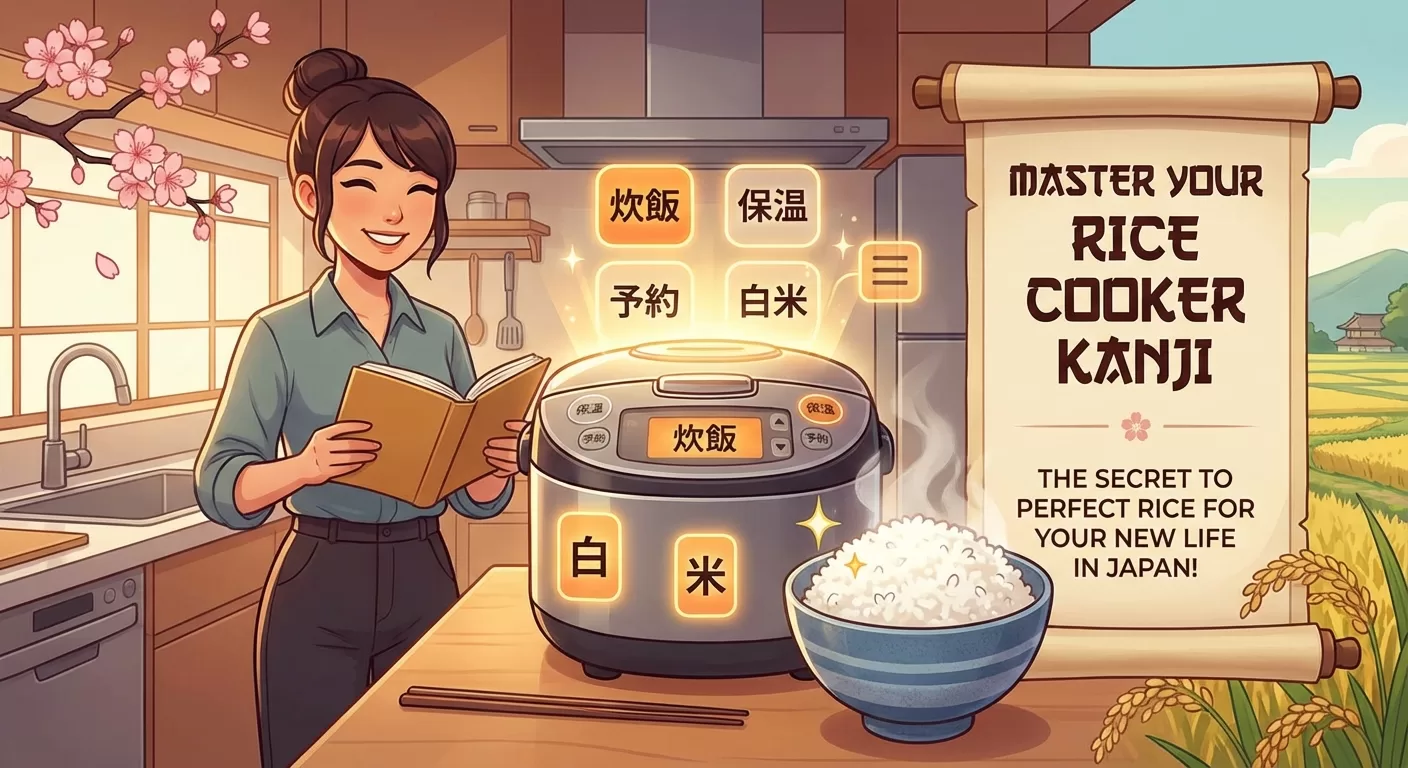
Master Your Rice Cooker Kanji: The Secret to Perfect Rice for Your New Life in Japan! 🍚✨
Executive Summary: Mastering the Kanji on a Japanese rice cooker is far more than a cooking skill—it is a crucial step toward independence in your new life. This guide teaches you the essential characters found on the control panel (炊飯, 白米, 保温) and explains the cultural reasoning behind each one, so you can prepare perfectly steamed rice from your very first day in Japan.
エグゼクティブ・サマリー:日本の炊飯器に表示される漢字をマスターすることは、単なる料理のスキルではなく、新生活における自立への重要な一歩です。このガイドでは、操作パネルにある必須の漢字(炊飯・白米・保温)を学び、それぞれの文化的な背景を理解することで、日本での初日から完璧に炊き上げたごはんを準備できるようにします。
Hello everyone! I am your instructor from SAMURAI Japan Business Center. For most Filipino families, rice is not simply a side dish—it is the heart of every meal. When you begin your new life in Japan, your rice cooker becomes your most trusted kitchen companion. Yet at first, the control panel filled with Kanji can feel intimidating. Do not worry. Today, I will guide you step by step so that every button becomes a familiar friend.
皆さん、こんにちは!SAMURAI Japan Business Centerの講師です。多くのフィリピンの家庭にとって、お米は単なる付け合わせではなく、毎日の食事の中心です。日本で新生活を始めると、炊飯器は最も頼りになるキッチンの相棒になります。しかし最初は、漢字で埋め尽くされた操作パネルに不安を覚えるかもしれません。ご安心ください。今日は、すべてのボタンが身近な存在になるよう、一歩ずつ丁寧にご案内します。
💡 Teacher’s Tip / 先生のポイント:
Before you press any button, look for the two characters 炊飯 (Suihan). They almost always mark the largest button on the machine—the one that starts the rice cooking. When in doubt, this is your north star.
どのボタンを押す前に、まず「炊飯(すいはん)」という二文字を探してください。この文字は、機械の中でほぼ必ず一番大きな「炊き始め」のボタンに書かれています。迷ったときは、この言葉が皆さんの道しるべになりますよ。
1. The Three Core Kanji Every Beginner Must Learn / 初心者が必ず覚えるべき3つの基本漢字
Every Japanese rice cooker is built around three fundamental operations: starting the cook, keeping the rice warm, and selecting a menu mode. Learning these three Kanji will already allow you to cook daily meals with confidence. Think of them as your first three “survival words” for the kitchen.
日本の炊飯器は、次の三つの基本操作を中心に作られています。「炊飯を始める」「保温する」「メニューを選ぶ」です。この三つの漢字を覚えるだけで、毎日の食事を自信を持って準備できます。キッチンで使う最初の三つの「サバイバル用語」だと考えてください。
| Kanji (漢字) | Reading (Romaji) | English Meaning | Japanese Meaning |
|---|---|---|---|
| 炊飯 | Suihan | Start cooking rice | ごはんを炊き始める |
| 保温 | Ho-on | Keep warm | 温かいまま保つ |
| メニュー | Menyū | Menu / Select mode | 炊き方の選択 |
Notice that the character 飯 in 炊飯 also appears in the daily Japanese word ご飯 (gohan), which means “rice” or “meal.” Once you recognize this single character, you will see it everywhere—on restaurant signs, in supermarket flyers, and even on convenience store rice balls. Recognizing this Kanji is a major milestone for any learner.
炊飯の「飯」は、日常語の「ご飯(ごはん)」にも使われます。この一文字を覚えると、飲食店の看板、スーパーのチラシ、コンビニのおにぎりなど、あらゆる場所で目にするようになります。この漢字を認識できることは、学習者にとって大きな節目になりますよ。
2. Choosing the Right Rice Mode: 白米・玄米・おかゆ / お米に合わせたモード選び
Japanese rice cookers are famous for having many specialized modes. For everyday cooking, the most common setting is 白米 (Hakumai), which means “white rice.” If you prefer brown rice for its nutritional value, look for 玄米 (Genmai). And when you are feeling unwell or want something gentle for your stomach, the おかゆ (Okayu) mode will prepare a smooth rice porridge.
日本の炊飯器は、多くの専用モードがあることでも有名です。普段使いで最も一般的なのが「白米(はくまい)」です。栄養価を重視して玄米を選ぶ方は「玄米(げんまい)」を探してください。体調が優れないときや胃に優しい食事が欲しいときは、「おかゆ」モードでなめらかなお粥を作ることができます。
When you are in a hurry, the 早炊き (Hayadaki) function cooks rice in a shorter time. The texture is slightly firmer and less glossy than the standard mode, but it is perfectly acceptable for busy mornings before work or class. Being able to switch between these modes proves that you understand the practical side of Japanese daily life.
時間がないときは、「早炊き(はやだき)」機能を使えば短時間で炊き上がります。食感は標準モードよりやや硬めで艶も少なめですが、仕事や学校の前の忙しい朝には十分に実用的です。これらのモードを使い分けられることは、日本の日常生活の実践的な側面を理解している証拠になります。
💡 Pro Tip: Read the Small Kanji Too / プロのヒント:小さな漢字も読んでみよう
Many machines hide useful characters in small print, such as 無洗米 (Musenmai) for pre-washed rice or おこわ (Okowa) for sticky glutinous rice. Scanning the entire panel patiently is itself an excellent Kanji reading exercise.
多くの機種では、「無洗米(むせんまい)」や「おこわ」といった便利な漢字が小さく書かれています。パネル全体をじっくり見渡すこと自体が、優れた漢字の読み取り練習になりますよ。
3. The Japanese Unit 合 (Go): Measuring Rice Correctly / 日本の単位「合」で正しくお米を測る
In the Philippines, rice is often measured with an ordinary cup or even by hand. In Japan, however, the standard unit is 合 (Go), which equals approximately 180 ml. Every rice cooker sold in Japan comes with a small measuring cup designed to hold exactly one Go. Inside the inner pot, you will see numbered lines. The rule is simple: match the water level to the number of Go you have placed in the pot.
フィリピンでは、お米を普通のカップや手で測ることが多いですが、日本での標準単位は「合(ごう)」で、約180mlに相当します。日本で販売されている炊飯器には、ちょうど1合分を測るための専用カップが付属しています。内釜には数字の線が刻まれています。ルールは簡単です。入れた合数の線に、水の量を合わせるだけです。
This unit is deeply embedded in Japanese culture. Sake is also measured in units related to Go, and many traditional recipes refer to rice by the number of Go. For this reason, understanding 合 is not only a cooking skill, but a cultural clue that helps you read menus, recipes, and labels throughout Japan.
この単位は日本文化に深く根付いています。日本酒も合に関連する単位で測られることがあり、多くの伝統的なレシピではお米を合数で表します。そのため、「合」を理解することは単なる料理のスキルにとどまらず、日本中のメニューやレシピ、ラベルを読み解くための文化的な手がかりにもなるのです。
If you also want to strengthen your daily Kanji reading habits, I recommend our related article Kanji is Fun! Discover the Secret to Mastering it Easily for Your Japan Dream 🇯🇵, where we share fun techniques to make Kanji a joyful part of your learning routine.
日常の漢字を読む力をさらに高めたい方には、こちらの記事「漢字は楽しい!日本での夢を叶えるための簡単な覚え方の秘密」もおすすめです。漢字を楽しく学ぶコツを紹介しています。
4. The Magic of 予約 (Yoyaku) and 保温 (Ho-on) / 予約と保温の魔法
Two functions make the Japanese rice cooker truly magical. The first is 予約 (Yoyaku)—the timer. You can set the machine in the evening so that steaming hot rice is ready exactly when you wake up. Nothing feels more like a dream life than the aroma of freshly cooked rice greeting you in the morning.
日本の炊飯器を真に魔法のようにしてくれる機能が二つあります。一つ目は「予約(よやく)」です。夜にセットしておけば、朝起きる時間にちょうど炊きたてのごはんが準備できます。朝、炊きたてごはんの香りに迎えられることほど、夢のような生活を感じる瞬間はありません。
The second is 保温 (Ho-on)—keep warm. Once cooking finishes, the machine automatically maintains a safe temperature so the rice stays tasty for hours. Remember that keeping rice warm for too long (more than twelve hours) can cause it to dry out or develop an odor. If you know you will not eat all of it, remove the rice, wrap it, and freeze it for later.
二つ目は「保温(ほおん)」です。炊き上がると、機械が自動的に安全な温度を保ち、ごはんを何時間もおいしく維持してくれます。ただし、長すぎる保温(12時間以上)は乾燥や匂いの原因になることを覚えておきましょう。食べきれない分は取り出して包み、冷凍保存するのがおすすめです。
💡 Teacher’s Tip: The Two-Character Reset / 先生のポイント:二文字のリセット
If you make a mistake, do not panic. Look for the important Kanji 取消 (Torikeshi) or simply 切 (Kiri). Pressing either one returns the machine to its standby state, allowing you to calmly start again.
もし操作を間違えても慌てないでください。重要な漢字「取消(とりけし)」または「切(きり)」を探しましょう。どちらかを押せば機械は待機状態に戻り、落ち着いてやり直すことができます。
5. The SAMURAI Japan Methodology / SAMURAI Japanの学習メソッド
At SAMURAI Japan Business Center, we believe that language proficiency is built on practical, everyday situations rather than memorization for its own sake. In our professional training programs, students do not simply study vocabulary lists; they simulate real scenarios such as reading appliance manuals, interpreting signage, and giving verbal instructions to colleagues. This is how we prepare Filipino learners to perform confidently and precisely in Japanese work environments.
SAMURAI Japan Business Centerでは、言語力は単なる暗記ではなく、日常の実践的な場面の積み重ねで育まれると考えています。当センターのプロフェッショナル研修では、語彙リストを暗記するだけではなく、家電の取扱説明書を読む、標識を読み取る、同僚に口頭で指示を出すなど、実際の場面を再現します。これにより、フィリピン人学習者が日本の職場で正確かつ自信を持って行動できるよう準備します。
Mastering something as small as the Kanji on a rice cooker may appear modest, yet it demonstrates the kind of meticulousness and cultural awareness that Japanese employers value. Executives who visit our Business Center often comment on this attention to detail. By learning the rice cooker Kanji, students prove that they are ready to handle the more demanding documents and devices they will encounter on the job.
炊飯器の漢字のような小さな事柄を習得することは、控えめに見えるかもしれません。しかし、そこには日本人の雇用主が重視する緻密さと文化的な認識が表れています。当Business Centerを訪れる企業幹部の方々は、しばしばこうした細部への配慮に感銘を受けられます。炊飯器の漢字を学ぶことを通じて、学生は仕事で出会うより高度な書類や機器にも対応できる準備ができていることを示せるのです。
6. よくある質問 (FAQ)
Q1: 誤って違うボタンを押してしまった場合はどうすればよいですか? / What should I do if I press the wrong button by mistake?
A: Do not worry. Press the 取消 (Torikeshi) button to reset the settings. The machine will return to its standby state, and you can safely begin again. Every learner makes this mistake at least once—consider it your first practice in recovering calmly.
A: ご心配なく。「取消(とりけし)」ボタンを押して設定をリセットしてください。機械は待機状態に戻り、安全にやり直せます。学習者は誰でも一度はこの間違いを経験します。落ち着いて立て直す最初の練習だと思いましょう。
Q2: 無洗米(むせんまい)を使うときは、どのモードを選ぶべきですか? / Which mode should I use for pre-washed rice (Musenmai)?
A: Most modern rice cookers sold in Japan include a dedicated 無洗米 (Musenmai) mode. If your model does not have one, simply use the standard 白米 (Hakumai) setting. Pre-washed rice is designed to cook beautifully even with standard settings, so you can rely on it with confidence.
A: 日本で販売されている最近の炊飯器の多くには、「無洗米」専用モードが搭載されています。もしお使いの機種にない場合は、標準の「白米(はくまい)」設定をそのまま使ってください。無洗米は通常の設定でもおいしく炊けるように作られているので、安心して使えます。
Q3: なぜ日本の炊飯器には漢字とカタカナが混ざっているのですか? / Why do Japanese rice cookers mix Kanji and Katakana?
A: Kanji is typically used for traditional Japanese words such as 炊飯 (Suihan), while Katakana is reserved for loanwords from other languages, such as スタート (start) and メニュー (menu). This mixture is a hallmark of Japanese product design, ensuring clarity for every user across generations.
A: 漢字は「炊飯」のような伝統的な日本語に使われ、カタカナは「スタート」や「メニュー」などの外来語に使われます。この混在は日本の製品デザインの特徴であり、あらゆる世代の利用者にとって分かりやすさを実現するための工夫です。
7. Conclusion: Small Kanji, Big Confidence / まとめ:小さな漢字が大きな自信に
Do not let a few unfamiliar characters stand between you and the comfortable life you are building in Japan. Every time you correctly identify 炊飯 or switch to 保温, you are not only cooking rice—you are quietly strengthening your independence and cultural fluency. The kitchen is one of the most honest classrooms in the world, and your rice cooker is a patient, generous teacher.
いくつかの見慣れない漢字が、日本で築いている快適な生活を妨げることはありません。「炊飯」を正しく見つけ、「保温」に切り替えるたびに、あなたは単にごはんを炊いているだけでなく、自立心と文化的な流暢さを静かに育てています。キッチンは世界で最も正直な教室の一つであり、炊飯器は忍耐強く寛大な先生なのです。
At SAMURAI Japan Business Center, we are committed to walking with you along every step of this journey—from your very first hiragana character to the moment you confidently explain a technical document to a Japanese colleague. Keep practicing, keep exploring each button with curiosity, and enjoy the delicious, perfectly steamed rice that you will soon be preparing. We look forward to walking beside you as you turn daily habits into lasting mastery, and we warmly invite you to explore our programs and take your next step toward a vibrant, successful life in Japan.
SAMURAI Japan Business Centerは、最初のひらがな一文字から、日本人の同僚に技術書類を自信を持って説明できるようになる日まで、この旅のあらゆる段階に寄り添うことをお約束します。練習を続け、好奇心を持ってボタンを押し、まもなく炊き上げる完璧でおいしいごはんを楽しんでください。日常の習慣が確かな熟達へと変わるその歩みを、私たちは共に歩めることを楽しみにしています。ぜひ当センターのプログラムをご覧いただき、日本での活気ある成功した生活への次の一歩を踏み出してください。
🇯🇵 日本語で新しい可能性を広げよう! ✨
SAMURAI Japan Business Centerは、あなたの日本語学習を全力でサポートします。
🚀 Start Your Learning Journey Today!
Ready to learn Japanese? Apply for our programs now!
🏫 お問い合わせ (Contact Us)
📞 Phone: +63 997 093 4550
📧 Email: samuraijapan.bc@gmail.com
🏢 Address: Room D3, Freb Bldg, Villa Donata Subd, Muntinlupa
📱 SNSで楽しく学ぼう!
Related posts:
 Your Japan Dream is Calling! 5 Simple Secrets to Start Learning Japanese Today 🇯🇵✨
 Be a Workplace Superstar! Easy Japanese Greetings and Manners to Help You Shine 🇯🇵
 Start Your Dream Life in Japan! 5 Must-Have 100-Yen Shop Finds for Your New Home 🇯🇵
 Shine at Your Dream Workplace! 5 Simple Japanese Greetings to Make a Great Impression 🇯🇵
 Master the Konbini! Easy Tips and Phrases for Your Dream Life in Japan 🏪
 Master Japan’s Trains Like a Pro! Easy Tips and Phrases for Your Big Dream 🇯🇵
