
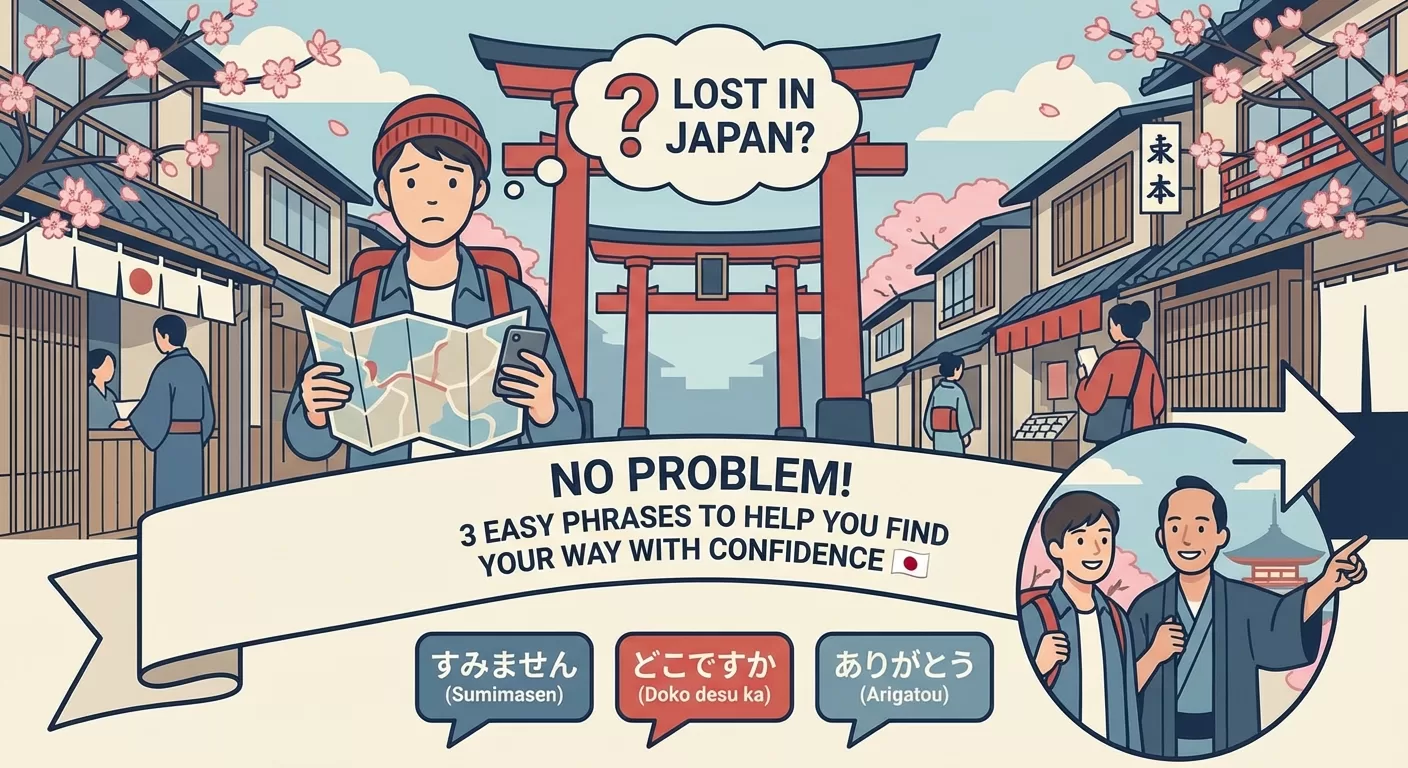
Lost in Japan? No Problem! 3 Easy Phrases to Help You Find Your Way with Confidence 🇯🇵
Executive Summary: Getting lost in Japan is not a disaster — it is an opportunity to speak, connect, and grow. In this lesson from SAMURAI Japan Business Center, you will learn three essential Japanese phrases that transform confusion into calm confidence: Sumimasen (Excuse me), … wa doko desu ka? (Where is …?), and Arigatou gozaimasu (Thank you very much). Each phrase is paired with cultural insight, pronunciation guidance, and real-world practice scenarios so you can navigate any street, station, or shopping district with poise.
要約:日本で道に迷うことは失敗ではなく、話す力とつながる力を育てる絶好のチャンスです。この記事では、SAMURAI Japan Business Centerのレッスンとして、迷いを落ち着いた自信に変える3つの必須フレーズを学びます。「すみません」「〜はどこですか?」「ありがとうございます」です。それぞれの発音のコツ、文化的な背景、そして実際の場面で使える練習方法まで丁寧に解説しますので、どんな街や駅でも落ち着いて行動できるようになりますよ。
1. Why Getting Lost Is a Golden Opportunity, Not a Problem
Many learners feel embarrassed when they cannot find a destination. In reality, Japanese cities are designed with a unique layout: street names are rarely used, addresses follow a block-based numbering system, and even locals rely heavily on landmarks. This means that asking for help is not a sign of weakness — it is a completely normal and expected part of daily life. When you approach a stranger politely, you are participating in the culture of mutual assistance that keeps Japanese society running smoothly.
多くの学習者は、目的地が見つからないと恥ずかしいと感じます。しかし実際には、日本の街は独特の仕組みで成り立っています。通り名はほとんど使われず、住所はブロック単位で表記され、現地の人でさえランドマークに頼って移動します。つまり、道を尋ねることは決して弱さの証明ではなく、日常生活のごく自然な一部なのです。丁寧に声をかけることは、日本社会を支える相互扶助の文化に参加することでもあります。
At SAMURAI Japan Business Center, we teach that confident communication begins with the decision to speak. You do not need perfect grammar to be understood — you need clarity, politeness, and the courage to open your mouth. The three phrases below are the foundation of that courage.
SAMURAI Japan Business Centerでは、自信あるコミュニケーションは「話してみよう」という決意から始まるとお伝えしています。完璧な文法は必要ありません。必要なのは、明確さ、丁寧さ、そして口を開く勇気です。以下の3つのフレーズは、その勇気の土台になります。
📚 Pro-Tip / Study Box
Before you study the phrases, decide on one simple habit: whenever you feel nervous, take one slow breath and count to three in Japanese — いち、に、さん (ichi, ni, san). This tiny ritual lowers your heart rate and gives your brain a moment to retrieve the words you have practiced.
フレーズを学ぶ前に、1つだけ習慣を決めましょう。緊張したときは、ゆっくり息を吸って日本語で3つ数えるのです。「いち、に、さん」。この小さな儀式が心拍を落ち着かせ、練習した言葉を思い出す余白を脳に与えてくれます。
2. The Magic Opener: すみません (Sumimasen)
The first phrase is the most powerful one. Sumimasen is often translated as Excuse me, but its true function is far richer. It acknowledges the other person’s presence, apologizes for the interruption, and shows respect for their time — all in a single word. In Japanese communication, how you begin a conversation matters as much as what you say afterward. Starting with Sumimasen instantly signals that you are a considerate and well-mannered person.
最初に紹介するフレーズが、最も強力な一言です。「すみません」は一般にExcuse meと訳されますが、その本当の役割はもっと豊かです。相手の存在を認め、話しかけることへの遠慮を表し、相手の時間への敬意を示す。それらすべてを一語で担っています。日本語のコミュニケーションでは、会話の始め方が、その後の内容と同じくらい重要なのです。「すみません」から始めるだけで、あなたが思いやりのある礼儀正しい人だというメッセージが瞬時に伝わります。
Pronunciation is simple. Break the word into four even beats: su-mi-ma-sen. Keep every syllable the same length, and soften the ending. Avoid rushing — a clear, unhurried delivery sounds far more polite than a fast one.
発音はシンプルです。「す・み・ま・せん」と4拍で均等に区切ります。すべての音を同じ長さで発音し、語尾はやわらかく。急がず、はっきりと落ち着いて言うほうが、速く言うよりずっと丁寧に聞こえます。
- Situation 1: Getting a Stranger’s Attention
When you need to ask someone on the street for help, raise your hand slightly to chest height and say Su-mi-ma-sen with a gentle bow of about 15 degrees. This combination of voice and gesture is the single most effective way to begin any request in Japan.
道で誰かに助けを求めたいときは、手を胸の高さまで軽く上げ、15度ほどの会釈とともに「すみません」と言いましょう。声と動作を組み合わせるこの方法は、日本で何かを頼むときの最も効果的な始め方です。
- Situation 2: Calling a Staff Member in a Shop or Restaurant
In Japan, service staff deliberately keep their distance so customers can think in peace. When you are ready to order, simply raise your hand and say Su-mi-ma-sen clearly. Staff will respond immediately and appreciate that you did not shout.
日本では、店員はお客様がゆっくり考えられるよう、あえて距離を保ちます。注文の準備ができたら、手を軽く上げてはっきりと「すみません」と言いましょう。店員はすぐに反応してくれますし、大声を出さない配慮も好印象です。
- Situation 3: Getting Off a Crowded Train
On a packed commuter train, saying Su-mi-ma-sen softly as you move toward the door lets people know you need to pass. It is a small courtesy that keeps crowded spaces calm and considerate.
満員電車でドアに向かって移動するとき、小さな声で「すみません」と言えば、通る必要があることが伝わります。混雑した空間を穏やかに保つための、小さくて大切な配慮です。
To deepen your understanding of this single word, we recommend reading our dedicated guide on how Sumimasen can make your life in Japan easier, where we explore its three distinct functions in greater depth.
この一言をさらに深く理解したい方は、「すみません」が日本での生活を楽にする方法という専用記事もあわせてご覧ください。3つの異なる役割をより詳しく解説しています。
3. The Golden Question: 〜はどこですか? (… wa doko desu ka?)
Once you have politely opened the conversation, the next step is to ask for your destination. The sentence pattern [Place] wa doko desu ka? literally means As for [Place], where is it? This structure is universal, easy to remember, and understood by every Japanese speaker regardless of region or dialect. The particle は (wa) marks your destination as the topic, and どこ (doko) asks for its location.
丁寧に会話を始めたら、次は目的地を尋ねます。「[場所] はどこですか?」という文型は、直訳すると「[場所] については、どこにありますか?」となります。この構造は普遍的で覚えやすく、地域や方言に関係なくすべての日本語話者に通じます。助詞の「は」が目的地を話題として示し、「どこ」がその場所を尋ねます。
Because Japanese streets often lack names, the most useful questions combine a landmark with the pattern. Learning a handful of high-frequency location nouns will multiply your ability to navigate any city.
日本の通りには名前が付いていないことが多いため、実用的な質問はランドマークと文型を組み合わせたものになります。頻度の高い場所の名詞をいくつか覚えるだけで、どんな街でも移動できる力が何倍にもなります。
- 駅 (Eki) — Train Station
The station is the heart of Japanese transit life. Ask Eki wa doko desu ka? to find trains, buses, taxi stands, and often the central meeting point of any neighborhood. Most Japanese towns are designed around their station.
駅は日本の交通生活の中心です。「駅はどこですか?」と尋ねれば、電車、バス、タクシー乗り場、そして多くの場合、その地域の待ち合わせ場所も見つかります。多くの日本の街は駅を中心に作られています。
- トイレ (Toire) — Restroom
A survival word for every traveler. Japanese public restrooms in stations, convenience stores, and department stores are generally clean and well-maintained. Asking Toire wa doko desu ka? is always appropriate and never rude.
旅行者にとっての救世主となる言葉です。駅やコンビニ、デパートの公共トイレは概して清潔で整備されています。「トイレはどこですか?」と聞くのは、いつでも適切で失礼にはなりません。
- コンビニ (Konbini) — Convenience Store
Open 24 hours and found on nearly every corner, convenience stores are reliable landmarks for meeting points, ATMs, restrooms, and quick meals. Ask Konbini wa doko desu ka? when you need a familiar anchor in an unfamiliar area.
24時間営業でほぼどの角にもあるコンビニは、待ち合わせ、ATM、トイレ、軽食のための信頼できるランドマークです。慣れない土地で安心できる基点が欲しいときは「コンビニはどこですか?」と尋ねましょう。
- ホテル (Hoteru) — Hotel
When returning to your accommodation, use Hoteru wa doko desu ka?. If your hotel name is unfamiliar to the listener, show a reservation screen on your smartphone to make the exchange smooth and quick.
宿泊先に戻るときは「ホテルはどこですか?」を使います。ホテル名が相手に伝わりにくい場合は、スマートフォンの予約画面を見せることで、やり取りがスムーズで素早くなります。
If you would like to further strengthen your train and station vocabulary, our guide on mastering Japan’s trains like a pro is an excellent companion lesson for this article.
電車や駅の語彙をさらに強化したい方には、プロのように日本の電車をマスターするためのガイドが、この記事と相性の良い次の一歩になります。
4. The Graceful Close: ありがとうございます (Arigatou gozaimasu)
The final phrase completes the circle. After someone helps you, close the conversation with a sincere Arigatou gozaimasu. This is the polite, formal way to say thank you, and it is appropriate for every situation — speaking to a stranger, a station attendant, a shop clerk, or an elder. Even if you did not fully understand the detailed directions, thank the person warmly. You are thanking their time and kindness, not just the information.
最後のフレーズで、やり取りが完結します。誰かに助けてもらったら、心からの「ありがとうございます」で会話を締めくくりましょう。これは丁寧でフォーマルな感謝の表現で、見知らぬ人、駅員、店員、年上の方など、あらゆる場面で適切に使えます。たとえ細かな道順を完全に理解できなかったとしても、温かくお礼を伝えましょう。情報だけでなく、相手の時間と親切に対して感謝しているのです。
Pronunciation has one key detail: hold the final vowel longer than you would in English. Say a-ri-ga-to-o go-zai-ma-su, keeping every beat even. The subtle elongation demonstrates care and formality.
発音の重要なポイントが1つあります。最後の母音を英語より長く伸ばしましょう。「あ・り・が・と・う・ご・ざ・い・ま・す」と、すべての拍を均等に保ちながら発音します。この微妙な伸ばし方が、丁寧さと形式美を表現します。
- Casual Close with Friends: ありがとう (Arigatou)
With classmates, close friends, and family members, the simple Arigatou is warm and natural. Adjusting formality to your relationship is itself a sign of cultural fluency.
クラスメート、親しい友人、家族には、シンプルな「ありがとう」が温かく自然です。関係性に応じて丁寧さを変えること自体が、文化的な適応力の表れです。
- Adding a Small Bow: The Finishing Touch
A brief 15-degree nod while saying Arigatou gozaimasu completes the interaction. Japanese people rarely expect foreigners to bow, which makes the effort genuinely touching.
「ありがとうございます」と共に15度の軽い会釈を添えれば、やり取りが完成します。日本人は外国人にお辞儀を期待していないため、その努力は本当に心に響きます。
- When Someone Apologizes to You
While Sumimasen can serve as both apology and thanks, always respond to an apology with a gentle Daijoubu desu (It is okay) or Iie, ki ni shinaide kudasai (No, please do not worry). This keeps the atmosphere light and harmonious.
「すみません」は謝罪と感謝の両方を担いますが、謝られたときは、やわらかく「大丈夫です」または「いいえ、気にしないでください」と応じましょう。場の空気を軽く、和やかに保つことができます。
5. How SAMURAI Japan Business Center Builds Real-World Confidence
Learning a phrase from a textbook and using it in a real conversation are two very different skills. At SAMURAI Japan Business Center, we develop both. Our curriculum deliberately moves beyond rote memorization and into guided practice that mirrors the situations you will actually face.
教科書でフレーズを覚えることと、実際の会話で使うことは、まったく別の技術です。SAMURAI Japan Business Centerでは、その両方を育てます。私たちのカリキュラムは、単なる暗記を意図的に超え、実際に直面する場面を再現したガイド付きの練習へと進みます。
- Scenario-Based Role-Play
Learners practice asking for directions at a simulated station gate, inside a crowded train, at a convenience store counter, and while checking into a hotel. Each scenario trains both the language and the physical gestures — posture, eye contact, and bowing depth — that accompany it.
受講生は、模擬的な改札、混雑した車内、コンビニのカウンター、ホテルのチェックインなど、場面を設定したロールプレイで道を尋ねる練習をします。各場面では、言語だけでなく、姿勢やアイコンタクト、お辞儀の深さといった身体的な動作も同時に訓練します。
- Formality Calibration
Students learn to adjust their phrasing based on context. The same request that works with a friend does not always fit a business setting, and our instructors explain exactly when and why the register changes.
受講生は、状況に応じて表現を調整することを学びます。友人に通じる言い方がビジネスの場に常に適するとは限りません。当センターの講師が、いつ、なぜ文体を変えるのかを明確に説明します。
- Pronunciation Coaching with Feedback
Every learner receives individualized pronunciation feedback. Rhythm, vowel length, and pitch accent are corrected early, so that politeness is preserved even at fast speaking speeds.
受講生はそれぞれ個別に発音のフィードバックを受けます。リズム、母音の長さ、アクセントを早い段階で修正することで、速く話しても丁寧さが損なわれません。
- Business Manners and Professional Communication
Beyond travel survival phrases, we prepare learners for professional environments — greetings, reporting, and respectful request forms. This combination of language and manners is what distinguishes our graduates in the workplace.
旅行で使うサバイバルフレーズにとどまらず、挨拶、報告、丁寧な依頼表現など、職場環境に必要な表現も準備します。言語とマナーの両方を身につけることが、当センターの修了生の強みです。
To see how far practical vocabulary extends into daily life, our guide on mastering Japanese drugstores like a pro is a valuable extension of the same learning philosophy.
実用的な語彙が日常生活にどこまで広がるかを確かめたい方は、日本のドラッグストアをプロのように使いこなすガイドも、同じ学習哲学の貴重な延長線上にあります。
📚 Pro-Tip / Study Box
Create a personal phrase card with the three expressions in this article and keep it in your wallet. Every evening, read them aloud three times, once slowly, once at normal speed, and once with a small bow. In three weeks, this small routine will make the phrases automatic — available the instant you need them.
この記事で紹介した3つのフレーズをカードに書き、財布に入れておきましょう。毎晩、声に出して3回読みます。1回はゆっくり、1回は普通の速さ、1回は軽いお辞儀と共に。3週間続ければ、必要な瞬間に自然と出てくるようになりますよ。
6. Frequently Asked Questions / よくある質問
Q1: If I only speak a few words of Japanese, is it rude to ask a stranger for directions? / 日本語をほんの少ししか話せない場合、見知らぬ人に道を尋ねるのは失礼ですか?
No, not at all — quite the opposite. Japanese culture places great value on the effort to communicate rather than on linguistic perfection. As long as you begin with Sumimasen and maintain a polite tone, most people will happily help you. Many will even use hand gestures or open a map application on their phone. Your sincerity is what matters, far more than flawless grammar.
いいえ、まったく逆です。日本の文化では、言語の完璧さよりも、伝えようとする努力が高く評価されます。「すみません」から始め、丁寧な口調を保てば、ほとんどの人は喜んで助けてくれます。身振り手振りを使ったり、スマートフォンの地図を見せてくれたりする人も多いです。完璧な文法よりも、あなたの誠実さが何より大切なのです。
Q2: Why should I learn Japanese phrases when English signs and apps are everywhere? / 英語の看板やアプリがどこにでもあるのなら、なぜ日本語のフレーズを覚える必要があるのですか?
Using even basic Japanese transforms the quality of your interactions. It signals respect for local culture and opens the door to warmer, more personal exchanges. In major cities, English support is common, but a simple Sumimasen or Arigatou gozaimasu can earn you a genuine smile and turn a routine transaction into a memorable human connection. Beyond travel, this skill is also essential in professional settings where relationships are built through language and manners.
基本的な日本語を使うだけでも、交流の質が大きく変わります。地域文化への敬意を示し、より温かく個人的なやり取りへの扉を開きます。大都市では英語対応も一般的ですが、シンプルな「すみません」や「ありがとうございます」が、心からの笑顔を引き出し、日常のやり取りを心に残る交流に変えてくれます。旅行だけでなく、関係性が言語とマナーによって築かれる職場環境でも、この力は欠かせません。
Q3: How can I become more confident when asking for directions in real situations? / 実際の場面で道を尋ねるとき、どうすればもっと自信を持てますか?
Confidence comes from repeated, supportive practice. At SAMURAI Japan Business Center, we build safe simulation environments where you can rehearse these interactions many times with a trained instructor. Memorize a few landmark nouns, practice the rhythm aloud, and rehearse the small bow. The more you train your mind and body, the more natural these phrases will feel when you step onto an actual Japanese street.
自信は、支えのある繰り返し練習から生まれます。SAMURAI Japan Business Centerでは、訓練を受けた講師と共に、こうしたやり取りを何度も練習できる安全なシミュレーション環境を用意しています。いくつかのランドマーク名詞を覚え、リズムを声に出して練習し、小さなお辞儀も練習しましょう。頭と体を訓練するほど、実際の日本の街に立ったときに自然に振る舞えるようになります。
7. Conclusion: Every Journey Begins with a Single, Polite Step
Getting lost in Japan is not an obstacle — it is an invitation to speak. With just three phrases, you can ask politely, receive help warmly, and express gratitude sincerely. These small tools are, in truth, cultural bridges. They carry the values of consideration, humility, and mutual respect that define Japanese society, and they will serve you far beyond any single journey.
日本で道に迷うことは障害ではなく、話しかけるための招待状です。たった3つのフレーズで、丁寧に尋ね、温かく助けを受け取り、心から感謝を伝えられます。これらの小さな道具は、実のところ文化的な架け橋です。日本の社会を形作る思いやり、謙虚さ、相互尊重の価値観を運び、一度の旅をはるかに超えてあなたを支えてくれます。
We encourage you to build a genuine passion for learning. Every phrase you master expands the world you can move through with confidence. Take the next step, explore our programs, and complete our application form when you are ready to begin guided training with our instructors. Your journey toward real Japanese fluency — and the confidence that comes with it — starts today.
学びへの本物の情熱を育ててください。マスターしたフレーズの数だけ、自信を持って歩ける世界が広がります。ぜひ次の一歩を踏み出し、私たちのプログラムを調べ、講師によるガイド付きトレーニングを始める準備が整ったら、申し込みフォームからお手続きください。本当の日本語力と、それに伴う自信への旅は、今日から始まります。
For additional lessons that support your journey, visit our blog, where we publish practical guides on language, culture, and professional communication in Japan.
あなたの学びを支えるさらなるレッスンは、ブログでご覧いただけます。言語、文化、そして日本でのプロフェッショナルなコミュニケーションに関する実践的なガイドを掲載しています。
🇯🇵 日本語で新しい可能性を広げよう! ✨
SAMURAI Japan Business Centerは、あなたの日本語学習を全力でサポートします。
🚀 Start Your Learning Journey Today!
Ready to learn Japanese? Apply for our programs now!
🏫 お問い合わせ (Contact Us)
📞 Phone: +63 997 093 4550
📧 Email: samuraijapan.bc@gmail.com
🏢 Address: Room D3, Freb Bldg, Villa Donata Subd, Muntinlupa
📱 SNSで楽しく学ぼう!
Related posts:
 Your Japan Dream is Calling! 5 Simple Secrets to Start Learning Japanese Today 🇯🇵✨
 Be a Workplace Superstar! Easy Japanese Greetings and Manners to Help You Shine 🇯🇵
 Start Your Dream Life in Japan! 5 Must-Have 100-Yen Shop Finds for Your New Home 🇯🇵
 Shine at Your Dream Workplace! 5 Simple Japanese Greetings to Make a Great Impression 🇯🇵
 Master the Konbini! Easy Tips and Phrases for Your Dream Life in Japan 🏪
 Master Japan’s Trains Like a Pro! Easy Tips and Phrases for Your Big Dream 🇯🇵
