

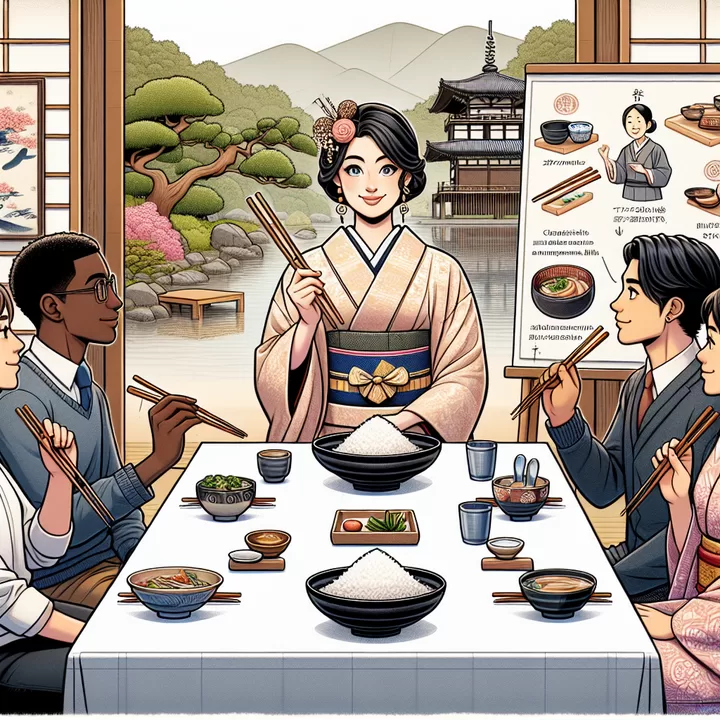
Chopstick Etiquette: Your Teacher’s Guide to Japanese Dining 🇯🇵🥢
Konnichiwa, aspiring Japan-bound learners! 👋 Are you dreaming of experiencing Japan’s vibrant culture, delicious food, and unique traditions? As your teacher, I know that preparing for life in Japan involves much more than just mastering grammar and vocabulary. One of the most common and practical challenges you’ll face is navigating Japanese dining, especially when it comes to chopsticks!
In Filipino culture, we often use spoons and forks, or even our hands, to enjoy our meals. So, adapting to chopsticks (お箸 – o-hashi) can feel a bit daunting at first. But don’t worry! This guide is designed to make you feel confident and comfortable at any Japanese dining table. Understanding chopstick etiquette isn’t just about good manners; it’s about showing respect for Japanese culture and truly immersing yourself in your new environment. Let’s dive in and master the art of dining the Japanese way! 🎉
1. The Foundation: Holding Your Hashi (Chopsticks) Correctly ✅
Before we talk about rules, let’s make sure you’re holding your chopsticks properly. It’s like learning to write; a good grip makes everything easier! While there are slight variations, the standard way ensures control and grace.
💡 Teacher’s Tip:
Practice makes perfect! Don’t get discouraged if it feels awkward at first. Try picking up small, slippery items like peanuts or beans with your chopsticks at home. The more you practice, the more natural it will become!
Here’s a simple breakdown of the standard grip:
-
Bottom Chopstick (Stationary):
Hold the first chopstick firmly between the base of your thumb and the tip of your ring finger. This chopstick should remain stationary and stable.
-
Top Chopstick (Movable):
Hold the second chopstick like a pencil, between your thumb, index finger, and middle finger. This chopstick is the one you will move to pick up food.
-
Movement:
Only the top chopstick should move. Use your index and middle fingers to gently pinch and lift the top chopstick, allowing you to grip food between the two tips.
It might feel a bit tricky initially, but once you get the hang of it, you’ll find it quite efficient!
2. Essential Do’s and Don’ts: The Golden Rules of Chopsticks 🥢🚫
Now that you know how to hold them, let’s explore the crucial etiquette points. Many of these rules exist to prevent perceived disrespect or bad luck. Learning these will help you avoid awkward situations and show your appreciation for Japanese customs.
Mastering Chopstick Manners: Do’s vs. Don’ts
| Manner | Explanation & Why it Matters |
|---|---|
| DO: Place chopsticks on a holder (Hashioki) | When not using your chopsticks, always place them on a hashioki (chopstick rest) if available, or across your bowl. This keeps the table clean and shows respect for the utensils. |
| DON’T: Stick chopsticks upright in rice (Tate-bashi / Hotoke-bashi) | This is a major taboo! It resembles incense sticks offered at a Buddhist funeral altar and is considered highly disrespectful. Never do this, especially in public. |
| DO: Use the “reverse end” for shared dishes | If you’re taking food from a communal dish and there are no serving chopsticks, it’s polite to flip your chopsticks and use the clean, wider end to pick up food. Then, flip them back to eat from your personal bowl. |
| DON’T: Pass food directly from chopstick to chopstick (Hashi-watashi) | This is another significant taboo. It’s reminiscent of transferring bones during a Japanese funeral cremation ceremony. Always place food onto a plate or into someone’s bowl rather than directly passing it. |
| DO: Bring your bowl closer to your mouth | It’s perfectly acceptable, and even encouraged, to bring your rice bowl or soup bowl close to your mouth when eating. This helps prevent spills and makes eating easier. |
| DON’T: Point with chopsticks (Sashi-bashi) | Using your chopsticks to point at people or things is considered rude, just like pointing with your finger in many cultures. |
| DO: Eat rice from your bowl first, then side dishes | It’s common to alternate between your rice and other dishes, rather than finishing one entirely before moving to the next. |
| DON’T: Tap dishes with chopsticks (Tataki-bashi) | Tapping your chopsticks on your bowl or plate is considered bad manners and is often associated with begging. |
| DO: Take only what you can eat | It’s good etiquette to take small portions and finish everything on your plate. Avoid wasting food. |
| DON’T: Hover over dishes while deciding (Mayoi-bashi) | Dithering your chopsticks over multiple dishes while you decide what to pick up next is seen as impolite and indecisive. Pick your food decisively! |
| DO: Use a small plate for bones/waste | If you have bones or inedible parts, discreetly place them on a small separate plate, or wrap them in a napkin if no plate is provided. |
| DON’T: Stab food with chopsticks (Sashi-bashi – also for stabbing) | While pointing is one form, stabbing food with one chopstick is also considered bad form. If a piece of food is too difficult to pick up, it’s better to ask for a fork or spoon if available, or break it into smaller pieces. |
| DO: Finish your meal completely | It’s a sign of appreciation to finish all the food in your bowl, especially rice. |
| DON’T: Lick your chopsticks (Neburi-bashi) | Licking food off your chopsticks or sucking on them is considered crude. |
⚠️ Most Critical Taboos to Remember:
Out of all the “Don’ts,” remember these two above all else, as they carry the most significant cultural implications related to funerals:
-
Tate-bashi (Sticking chopsticks upright in rice)
-
Hashi-watashi (Passing food from chopstick to chopstick)
Avoiding these will immediately show your respect for Japanese customs.
3. Beyond the Chopsticks: General Dining Manners 🇯🇵🍜
Chopsticks are just one part of the dining experience. Japanese dining etiquette extends to general behaviors that show respect for the food, the host, and your fellow diners.
💡 Cultural Insight: The Meaning of Mealtime Greetings
The phrases 「いただきます」(Itadakimasu) and 「ごちそうさまでした」(Gochisousama deshita) are more than just “Let’s eat” and “Thank you for the meal.” Itadakimasu literally means “I humbly receive,” expressing gratitude for all living things that sacrificed their lives for the meal, and for the people who prepared it. Gochisousama deshita similarly expresses gratitude for the meal and everyone involved in its preparation and serving. Always say these before and after a meal!
* **Before Eating: 「いただきます!」(Itadakimasu!)**
* Always say this before you start eating, often with a slight bow. It’s a respectful acknowledgment of the food and everyone involved in preparing it.
* **After Eating: 「ごちそうさまでした!」(Gochisousama deshita!)**
* Say this after you finish your meal. It means “It was a feast!” or “Thank you for the meal!” and shows your appreciation.
* **Pouring Drinks:**
* In a group setting, it’s customary to pour drinks for others, especially your elders or superiors, rather than pouring your own. Wait for someone to pour for you, and offer to pour for them. A simple 「どうぞ」(Douzo) as you pour is polite.
* **Table Etiquette:**
* **Posture:** Sit upright and avoid slouching.
* **Noise:** Eating quietly is generally preferred, although slurping noodles is an exception (more on that below!).
* **Finishing Food:** Try to finish everything on your plate, especially the last grain of rice. It’s a sign of gratitude and respect for the food.
* **Wiping Mouth:** Use the provided napkin or a tissue discreetly.
4. Handling Specific Foods with Chopsticks 🥢🍣
Some foods present unique challenges and have specific etiquette nuances when using chopsticks.
* **Sushi:**
* You can eat sushi with your hands or chopsticks! For nigiri sushi (fish on top of rice), it’s traditional to eat it with your hands. Dip the fish part (not the rice!) into soy sauce sparingly. Don’t mix wasabi into your soy sauce unless specifically done at the sushi counter for specific fish.
* **Noodles (Ramen, Udon, Soba):**
* Here’s a fun one for Filipinos: it’s perfectly fine, and even encouraged, to slurp your noodles and soup! Slurping is a sign of enjoyment and helps cool down hot noodles as you eat them. It also helps to enhance the flavor. Don’t be shy!
* Use your chopsticks to lift the noodles and your other hand to lift the bowl closer to your mouth for easier slurping.
* **Rice:**
* It’s acceptable to pick up your rice bowl and hold it close to your mouth. Use your chopsticks to scoop rice into your mouth, rather than trying to pick up individual grains.
* **Soup:**
* For miso soup or other clear soups, you can pick up the bowl and drink the broth directly. Use your chopsticks to pick up any solid ingredients like tofu or seaweed.
* **Shared Dishes:**
* As mentioned, if there are no communal serving utensils, use the reverse (clean) end of your chopsticks to take food from shared plates. Take a reasonable portion, not too much.
💡 Teacher’s Tip on Sushi & Soy Sauce:
When dipping sushi, aim for the fish side, not the rice. The rice absorbs too much soy sauce, altering the chef’s intended flavor. Use just a tiny bit – less is more when it comes to quality sushi!
5. When in Doubt: What to Do and Say 🤔🗣️
Even with all this information, there might be times you feel unsure. Don’t panic! Japanese people are generally very understanding of foreigners learning their customs.
* **Observe Others:** The best way to learn is to watch how Japanese people around you are eating. Mimic their actions.
* **Ask Politely:** If you’re really stuck, you can politely ask for guidance.
* 「どうすればいいですか?」(Dō sureba ii desu ka?) – “What should I do?”
* 「教えてください。」(Oshiete kudasai.) – “Please teach me.”
* 「すみません、これはどうやって食べますか?」(Sumimasen, kore wa dou yatte tabemasu ka?) – “Excuse me, how do I eat this?”
* **Use a Fork/Spoon (if available):** If you’re truly struggling and it’s an informal setting, don’t hesitate to ask for a fork or spoon (フォーク – fooku, スプーン – supuun) if they are available. It’s better to eat comfortably than to struggle and potentially cause a bigger etiquette faux pas.
* **Acknowledge and Apologize (if you make a mistake):** If you realize you’ve made a minor mistake, a simple 「すみません」(Sumimasen) or 「ごめんなさい」(Gomen nasai) can go a long way.
🌟 Encouragement from Your Teacher!
Remember, everyone starts somewhere! The Japanese appreciate effort and a willingness to learn their customs. Don’t be afraid to try, and don’t let small mistakes discourage you. Your journey to Japan will be filled with new experiences, and learning how to use chopsticks gracefully is just one exciting part of it. You’ve got this! Ganbatte kudasai! 💪
Conclusion: Embrace the Japanese Dining Experience 🎉
Learning chopstick etiquette and general dining manners is an essential step towards a richer, more respectful experience in Japan. It shows that you value the culture and are committed to integrating smoothly. This isn’t just about following rules; it’s about understanding the deep-rooted cultural values of respect, gratitude, and harmony that underpin Japanese society.
By practicing your chopstick skills and remembering these etiquette tips, you’ll not only enjoy your meals more but also build stronger connections with Japanese people. So go ahead, pick up those chopsticks with confidence, say 「いただきます!」, and savor every moment of your culinary journey in Japan! Oishii! 😋
Contact & Follow Us
お問い合わせ
📞 電話: +63 997 093 4550
📧 メール: samuraijapan.bc@gmail.com
🏠 住所: Room D3, Freb Bldg, Villa Donata Subd, Muntinlupa
🏢 会社名: SAMURAI Japan Business Center Inc.
SNSでフォロー
🎵 Tiktok: @samuraijapan0221
📸 Instagram: @samuraijapan.bc
▶️ Youtube: @SamuraiJapan-bc
📘 Facebook: Visit our Page

Leave a Reply