

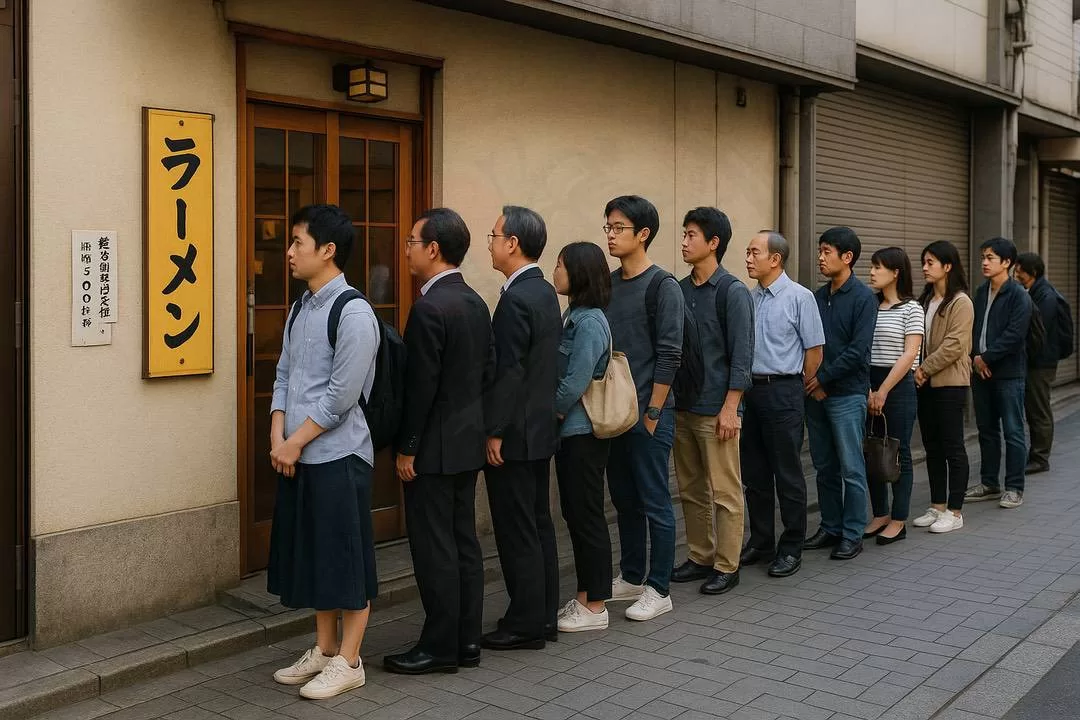
Welcome, Aspiring Japan Explorers! 🎉
Konnichiwa, future residents of Japan! As your teacher from a Japanese language school, I’m absolutely thrilled to guide you on your journey. We often focus on grammar and vocabulary, but truly mastering life in Japan means understanding its unique social rhythm. Today, we’re diving into a seemingly simple yet incredibly vital aspect of daily Japanese life: queueing (列に並ぶ – retsu ni narabu).
You might be thinking, “Queueing? I already know how to stand in line!” But in Japan, it’s more than just waiting; it’s an art form, a reflection of the society’s deep respect for order, harmony, and efficiency. Mastering this skill will not only make your daily life smoother but also show your respect for Japanese culture, paving the way for a truly enriching experience! Let’s get started!
Why Queueing is So Important in Japan 🇯🇵
In Japan, queueing is an unspoken social contract that contributes significantly to the country’s renowned orderliness and efficiency. It’s deeply rooted in the cultural values of harmony (和 – wa) and consideration for others (思いやり – omoiyari).
* Respect for Others: By patiently waiting your turn, you show respect for everyone else’s time and position. It prevents chaos and ensures fairness.
* Efficiency: Clearly defined queues make processes flow smoothly, whether it’s boarding a train, buying groceries, or ordering food. This collective adherence to rules helps everything run on time.
* Predictability: When everyone follows the system, daily life becomes predictable and stress-free. You know what to expect, and so does everyone else.
Think of it as a dance where everyone knows the steps, ensuring no one trips and everyone enjoys the performance. Your ability to queue correctly will make you feel more at home and comfortable in your new environment.
The Unwritten Rules of Japanese Queueing ✅
While specific lines might vary, there are fundamental principles that apply almost everywhere. Your keen observation skills will be your best guide!
💡 Teacher’s Tip: Observe and Adapt!
One of the best ways to learn is by observing. When you first arrive at a new place, take a moment to look around. Where are people gathering? Is there a designated line? Are there floor markings? Japanese society is very good at providing subtle visual cues. Trust your eyes!
Here are some core “unwritten rules”:
-
One Line, One Service:
Generally, people form a single line, even if there are multiple service counters. When the first counter becomes free, the person at the front of the line goes there. This ensures maximum efficiency and fairness.
-
No Cutting (割り込み – warikomi):
This is a big no-no. Cutting in line is considered very rude and will earn you disapproving glances, even if no one says anything directly. Patience is a virtue here.
-
Mind Your Personal Space:
While people stand closer in Japan than in some Western countries, there’s still a respectful distance. Don’t crowd the person in front of you. Often, you’ll see floor markings or stickers indicating where to stand.
-
Stay in Line:
If you leave the line, you lose your spot. Only step away for emergencies, and ideally, let the person behind you know briefly if you must. Don’t expect your spot to be held for long periods.
-
Follow Floor Markings and Signs:
Many places, especially train stations and large stores, have clear lines or footprints marked on the floor. Always follow these. If you don’t see any, look for where the longest line of people is naturally forming.
Common Queueing Scenarios & Essential Phrases 🗣️
Let’s look at some specific situations you’ll encounter and the phrases that will help you navigate them.
Queueing Scenarios & Useful Phrases
| Scenario | What to Look For / Do | Useful Japanese Phrase |
|---|---|---|
| Train/Bus Station Platform | Look for markings on the platform floor indicating where to stand. Often, there are two lines for two train doors. Wait behind the lines. | (No phrase needed, just follow the lines and wait patiently.) |
| Convenience Store/Supermarket | Join the back of the longest line. Some larger stores may have separate lines for each register. Wait for the staff to call “どうぞ” (Douzo – please go ahead) or gesture to the next available counter. | 「次、お願いします。」(Tsugi, onegaishimasu.) – *If you want to signal you’re ready to be served, though often unnecessary.* |
| Restaurant/Cafe | If there’s a queue outside, join it. Some places use a waiting list (記名帳 – kimeichou). Write your name and number of people. Some have numbered tickets (整理券 – seiriken) from a machine. | 「何人ですか?」(Nannin desu ka?) – *How many people?* (They might ask you) 「一人です/二人です。」(Hitori desu/Futari desu.) – *One person/Two people.* |
| Post Office/Bank/Government Office | Almost always a numbered ticket system. Take a ticket from the machine near the entrance and wait for your number to be called or displayed on a screen. | 「番号札をお願いします。」(Bangōfuda o onegaishimasu.) – *Please give me a numbered ticket.* (Usually you just take it yourself.) |
⚠️ Common Mistake Alert: Asking “Are you in line?”
In some cultures, it’s common to ask “Are you in line?” or “Is this the end of the line?” In Japan, it’s generally unnecessary and can even come across as implying someone might be cutting. Just observe. If someone is standing behind another person, they are almost certainly in line. Just go to the very end.
Navigating Challenges: Tips for Filipino Learners 🇵🇭
Filipino learners, like all international students, bring their own cultural norms. Sometimes, these can subtly clash with Japanese customs. Here’s how to bridge that gap specifically for queueing:
* Patience is Your Superpower: Filipinos are known for their warmth and hospitality, and sometimes a natural desire to “get things done” or be helpful. In Japan, the queue is a space where patience (我慢 – gaman) is truly valued. If a line is long, it’s not seen as inefficient, but rather a normal part of life. Embrace the wait.
* Subtle Cues vs. Direct Communication: In the Philippines, we might use verbal cues or direct questions if unsure about a line. In Japan, it’s more about reading the atmosphere (空気を読む – kūki o yomu) and observing non-verbal signals. If someone is standing near a service window but not clearly in a line, they might be waiting for someone, or for a specific number to be called, not actively queuing. Always assume the most orderly scenario.
* “Politeness” in Line: Filipino politeness often involves letting others go first or being less assertive. While Japanese politeness is paramount, in a queue, it means sticking to the system. Don’t wave someone ahead of you if they clearly arrived after you; it might confuse or even subtly offend them. Conversely, don’t let others cut in front of you unintentionally by being too polite and not taking your rightful place.
Practice Makes Perfect: Building Your Queueing Confidence 💪
The best way to become confident in queueing in Japan is to practice, practice, practice!
-
Start Observing Now:
Even before you arrive, watch videos of daily life in Japan (e.g., commute vlogs, shopping trips). Pay attention to how people line up at train stations, convenience stores, or even vending machines. This mental preparation is invaluable.
-
Embrace the Numbered Ticket System:
This is probably the easiest queueing system to master because it’s so clear. Practice taking a ticket, understanding the numbers, and waiting for your turn. You’ll encounter these at banks, post offices, hospitals, and even some restaurants.
-
Don’t Fear Small Mistakes:
Everyone makes mistakes, especially when learning a new culture. If you accidentally stand in the wrong spot or miss a cue, most Japanese people will be understanding and simply guide you with a gesture or a quiet word. The key is to learn from it and adjust next time. Remember, you’re learning!
-
Be Patient, Be Present:
Use queueing time as an opportunity. Observe your surroundings, listen to the language, or simply practice mindfulness. It’s a part of the Japanese way of life, and embracing it will make your experience more enjoyable.
Your Journey to a Smooth Japanese Life ✨
Learning to queue in Japan is more than just a practical skill; it’s a step towards understanding and respecting the intricate social fabric of the country. It shows that you are considerate, patient, and willing to adapt. These qualities will serve you well not just in lines, but in all aspects of your life in Japan.
As your teacher, I believe in your ability to master this, and so much more! With every correctly formed line you join, you’re building confidence and becoming more immersed in your dream life in Japan. Keep observing, keep practicing, and most importantly, keep that positive and enthusiastic spirit! Ganbatte kudasai! You can do it!
Contact & Follow Us
お問い合わせ
📞 電話: +63 997 093 4550
📧 メール: samuraijapan.bc@gmail.com
🏠 住所: Room D3, Freb Bldg, Villa Donata Subd, Muntinlupa
🏢 会社名: SAMURAI Japan Business Center Inc.
SNSでフォロー
🎵 Tiktok: @samuraijapan0221
📸 Instagram: @samuraijapan.bc
▶️ Youtube: @SamuraiJapan-bc
📘 Facebook: Visit our Page

Leave a Reply