

Essential Japanese for Your Japan Dream: Restaurant & Business 🇯🇵🍽️💼
Konnichiwa, aspiring Japan explorers! Are you dreaming of experiencing Japan’s vibrant culture, delicious food, and efficient work environment? Learning Japanese is your golden ticket! While textbooks are great, mastering practical, everyday Japanese – especially for dining and general workplace interactions – is crucial for a smooth and enjoyable life in the Land of the Rising Sun. As your language teacher, I’m here to tell you that with a little effort and the right phrases, you can confidently navigate Japanese restaurants and workplaces.
This article will equip you with essential Japanese phrases and cultural insights, transforming complex information into easy-to-understand and encouraging guidance. Let’s unlock your potential to thrive in Japan!
Savoring Japan: Restaurant Essentials 🍜✨
One of the greatest joys of living in Japan is undoubtedly the food! From steaming bowls of ramen to intricate sushi, the culinary scene is a delight. But how do you order, ask questions, or pay like a local? Let’s dive into the phrases that will make your dining experiences memorable and stress-free.
Ordering Like a Pro: From Ramen to Izakaya 🥢
Walking into a restaurant can be intimidating, but a few key phrases will make you feel right at home. Remember, politeness and clarity are highly valued.
- すみません (Sumimasen):
This is your all-purpose phrase! Use it to get the attention of staff, apologize if you accidentally bump into someone, or even to say “excuse me” when passing through a crowded area. In a restaurant, it’s how you call the waiter. “Sumimasen!”
- 〜をお願いします (~o onegaishimasu):
When ordering, this phrase means “Please give me ~.” You just need to insert the item name before it. For example, if you want ramen, you’d say 「ラーメンをお願いします」(Ramen o onegaishimasu).
- これ、お願いします (Kore, onegaishimasu):
If you’re pointing at something on the menu, this phrase means “This one, please.” Very handy!
- お水をお願いします (Omizu o onegaishimasu):
Need water? Just ask for “water, please.”
- これは何ですか? (Kore wa nan desu ka?):
If you’re curious about an unfamiliar dish on the menu, point to it and ask, “What is this?”
- アレルギーがあります (Arerugī ga arimasu):
If you have allergies, it’s important to communicate this. Follow it with specific allergy information. For example, 「ピーナッツアレルギーがあります」(Pīnattsu arerugī ga arimasu) for peanut allergy.
- ベジタリアンです (Bejitarian desu):
If you’re vegetarian, saying “I am vegetarian” is a good start, though specific dietary requests might still require more detailed explanation depending on the restaurant.
💡 Teacher’s Tip: Practice Pronunciation!
Many Filipino learners find the Japanese ‘R’ sound tricky, as it’s somewhere between an ‘L’ and a ‘D’. Listen carefully to native speakers and try to imitate. Also, pay attention to long and short vowels (e.g., おばさん (obasan – aunt) vs. おばあさん (obaasan – grandmother)). A small difference in length can change the meaning entirely!
Dining Etiquette & Paying with Grace 🙇♀️💸
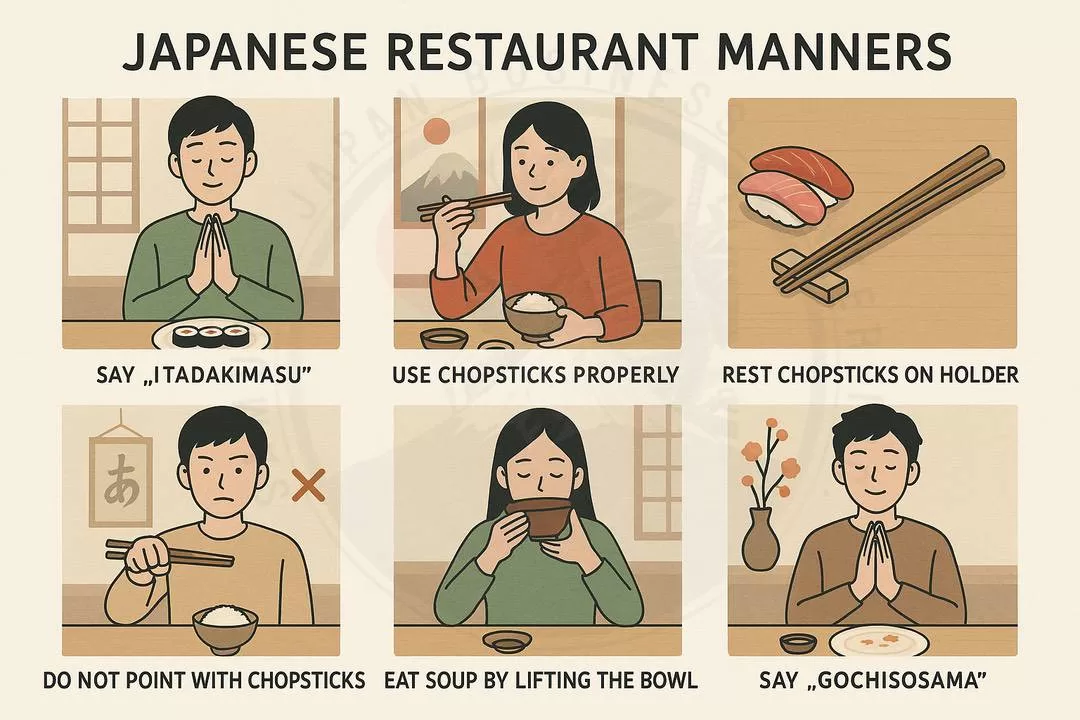
Japanese dining has a few unique customs that are good to know, beyond just the phrases. Embracing these shows respect and enhances your experience.
- いただきます (Itadakimasu):
Said before eating, this expresses gratitude for the food and all those involved in its preparation. It’s a fundamental part of Japanese dining culture. Always say 「いただきます」 before you start!
- ごちそうさまでした (Gochisousama deshita):
Said after eating, this thanks the cook, the staff, and expresses appreciation for the meal. Say 「ごちそうさまでした」 as you leave or before leaving your table.
- お会計をお願いします (Okaikei o onegaishimasu):
When you’re ready to pay, this means “The check, please.” In many casual restaurants, you pay at the front counter near the exit, not at your table.
⚠️ Cultural Note: No Tipping!
Unlike in many Western countries, tipping is not customary in Japan and can even be considered rude or confusing. The service charge is usually included in the price, or the concept simply doesn’t exist.
Essential Restaurant Vocabulary
| Japanese | Romaji | English |
|---|---|---|
| メニュー | Menyuu | Menu |
| お箸 | Ohashi | Chopsticks |
| フォーク | Fōku | Fork |
| スプーン | Supuun | Spoon |
| お皿 | Osara | Plate |
| おいしい | Oishii | Delicious |
| 定食 | Teishoku | Set meal |
💡 Cultural Insight: Slurping Ramen is OK!
Unlike in some cultures where slurping is considered impolite, in Japan, especially with noodles like ramen or soba, slurping is often seen as a sign of enjoyment and appreciation for the chef’s hard work. It also helps cool down the hot noodles!
Navigating the Japanese Workplace: Business Basics 🤝🏢
Beyond dining, understanding basic workplace Japanese and cultural norms is vital for anyone planning to work or interact professionally in Japan. While we won’t discuss job specifics, mastering general communication and etiquette will make you a valued team member.
Greetings & Introductions: Making a Good First Impression 🌸
First impressions matter everywhere, and Japan is no exception. Formal greetings are essential in a business context.
- おはようございます (Ohayou Gozaimasu):
Good morning. Use this universally until around noon. It’s also used as a general greeting to colleagues you see for the first time in the day, even in the afternoon, if it’s the first time you’re greeting them.
- こんにちは (Konnichiwa):
Good afternoon/hello. Standard greeting during the day.
- こんばんは (Konbanwa):
Good evening. Used after sunset.
- お疲れ様です (Otsukaresama desu):
This phrase doesn’t have a direct English translation, but it’s used extensively in the Japanese workplace. It roughly means “You must be tired from your hard work” and is used to acknowledge someone’s effort, upon arrival, departure, or when seeing colleagues working. It’s a way to show solidarity and mutual respect among colleagues.
- 初めまして (Hajimemashite):
Nice to meet you. Use this when meeting someone for the first time.
- 〜と申します (~to mōshimasu):
A humble way to say “My name is ~.” Follows your name. For example, 「[あなたの名前] と申します」([Anata no namae] to mōshimasu).
- どうぞよろしくお願いします (Dōzo yoroshiku onegaishimasu):
Often said after an introduction, this is a very versatile phrase expressing “Please treat me well,” “I look forward to working with you,” or “Please take care of me.” It’s almost mandatory after your first self-introduction.
⚠️ Common Mistake Alert: Over-familiarity!
In the Japanese workplace, it’s generally best to start with polite forms (-masu/-desu) and more formal language, especially with superiors or new colleagues. Don’t rush into casual speech (plain form) unless explicitly invited to do so. Observe how others interact.
Daily Workplace Communication: Effective & Polite 🗣️
Everyday interactions require a set of phrases to ensure smooth communication and maintain good relationships.
- ありがとうございます (Arigatou Gozaimasu):
Thank you (polite). Used frequently to express gratitude.
- 恐れ入ります (Osoreirimasu):
A very polite way to say “Excuse me,” “I’m sorry,” or “Thank you,” often used when asking for a favor or when someone has gone out of their way for you. It carries a sense of humility.
- 申し訳ありません (Moushiwake arimasen):
A more formal and sincere apology than 「すみません」, used in business contexts for more serious apologies.
- 手伝っていただけませんか? (Tetsudatte itadakemasenka?):
Could you please help me? (Very polite and humble request).
- 分かりました (Wakarimashita):
I understand / I got it. A simple and effective way to confirm understanding.
- 確認します (Kakunin shimasu):
I will confirm. Use this when you need to double-check something.
- お先に失礼します (O saki ni shitsurei shimasu):
Literally “Excuse me for going ahead (leaving first).” Said when leaving the office before others. Colleagues will usually reply with 「お疲れ様でした」.
Essential Workplace Phrases
| Japanese | Romaji | English Usage |
|---|---|---|
| 失礼します | Shitsurei shimasu | Excuse me / Sorry to bother you (when entering/leaving a room, or hanging up a call) |
| 承知いたしました | Shōchi itashimashita | Understood / I have received (a more formal “Wakarimashita”) |
| お世話になっております | Osewa ni natte orimasu | Thank you for your continued support (Common business greeting, especially via email/phone) |
| よろしくお願いします | Yoroshiku onegaishimasu | Please take care of me / I look forward to working with you (Very versatile, used frequently) |
Cultural Keys to Success in Business 🔑🇯🇵
Beyond language, understanding cultural nuances is paramount for effective interaction in Japanese workplaces.
- Punctuality (時間厳守 – Jikan Genshu):
Being on time, or even a few minutes early, is highly valued. Tardiness can be seen as a lack of respect.
- Hōrensō (報告・連絡・相談):
This isn’t a phrase, but a vital communication principle: 報告 (Hōkoku – Report), 連絡 (Renraku – Inform/Contact), 相談 (Sōdan – Consult). It means always reporting progress, informing others of necessary updates, and consulting your superiors or colleagues when facing issues. This fosters transparency and teamwork.
- Group Harmony (和 – Wa):
Maintaining harmony and avoiding direct confrontation is often prioritized. Discussions might be indirect, and consensus-building is common. Reading between the lines is a skill you’ll develop.
- Meishi (名刺 – Business Cards):
Exchanging business cards is a formal ritual. Receive with both hands, read the card, and place it respectfully on the table in front of you during a meeting, not immediately putting it away. Always present your card with the Japanese side facing up towards the recipient.
💡 Teacher’s Tip: Embrace Indirectness!
Filipinos are often more direct in communication. In Japan, especially in formal settings, indirectness is common. Instead of “No, I can’t do that,” you might hear “It might be a little difficult” or “I will consider it.” Learn to pick up on subtle cues and non-verbal communication.
General Tips for Your Japanese Language Journey 🎉
Learning a new language is a marathon, not a sprint. Here are some enduring tips to keep you motivated and progressing:
- Consistency is Key ✅:
Even 15-30 minutes of study every day is more effective than one long session once a week. Review vocabulary, practice phrases, and listen to Japanese media regularly.
- Don’t Be Afraid to Make Mistakes 🗣️:
Everyone makes mistakes, especially when learning a new language. View them as learning opportunities, not failures. Japanese people are often very understanding and appreciate your effort to speak their language.
- Listen Actively 👂:
Immerse yourself! Watch Japanese dramas, anime, or news. Listen to Japanese music. Try to catch phrases you’ve learned. Pay attention to how native speakers pronounce words and intonate sentences.
- Practice with Native Speakers (if possible) 🤝:
Language exchange partners, online communities, or Japanese friends can provide invaluable real-world practice. Speaking is the best way to solidify what you’ve learned.
- Utilize Apps and Resources 📱:
There are many fantastic apps (like Duolingo, Memrise, Anki for flashcards), YouTube channels, and online resources available. Find what works best for your learning style and incorporate them into your routine.
Your Japan Dream is Within Reach! 🌟
Embarking on a journey to Japan, whether for work or extended stay, is an exciting prospect. The ability to communicate effectively in Japanese will not only ease your daily life but also enrich your cultural experiences and open doors to deeper connections. Remember, every phrase you learn, every cultural nuance you grasp, is a step closer to your dream. You have the determination, and with consistent effort and a positive attitude, you will succeed. Ganbatte kudasai!
Contact & Follow Us
お問い合わせ
📞 電話: +63 997 093 4550
📧 メール: samuraijapan.bc@gmail.com
🏠 住所: Room D3, Freb Bldg, Villa Donata Subd, Muntinlupa
🏢 会社名: SAMURAI Japan Business Center Inc.
SNSでフォロー
🎵 Tiktok: @samuraijapan0221
📸 Instagram: @samuraijapan.bc
▶️ Youtube: @SamuraiJapan-bc
📘 Facebook: Visit our Page

Leave a Reply