

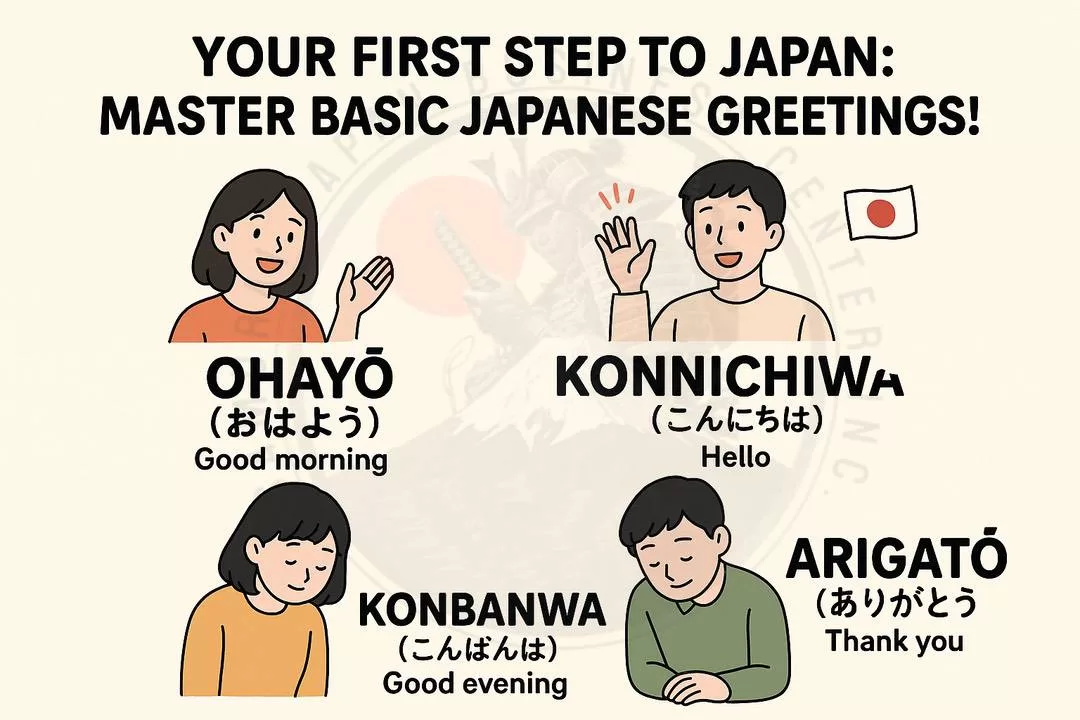
Your First Step to Japan: Master Basic Japanese Greetings! 🇯🇵
Konnichiwa, aspiring Nihongo learners! Are you dreaming of experiencing the vibrant culture, delicious food, and beautiful scenery of Japan? Perhaps you envision yourself walking through the bustling streets of Tokyo, exploring the serene temples of Kyoto, or simply enjoying daily life in a cozy Japanese neighborhood. Whatever your dream, your journey to Japan begins with a single, yet incredibly powerful, step: mastering basic Japanese greetings.
As your language teacher, I know that starting something new can feel overwhelming. But trust me, greetings are your first key to unlocking communication and building connections in Japan. They show respect, open doors, and make everyday interactions much smoother. This guide is specifically designed for you, our dedicated Filipino students, to make this crucial first step easy, engaging, and fun! Let’s dive in and get you speaking like a local in no time. Ganbatte kudasai! 💪
Hajimemashite! The Foundation of Connection ✨
When you meet someone new in Japan, the very first thing you say sets the tone for your entire interaction. This is where 「はじめまして」(Hajimemashite) comes in.
* はじめまして (Hajimemashite)
*
This phrase is the equivalent of “Nice to meet you” or “How do you do?” It’s used exclusively when you meet someone for the very first time. It signifies the start of a new acquaintance and is almost always accompanied by a bow.
💡 Teacher’s Tip: Pronunciation Focus!
For Filipinos, the “ha” sound in 「はじめまして」 is like the “ha” in “hello,” not like the “fa” in “father.” Practice saying it clearly and crisply. Remember, Japanese vowels are pronounced cleanly, without diphthongs (e.g., ‘i’ is like ‘ee’ in ‘meet’, ‘e’ is like ‘e’ in ‘get’).
After `Hajimemashite`, it’s common to follow up with your name and then 「どうぞよろしくお願いします」(Douzo yoroshiku onegaishimasu), or its shorter form 「よろしくお願いします」(Yoroshiku onegaishimasu).
* どうぞよろしくお願いします (Douzo yoroshiku onegaishimasu)
*
This phrase is incredibly versatile and doesn’t have a direct English translation. It conveys feelings like “Please treat me well,” “I look forward to working with you,” or “Please give me your favor/kindness.” It’s essential in introductions, at the start of collaborations, or when asking for a favor.
🌸 Cultural Insight: The Bow (O-jigi) 🌸
In Japan, greetings are often accompanied by a bow. For beginners, a simple slight nod or a 15-degree bow from the waist is perfectly acceptable and shows respect. Don’t worry too much about the depth initially, but make sure it’s genuine!
Morning, Noon, and Night: Time-Specific Greetings ☀️🌙
Just like in English, Japanese has different greetings depending on the time of day. These are fundamental for daily interactions.
Time-Specific Japanese Greetings
| Phrase | Meaning | Usage Context |
|---|---|---|
| おはようございます (Ohayō gozaimasu) | Good morning | Used until around 11 AM or noon. Can be used in the afternoon/evening for colleagues you’re seeing for the first time that day, especially in professional settings. |
| こんにちは (Konnichiwa) | Good afternoon / Hello | Used from around noon until early evening. It’s a general “hello” or “good day.” |
| こんばんは (Konbanwa) | Good evening | Used from evening onwards, typically after sunset. |
⚠️ Common Mistake Alert: “Ohayō” vs. “Ohayō gozaimasu”
While 「おはよう」(Ohayō) is a casual “good morning,” remember to use the full, polite form 「おはようございます」(Ohayō gozaimasu) when speaking to elders, superiors, or people you don’t know well. Always err on the side of politeness when in doubt!
Saying Goodbye: More Than Just “Bye” 👋
Japanese goodbyes are often nuanced, reflecting the relationship between speakers and the context of the departure.
* さようなら (Sayounara)
*
This is the classic “goodbye” you often learn first. However, it carries a sense of finality or long-term separation, like “farewell.” It’s not typically used for daily departures where you expect to see the person again soon (e.g., leaving work for the day). You might hear it used by students leaving school for the day, as a polite way to say goodbye to their teachers, or if someone is moving away.
* またね (Mata ne) / じゃあね (Jaa ne)
*
These are casual and very commonly used phrases for saying goodbye among friends, family, or close colleagues. 「またね」 means “See you again,” while 「じゃあね」 is more like “See ya!” or “Later!”
* お先に失礼します (O-saki ni shitsurei shimasu)
*
When leaving work or a group activity before others, this polite phrase means “Excuse me for leaving before you” or “I’m leaving first.” It’s a crucial phrase in a Japanese workplace or group setting to show consideration.
* おやすみなさい (Oyasumi nasai)
*
This means “Good night” and is used when someone is going to bed. The casual form is 「おやすみ」(Oyasumi).
💡 Teacher’s Tip: Context is King!
Don’t overuse 「さようなら」! For everyday situations, especially with people you’ll see again, stick to 「またね」 or 「じゃあね」 with friends, or 「お先に失礼します」 in a work setting. This will make your Japanese sound much more natural!
Politeness is Key: Thank You and Sorry 🙏
Showing gratitude and expressing apology are cornerstones of Japanese communication. Master these, and you’ll navigate social situations with grace.
* ありがとうございます (Arigatou gozaimasu)
*
This is the standard, polite way to say “Thank you.” You’ll use it countless times a day. The casual form is 「ありがとう」(Arigatou), which you use with close friends and family.
*
For even greater politeness, especially when thanking someone for a significant favor or a past action, you can use 「ありがとうございました」(Arigatou gozaimashita), which translates to “Thank you very much (for what you did).”
* すみません (Sumimasen)
*
This is one of the most versatile and important words in Japanese. It can mean “Excuse me,” “I’m sorry,” and even “Thank you” in certain contexts. Learning its various uses will greatly enhance your communication.
The Versatile 「すみません」(Sumimasen)
| Usage | Example Situation | English Equivalent |
|---|---|---|
| Apology | You accidentally bump into someone. | “I’m sorry.” |
| Getting Attention | Calling a waiter in a restaurant. | “Excuse me!” |
| Expressing Gratitude (with a hint of apology/trouble caused) | Someone holds a door open for you, or goes out of their way to help you. | “Thank you (for going to the trouble).” |
* ごめんなさい (Gomen nasai)
*
This phrase means “I’m sorry” and is generally used for more direct apologies, often when you feel you’ve genuinely inconvenienced or wronged someone. The casual form is 「ごめん」(Gomen).
⚠️ Common Mistake Alert: Sumimasen vs. Gomen nasai
While both mean “sorry,” 「すみません」 is more like “excuse me” or a light apology/thank you for the trouble. 「ごめんなさい」 is a stronger, more direct apology for a mistake. If you accidentally step on someone’s foot, 「ごめんなさい」 is appropriate. If you just need to get past someone, 「すみません」 is enough.
Daily Essential Phrases: Beyond Greetings 🏡
Beyond standard greetings, there are several everyday phrases that are deeply embedded in Japanese culture and daily life. Mastering these will make you feel more integrated and comfortable.
Essential Daily Phrases for Life in Japan
| Phrase | Meaning | Usage Context |
|---|---|---|
| いってきます (Ittekimasu) | “I’m going (and coming back)” | Said when leaving home or a place where you expect to return. |
| いってらっしゃい (Itterasshai) | “Go and come back” / “See you later!” | The response to `ittekimasu`. Said to someone who is leaving. |
| ただいま (Tadaima) | “I’m home” / “I’m back” | Said upon returning home or to your office/group. |
| おかえりなさい (Okaerinasai) | “Welcome home” / “Welcome back” | The response to `tadaima`. Said to someone who has returned. |
| いただきます (Itadakimasu) | “I humbly receive (this food)” | Said before starting a meal, expressing gratitude for the food and all involved in its preparation. |
| ごちそうさま (Gochisousama) | “It was a feast” / “Thank you for the meal” | Said after finishing a meal, expressing gratitude for the food. Often paired with 「ごちそうさまでした」(Gochisousama deshita) for more politeness. |
| おつかれさまです (Otsukaresama desu) | “You must be tired” / “Good work” | A very common and versatile phrase used in professional or group settings to acknowledge someone’s hard work or effort. Can be used when arriving, leaving, or encountering colleagues. |
🌸 Cultural Insight: Importance of Ritual Phrases 🌸
These phrases (いってきます, ただいま, いただきます, おつかれさまです) are more than just words; they are rituals that foster group harmony and respect in Japanese society. Using them correctly shows you understand and appreciate these cultural nuances.
Teacher’s Pro-Tips for Filipino Learners 💡
As your teacher, I’ve observed common challenges and triumphs among Filipino learners of Japanese. Here are some insights to help you excel:
-
Mastering Japanese Sounds:
While Filipino languages share some phonetic similarities with Japanese, pay close attention to:
- R/L Distinction: Japanese “r” sound is often described as being between an English “r” and “l,” like a soft “d” in some Filipino dialects. It’s not the strong English “r.” Practice with words like 「ラーメン」(raamen) or 「ありがとう」(arigatou).
- Long Vowels: Double vowels (e.g., in 「おかあさん」(okaasan – mother) or 「おおきい」(ookii – big)) are crucial. A long vowel can change the meaning of a word! For instance, 「おばさん」(obasan – aunt) vs. 「おばあさん」(obaasan – grandmother).
- Double Consonants (ッ): The small `tsu` (っ) indicates a pause or a doubled consonant, like holding your breath for a beat. In 「きって」(kitte – stamp), you pause before “te,” unlike 「きて」(kite – come). This is vital for clear communication.
-
Embrace Politeness Levels (Keigo Light):
Japanese society places a high value on politeness. While full Keigo (honorific language) is advanced, start by always using the polite `~masu`/`~desu` forms with strangers and superiors. When in doubt, be polite! It’s always better to be too polite than not polite enough.
-
Practice, Practice, Practice!
Don’t just memorize; internalize!
- Shadowing: Listen to native speakers (anime, dramas, YouTube, language apps) and try to mimic their pronunciation, rhythm, and intonation exactly.
- Role-Playing: Practice dialogues with a language partner or even by yourself in front of a mirror. Simulate real-life scenarios.
- Daily Use: Try to incorporate new phrases into your daily life, even if you’re just talking to yourself.
-
Don’t Fear Mistakes:
Every language learner makes mistakes – it’s a natural part of the process! Japanese people are generally very understanding and appreciate your effort to speak their language. View mistakes as learning opportunities, not failures. Be brave and speak!
🌸 Cultural Insight: Eye Contact & Bowing 🌸
Unlike in the Philippines where direct eye contact signifies sincerity, in Japan, prolonged direct eye contact can sometimes be perceived as aggressive or disrespectful, especially with superiors. A brief glance is usually sufficient. Remember to combine your greetings with a slight bow or nod, as appropriate.
Conclusion: Your Journey Has Begun! 🎉
Congratulations! By learning these basic Japanese greetings and daily phrases, you’ve already taken significant strides towards realizing your dream of living in Japan. These simple words are powerful tools that will allow you to connect with people, navigate daily life, and truly immerse yourself in the culture.
Remember, language learning is a marathon, not a sprint. Be patient with yourself, celebrate every small victory, and never lose sight of your goal. The warmth and hospitality of the Japanese people await you, and your effort to speak their language will be genuinely appreciated. Keep practicing, stay curious, and know that every “Ohayō gozaimasu” and “Arigatou gozaimasu” brings you closer to your dream.
Ganbatte kudasai! We believe in you!
Contact & Follow Us
お問い合わせ
📞 電話: +63 997 093 4550
📧 メール: samuraijapan.bc@gmail.com
🏠 住所: Room D3, Freb Bldg, Villa Donata Subd, Muntinlupa
🏢 会社名: SAMURAI Japan Business Center Inc.
SNSでフォロー
🎵 Tiktok: @samuraijapan0221
📸 Instagram: @samuraijapan.bc
▶️ Youtube: @SamuraiJapan-bc
📘 Facebook: Visit our Page

Leave a Reply