

Unlock Japan’s Unwritten Rules: Essential Life Manners Guide 🇯🇵💡
Konnichiwa, future Japan adventurers! Are you dreaming of experiencing life in the Land of the Rising Sun? Whether it’s for study, work, or simply immersing yourself in a new culture, understanding Japan’s unique social customs is key to a smooth and enjoyable transition. Unlike the Philippines, where warmth and directness often characterize interactions, Japanese society operates on a subtle, unspoken code of conduct.
As your guide from a Japanese language school, I know that learning grammar and vocabulary is just one piece of the puzzle. The true secret to thriving in Japan lies in mastering its “unwritten rules” – the essential manners that dictate daily life. These aren’t just polite suggestions; they are fundamental principles rooted in respect, harmony, and consideration for others. Don’t worry, though! This guide is designed to make these concepts easy to understand and even fun to learn. Let’s dive in and unlock the secrets to living respectfully and confidently in Japan! 🎉
The “Why” Behind Japanese Manners: Respect and Harmony 🤝
At the heart of Japanese etiquette lies a deep-seated emphasis on group harmony (和 – wa) and avoiding causing inconvenience (迷惑 – meiwaku) to others. Unlike many Western cultures that prioritize individual expression, Japanese society often places the group’s well-being above personal desires. This mindset influences everything from how people interact in public to how they conduct business.
Understanding meiwaku (迷惑) is perhaps one of the most crucial cultural insights for any foreigner in Japan. It’s not just about not being annoying; it’s about actively ensuring your actions do not disturb, bother, or inconvenience anyone around you, whether directly or indirectly. This includes keeping noise levels down, not blocking pathways, and being punctual.
💡 Cultural Insight: The Power of Meiwaku (迷惑)
In Japanese culture, avoiding meiwaku (inconvenience/trouble) is a paramount social value. This means being mindful of your surroundings and how your actions impact others. For instance, speaking loudly on a train, taking up too much space with your bag, or littering are all considered meiwaku. Embracing this concept will greatly help you navigate Japanese society with ease and earn respect.
Another important concept is uchi (内 – inside/in-group) and soto (外 – outside/out-group). The way you interact and the level of formality you use will often depend on whether someone is considered part of your in-group (family, close friends, immediate colleagues) or an out-group (strangers, customers, superiors). This can influence language use, physical proximity, and overall behavior.
Navigating Daily Interactions: Greetings & Communication 👋🗣️
First impressions are everything, and in Japan, politeness begins with how you greet others and communicate.
* **Bowing (お辞儀 – Ojigi):** Bowing is an integral part of Japanese communication, used for greetings, apologies, showing gratitude, and respect. There are different depths of bows depending on the situation and the person you’re addressing. For daily interactions, a slight nod of the head or a shallow bow (around 15 degrees, called 会釈 – Eshaku) is usually sufficient. When meeting someone for the first time or for more formal apologies/gratitude, a deeper bow (around 30 degrees, 敬礼 – Keirei) is appropriate.
* **Essential Phrases:** Mastering a few key phrases with their nuances will instantly make you feel more comfortable and show your effort.
Essential Daily Phrases & Their Nuances
| Phrase (Romaji) | Japanese | Common Usage & Nuance |
|---|---|---|
| Arigatou Gozaimasu | ありがとうございます | “Thank you very much.” The standard polite way to express gratitude. |
| Sumimasen | すみません | Highly versatile: “Excuse me,” “I’m sorry,” “Thank you.” Used to get attention, apologize for minor things, or acknowledge a service (e.g., being handed something). |
| Onegaishimasu | お願いします | “Please,” “I humbly ask,” “I request.” Used when asking for a favor, placing an order, or starting a new relationship (e.g., when introducing yourself: 「よろしくお願いします」(Yoroshiku onegaishimasu)). |
| Gomen nasai | ごめんなさい | “I’m sorry.” Generally used for more significant apologies than Sumimasen, implying greater fault. |
💡 Teacher’s Tip: Mastering Sumimasen
Filipino learners sometimes find Sumimasen confusing because it covers so many meanings. Think of it as a general phrase to smooth over social interactions. If you bump into someone, Sumimasen. If you want to ask a question, Sumimasen. If someone holds a door for you and you want to say “thank you” but also acknowledge the slight bother, Sumimasen works perfectly. It’s your polite, all-purpose social lubricant!
* **Indirect Communication (Honne & Tatemae):** Japanese communication can be very indirect. People often avoid direct “no” or confrontation to maintain harmony. There’s a concept called honne (本音 – true feelings) and tatemae (建前 – public facade). What someone says (tatemae) might not always be their true feeling (honne). Learn to read between the lines and pay attention to context, tone, and body language.
Public Spaces: Where Silence is Golden 🤫🚶♀️
Public spaces in Japan are remarkably quiet and orderly. This is a direct reflection of the meiwaku principle.
* **Public Transport Etiquette:**
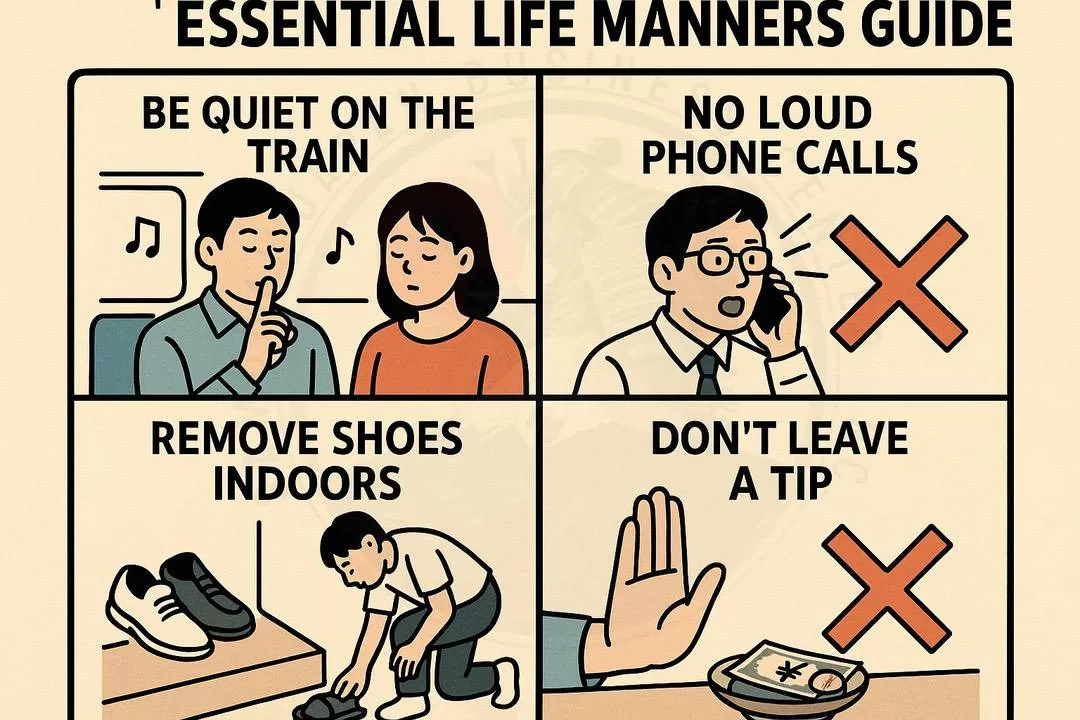
* **Keep Noise Down:** Avoid loud conversations, phone calls, or listening to music without headphones. Many trains even have signs reminding passengers to switch phones to silent mode.
* **No Eating or Drinking:** Generally, it’s considered impolite to eat or drink on public transport, especially trains and buses.
* **Priority Seats:** Offer your seat to the elderly, pregnant women, or those with small children. These seats are usually clearly marked.
* **Queuing:** Always form orderly queues when waiting for trains, buses, or in shops. Don’t cut in line.
* **Walking Etiquette:** In crowded areas, especially on escalators, people generally stand on one side (left in Kanto region like Tokyo, right in Kansai region like Osaka) to allow others to walk past.
* **Trash Disposal and Recycling:** Japan is known for its strict and complex waste disposal rules. Public trash cans are scarce, so you’ll often need to carry your trash with you until you find one or return home. At home, you must sort your trash meticulously (burnable, non-burnable, plastic, cans, bottles, paper, etc.) and dispose of it on specific days.
⚠️ Warning: Trash Rules are Serious!
Improper trash disposal is a major offense in Japan and can lead to fines or community admonishment. When you move to Japan, make sure to get a detailed guide from your local municipality (市役所 – Shiyakusho) or landlord. Don’t just throw things away without sorting!
Dining Etiquette: Savoring Japanese Cuisine Respectfully 🍜🥢
Enjoying Japanese food is a highlight for many, but there are specific manners to observe.
* **Before and After Meals:** Always say 「いただきます」(Itadakimasu) before eating, which roughly translates to “I humbly receive this food.” After finishing, say 「ごちそうさまでした」(Gochisousama deshita), meaning “It was a feast” or “Thank you for the meal.”
* **Chopsticks (お箸 – O-hashi):**
* **Never stick chopsticks upright in a bowl of rice.** This resembles an offering at a funeral.
* **Never pass food from chopstick to chopstick.** This is also a funeral ritual.
* **Don’t point with your chopsticks.**
* **Don’t use chopsticks to move bowls or plates.**
* **When not using them, place them on the chopstick rest (箸置き – Hashioki) or across your bowl.**
* **Slurping Noodles:** Contrary to what you might expect, slurping noodles like ramen or soba is perfectly acceptable and even encouraged as a sign of enjoyment, and it helps cool down hot noodles.
* **Tipping:** Tipping is generally not practiced in Japan. Exceptional service is expected and included in the price. Offering a tip might even be considered rude or confusing.
* **Sharing Dishes:** When eating from communal dishes, use the serving chopsticks or serving spoon provided, not your personal chopsticks.
Chopstick Dos and Don’ts ✅❌
| ✅ Do’s | ❌ Don’ts |
|---|---|
| ✅ Hold chopsticks correctly and gracefully. | ❌ Stick chopsticks upright in rice (resembles funeral rites). |
| ✅ Use a chopstick rest (hashioki) when not eating. | ❌ Pass food directly from chopstick to chopstick. |
| ✅ Lift bowls to your mouth to eat rice or soup easily. | ❌ Point with your chopsticks or wave them around. |
| ✅ Slurp noodles loudly to show enjoyment. | ❌ Use chopsticks to move dishes around the table. |
| ✅ Use serving chopsticks for communal dishes. | ❌ Spear food with your chopsticks. |
Home & Private Settings: The Art of Being a Good Guest 🏡🎁
When visiting someone’s home, specific customs show respect for their private space.
* **Taking Off Shoes (玄関 – Genkan):** This is non-negotiable! Always remove your shoes at the genkan (entryway) and place them neatly with the toes pointing outwards. You might be offered slippers (スリッパ – surippa). Remember to take off slippers when entering a tatami room or going to the bathroom, where specific bathroom slippers are usually provided.
* **Omiyage (お土産):** It’s customary to bring a gift (omiyage) when visiting someone’s home or returning from a trip. This small token of appreciation shows consideration. Local delicacies or souvenirs are popular choices.
* **Respecting Privacy:** Be mindful of noise levels, especially in apartment buildings, and avoid opening doors or cupboards without permission.
💡 Quick Tip: Omiyage Power!
Bringing an omiyage (souvenir/gift) when visiting someone’s home or after a trip is a wonderful way to show appreciation and thoughtfulness. It doesn’t have to be expensive, but the gesture itself is highly valued. Even a small box of sweets from your hometown in the Philippines would be warmly received!
Punctuality & Professionalism (General Life) ⏰✅
While we avoid topics related to employment, punctuality is a general life skill that applies to all aspects of Japanese society, from meeting friends to attending language classes.
* **Be On Time, Or Early:** Punctuality is extremely important in Japan. Being on time means arriving slightly *before* the agreed-upon time. If you’re running even a minute late, it’s considered polite to inform the other party as soon as possible with a quick call or message, along with an apology.
* **Communication is Key:** If something unforeseen causes a delay, immediate and polite communication is crucial. A simple 「遅れてすみません」(Okurete sumimasen – I’m sorry for being late) or 「少し遅れます」(Sukoshi okuremasu – I will be a little late) will go a long way.
Embrace the Learning Journey! 🎉
Navigating Japan’s unwritten rules might seem daunting at first, especially coming from a different cultural background. However, remember that Japanese people are generally very understanding and appreciative of foreigners who make an effort to understand and respect their customs. Don’t be afraid to make mistakes – that’s part of the learning process! The key is to observe, be respectful, and show a genuine willingness to adapt.
By understanding these essential manners, you’re not just learning a set of rules; you’re gaining deeper insights into Japanese culture and building a foundation for truly enriching experiences. Your journey to Japan will be full of discovery, and mastering these social nuances will open doors and create wonderful connections. Keep practicing your Japanese language skills, keep observing, and keep that eager spirit! You’ve got this, future Japan residents! Ganbatte kudasai! 💪🇯🇵
Contact & Follow Us
お問い合わせ
📞 電話: +63 997 093 4550
📧 メール: samuraijapan.bc@gmail.com
🏠 住所: Room D3, Freb Bldg, Villa Donata Subd, Muntinlupa
🏢 会社名: SAMURAI Japan Business Center Inc.
SNSでフォロー
🎵 Tiktok: @samuraijapan0221
📸 Instagram: @samuraijapan.bc
▶️ Youtube: @SamuraiJapan-bc
📘 Facebook: Visit our Page

Leave a Reply